Helping design and engineering professionals discover, evaluate and specify technologies and processes that shorten the design cycle and enable success.



Digital Engineering April 2026
In the latest issue of Digital Engineering, we take a look at the latest innovations in design for additive manufacturing, including the use of natural language inputs, social media cosplayers, and AI integration. The issue also includes a feature…

January Special Focus Issue: Design for Additive
In this Special Focus Issue of Digital Engineering, learn about the latest advancements in design for additive manufacturing, including new software tools, additive in automotive, custom medical devices, and more.
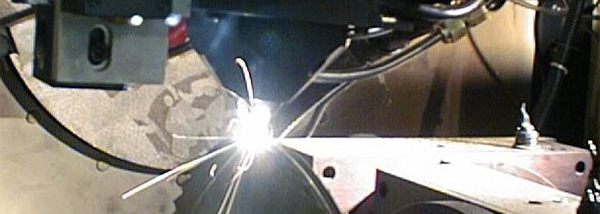
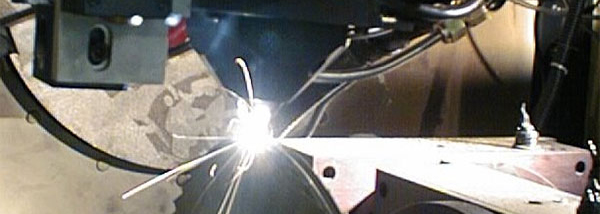 Optomec LENS 3D-Printing technology in action. Image courtesy Optomec.
Offering comparable expertise, but applied to 3D printing metals and other materials, Optomec has now published highly detailed, vendor-specific guidelines for additive manufacturing (AM) on both its LENS (laser engineered net shaping) and Aerosol Jet systems. The company’s material scientists and process engineers have compiled what they term “Starter recipes” that give customers an optimal set of system parameters for dozens of raw materials either in powder (LENS) or liquid (Aerosol Jet) forms.
LENS systems use a high-power laser (500W to 4kW) to fuse powdered metals into fully dense 3D structures. Materials include titanium, nickels, tool steels, stainless steels, aluminum and cobalt chrome, and applications include part production, enhancement and repair. Starter recipes for the various LENS models state optimized process parameters for the laser, optics, powder feeder, atmosphere and layer/deposition geometry. Expected mechanical properties and microstructure are given.
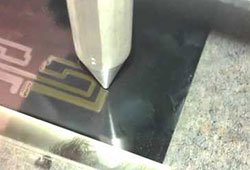 3D-printing a dual-band antenna on an existing part, using the Optomec Aerosol Jet additive manufacturing system. Image courtesy Optomec.
The Aerosol Jet process is designed to 2D and 3D print electronics and more, and works with any material (other than energetic/explosive particles) that can be suspended in a liquid (solvent) suspension, including electrically conductive inks, resistive inks, non-metallic conductors, dielectrics, and even biological materials. Depending on the set-up of the dispensing nozzle(s), two materials can be deposited during a single build, or even blended on the fly.
A sample Starter recipe for a silver ink (viscosity 20 centipoise) from supplier SunChemical includes more than a dozen operating recommendations, such as: use the Aerosol Jet system’s pneumatic atomizer (not the ultrasonic one) to better create droplets at this viscosity, choose the “fine feature” print head, work with the 300-micron nozzle tip, and set the nozzle-to-substrate stand-off distance at 4 millimeters. The recipe also instructs users to dilute the silver ink into the recommended solvent, and states optimum settings for atomizer flow rate, sheath (focusing) gas flow rate, exhaust flow rate and print speed. Lastly, the datasheet gives sintering (curing) recommendations and values for expected printed line width, line thickness and resistivity.
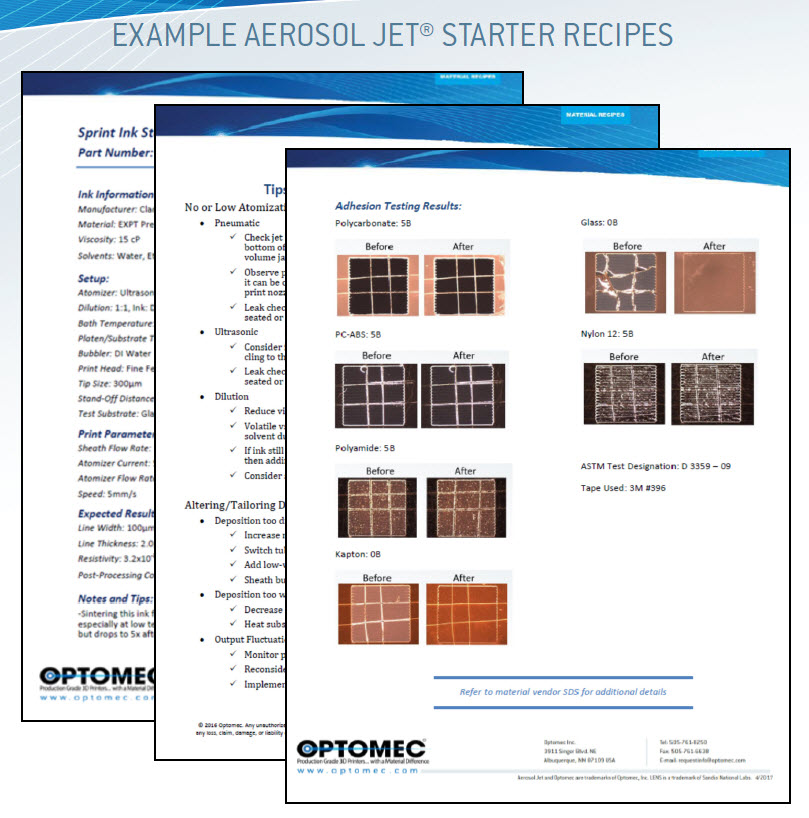 Pages from a sample Starter Recipe for 3D Printing electronics using an Optomec Aerosol Jet printer. The sample lists optimized parameters for 3D-printing with a silver ink from SunChemical. Image courtesy Optomec.
Also called “Starter Plus” recipes, these material-specific libraries list process parameters optimized for an extended period of printing on LENS or Aerosol Jet systems, along with value envelopes for expected print results (including its process capability index/cPk). A given Production recipe can include electrical and mechanical performance against a given set of process parameters, or, specifically for electrical circuit printing, data such as ASTM adhesion behavior before and after environmental testing.
“We have a few Production recipes already,” says Vartanian. “For example, if you’re depositing a silver nanoparticle ink, at a certain deposition rate – say, 10 mg/minute – and it must maintain that same 10 mg/minute for four hours of continuous operation, and it can’t vary by any more than +/-10 percent, we’ve tested and developed a process where the output rate will perform within those control limits. (For example, employing a solvent refresh-rate to maintain the particle/solvent ratio, based on a closed-loop sensor-feedback system.) “It takes much longer to develop these kinds of recipes,” he adds.
“It will be just like them buying a physical component, but instead we are going to give them the software components that are printable,” he says. To Vartanian, this is a big effort, but provides one of the missing links in AM: “You need to go up the food chain, and equip the designers with the tools that they need to successfully produce products with AM. We do this now for our customers, but we want to be able to empower them to do it for themselves.”


Pamela Waterman worked as Digital Engineering's contributing editor for two decades. Contact her via DE-Editors@ digitaleng.news.
Follow DE
Join over 90,000 engineering professionals who get fresh engineering news as soon as it is published.






About Us · Contact Us · Editorial Team · Advertising · Privacy Policy · Subscriber Services · © 2026 Digital Engineering 24/7 · Peerless Media