Helping design and engineering professionals discover, evaluate and specify technologies and processes that shorten the design cycle and enable success.


Sponsored

Digital Engineering April 2026
In the latest issue of Digital Engineering, we take a look at the latest innovations in design for additive manufacturing, including the use of natural language inputs, social media cosplayers, and AI integration. The issue also includes a feature…

January Special Focus Issue: Design for Additive
In this Special Focus Issue of Digital Engineering, learn about the latest advancements in design for additive manufacturing, including new software tools, additive in automotive, custom medical devices, and more.
Founded in 1973, Tessy Plastics is a global contract manufacturer headquartered in Skaneateles, NY, specializing in injection molding and custom automated assembly solutions. One of their largest customers manufactures minimally invasive surgical tools.
In the past, large scale predictive modeling studies were done to optimize features and then a mold was made of the most promising design – this was the only way to make a prototype to test the design due to the complexity, small size and tight tolerances required for these parts. The downfall to this is that making multiple molds just for a prototype was cost and time prohibitive with some component molds taking 6 months and costing more than half a million dollars.
One of the responsibilities of Mark Lattimore, Director of Research and Development at Tessy Plastics is to research and propose new technologies for the company. One challenge he was researching was looking for an alternative to molding for creating prototypes for product testing. In doing some of his research, he came across BMF’s micro-precision 3D printing technology.
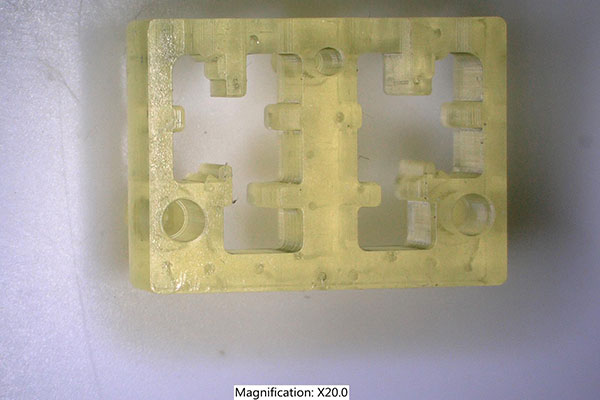
What attracted Mark to BMF’s technology was the extremely tight tolerances BMF’s line of microArch® 3D printers can hold as well as the potential of using a printer capable of printing materials with stronger properties. Using their microArch S240, Tessy is able to print parts within 0.001 inches of the CAD nominal on dimensions of <0.5 inches. Tessy was also interested in printing 3D mold cavity inserts – this helps with time sensitivity as metal prototype molds typically take about 2 weeks.
Tessy was able to produce multiple prototypes for their customer using high precision micro 3D printing with their microArch S240. They tested the prototypes using optical and CT scanning quality metrics to verify that the parts printed at the expected tolerances. The surprise benefit of the BMF printer was the accuracy and the material strength combined. It allowed Tessy to make samples for their customers that could be functionally tested and used. As a result, they were able to test 15 different designs in order to optimize the product development process.
The BMF printer took a typical prototype production tool (10-16 weeks) down to just a couple of weeks and allowed Tessy and their customer to improve a fairly mature product line with the added ability to experiment with multiple design iterations without having to wait for a mold.
Brian Anderson, R&D Engineer, Tessy Plastics:
"This printer allows our customers to minimize their initial investment in tooling by being able to quickly prototype various design iterations and vet them out prior to kicking off prototype molds. Being able to vet out various options prior to prototype molds saves a ton of time and money and helps us reach a solution with the customer much faster. Using our BMF S240 printers we are able to support our customer’s accelerated development timeline and allow them to fully optimize their product by experimenting with every design option to choose the best product to bring to clinical studies."
Tessy plans to continue using their microArch printer for prototyping and design testing. In addition, they have been able to 3D print mold inserts, successfully getting 1-2 shots out of them with their own material resulting in end-use parts that can potentially bridge to production molding. Micro 3D printing has also enabled Tessy to use 3D printed parts to increase automation, rather than waiting for production tools which can take 24 weeks or more.
Having used other 3D printers in the past, BMF’s microArch S240 is the only printer they have used that can print parts meeting the tight tolerances they require at a speed that enables multiple design iterations during the product development process.


Boston Micro Fabrication is the world leader in micro-precision 3D printers utilizing Projection Micro Stereolithography (PµSL) technology. Many leading companies worldwide are adopting PµSL to 3D print true microstructures with ultra-high…

Ultra-high Accuracy, Precision, and Resolution Micro 3D Printed Medical Device Manufacturing
Discover how the use of micro-precision 3D printing is aiding medical device producers to tackle two common issues through this white paper.

Join over 90,000 engineering professionals who get fresh engineering news as soon as it is published.






About Us · Contact Us · Editorial Team · Advertising · Privacy Policy · Subscriber Services · © 2026 Digital Engineering 24/7 · Peerless Media