Helping design and engineering professionals discover, evaluate and specify technologies and processes that shorten the design cycle and enable success.



May 2026 Special Focus: Artificial Intelligence in Design and Simulation
In this Special Focus Issue, learn about the latest developments in the integration of artificial intelligence into engineering workflows.

April 2026 Special Focus Issue: Generative Design
In this Special Focus Issue, Digital Engineering takes a look at how generative design solutions can be used across different types of design problems and with a variety of manufacturing approaches to accelerate design space exploration, and…
With C3D Mesh2Brep, CAD developers will be able to transform polygonal models into b-rep bodies. The resulting b-rep model then allows users to employ CAD tools to make changes (such as Boolean operations and chamfers), and to generate additional data, such as through projections and sections.
The company suggests various applications of C3D Mesh2Brep. One possible use is in the area of reverse engineering, which involves 3D scanning a part and then turning it into an editable CAD model. In CAE systems, developers could use the Mesh2Brep module to process the results of topological optimization. Computer graphics designers could use the new module for grid smoothing, decimation and applying compression algorithms.
"Our new C3D Mesh2Brep module has two main modes: fully automatic, and interactive," says Andrey Tumanin, lead developer of the C3D Modeler geometric kernel. "Automatic mode generates acceptable results for high-quality polygon meshes, which are triangulations of CAD models that mostly contain elementary surfaces. If, however, a polygon mesh is constructed from 3D object scans and so contains general surfaces, then the user will have to be involved in the process."
To join the beta testing program, or for more info, visit C3D Labs.
Sources: Press materials received from the company.


DE's editors contribute news and new product announcements to Digital Engineering. Press releases may be sent to them via [email protected].
Follow DE
Join over 90,000 engineering professionals who get fresh engineering news as soon as it is published.






About Us · Contact Us · Editorial Team · Advertising · Privacy Policy · Subscriber Services · © 2026 Digital Engineering 24/7 · Peerless Media
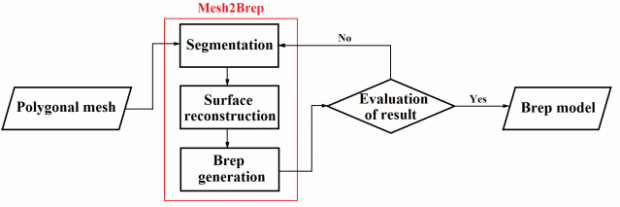 Example of a workflow. Image courtesy of C3D Labs.