Helping design and engineering professionals discover, evaluate and specify technologies and processes that shorten the design cycle and enable success.


May 2026 Special Focus: Artificial Intelligence in Design and Simulation
In this Special Focus Issue, learn about the latest developments in the integration of artificial intelligence into engineering workflows.

April 2026 Special Focus Issue: Generative Design
In this Special Focus Issue, Digital Engineering takes a look at how generative design solutions can be used across different types of design problems and with a variety of manufacturing approaches to accelerate design space exploration, and…
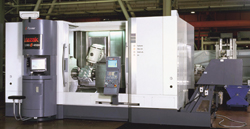
When it comes to programming high-performance multitasking machineslike Mazak's Integrex e-410H, which can turn, mill, drill, tap, andperform other operations in a single setup, today's CAM developers arestepping up to the challenge to make sure manufacturers stay in theinternational ballgame.
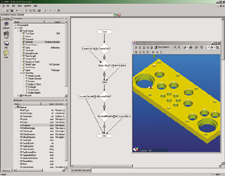
Two current trends in stand-alone CAM are helping to make Westernmanufacturing companies more competitive with overseas companies thathave access to a large pool of cheap labor. Those trends incorporatetechnology for faster and easier generation of toolpaths throughautomatic feature recognition (AFR) and programming for high-techmultitask machine tools with multiple turrets and spindles.
This story looks at five CAM developers, two of which—PathtraceSystems, manufacturers of EdgeCAM, and Engineering Geometry Systems,makers of FeatureCAM—focus primarily on feature recognition. Gibbs& Associates (GibbsCAM) is currently working on both capabilities.DP Technology, developer of Esprit, has already racked up 15 years ofdevelopment for the multitask machining arena. And CNC Software(Mastercam) will introduce new capabilities in both areas in about ayear, while building up to that with new ways to speed up and automatea number of more conventional machining techniques.
|
|
|
|
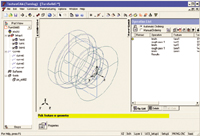
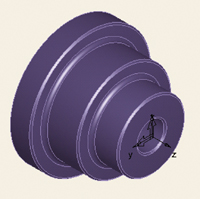
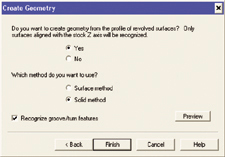
| Above: AFR defines features on the solid model and makes machiningpossible without further user intervention. Below: Itrecognizes features from either solids or surfaces and includes supportfor groove/turn features. |
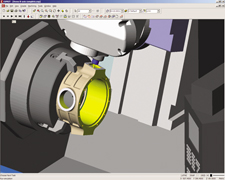
Above, right: DP Technology's ESPRIT simulation of Nakamura Tome mill-turn machiningwith one B-axis head, two turrets, and two spindles. With ESPRIT, theB-axis head can be used on the spindle and synchronized with the lowerturrets, allowing machining of features at compound angles.
"Feature recognition for turning is another growth area," he says."Complex machines are strong in turning, and some have milling aswell." The company launched support for such machines in its Version 8release last Fall.
Complex Multitask Machines
Multitask machines, says Soucy of Mastercam, "currently do turning andmilling—and some machine tool manufacturers plan to add laser hardeningand grinding. Today, Mastercam handles the operations for thesemachines, but hasn't yet started to synchronize them. Our next releasewill have a new, icon-driven user interface that will be fullyuser-customizable, and will read solid models directly with theirhistory tree intact for feature recognition. We're also working ondefining the various multitask tools as the first step providingsynchronized programming for them."
DP Technology's Matthews says that just as they are adding more complexmachining equipment, manufacturers are demanding newer and better waysto use it. "Today, companies have fewer dedicated part programmers, sothey need ease of use to keep pace with increased functionality. Andthey want fewer bugs and more reliability."
Given the complexity of multitasking machines, Matthews points out,simulation and postprocessing are very important. "We work with machinetool makers to build our postprocessing at the R&D level so thatusers don't need customization. To get there requires good qualitysimulation of the machines, because it's easy to damage them ifoperations run into each other." He adds that being able to simulatefull product runs on the computer reduces machine idle time andmistakes. "Good simulation also assists with synchronization andcollision detection."
In programming for multitask machines, which Matthews says nowrepresents 75 to 80% of DP Technology's business in North America,"there's a need for time studies, because parts can be run in manydifferent ways. Although machines vary in the number of turrets,spindles, and speed, we build a tool that can be applied to all. Butit's important to play with synchronization and utilization of turretsand spindles, and integrate all of them with the core tasks of toolpathcreation."
Callen of Gibbs says of these machine tools, "They can take stock in onone side and spit out a finished part on the other—with part transferhandled by the machine itself." Like DP Technology, Gibbs has custompostprocessors for some of the individual machines.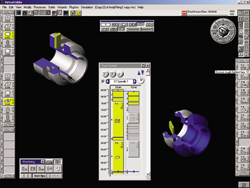
Unlike DP Technology, Gibbs customizes GibbsCAM to model and configureaccurately to the specific machine tool. "Each of these machines hasdifferent bells and whistles," says Callen. "To program them, we haveto model every aspect of the machine—and it's a very big job. In fact,we spend part of our delivery time customizing the software—startingwith a 12-page survey of each customer, to find out how they use thetools and want to use them, how they've configured their machine, itsutilities, what they need. This makes it easier for us to help themimplement the capabilities of the machines."
Above, right: GibbsCAM MTM Sync Manager can be used to examine the parallel machiningflows across two spindles. Here, the Sync Manager is being used tosynchronize simultaneous cuts across one or more spindles graphicallywith the system managing all the underlying timing details.
Callen says that GibbsCAM takes care of all internal synchronizationdetails, even when such a machine runs more than one part at a time."It's our philosophy to build simplicity into the interface, so userscan get the best from these machines without wasting time."
Gibbs & Associates is also adding feature recognitioncapabilities—most recently with a hole wizard. That's becauseconventional machine centers continue to be used, and because multitaskmachines still can't do everything. Callen explains, "Many industriesare moving to multitask equipment for parts such as manifolds, becausethe part can be completely machined in a single virtual set up,reducing cycle time. If the machine has two spindles, you can finishparts in half the time as on conventional turning machines, or in aquarter of the time with four spindles. It's possible to have 12 to 16live positions to produce brass fittings—and finish parts in seconds.This requires great manufacturing choreography, with CAM as thechoreographer."
All the companies mentioned here are working toward more efficient,high-speed machining on conventional, 5-axis, and multitask equipment.All of them aim to make their CAM products as easy as possible to usefor increasingly complex programming. And all of them appear to be inthe forefront of the industrialized world's struggle forcompetitiveness.
Contributing editor Louise Elliott is a freelance writer based inCalifornia. Offer Louise your feedback on this article through[email protected].
Company Information
CNC Software/Mastercam
DP Technology
Engineering Geometry Systems - EGS
Gibbs and Associates
Pathtrace Systems, Inc.


DE's editors contribute news and new product announcements to Digital Engineering. Press releases may be sent to them via [email protected].
Follow DE
Join over 90,000 engineering professionals who get fresh engineering news as soon as it is published.






About Us · Contact Us · Editorial Team · Advertising · Privacy Policy · Subscriber Services · © 2026 Digital Engineering 24/7 · Peerless Media