Helping design and engineering professionals discover, evaluate and specify technologies and processes that shorten the design cycle and enable success.



May 2026 Special Focus: Artificial Intelligence in Design and Simulation
In this Special Focus Issue, learn about the latest developments in the integration of artificial intelligence into engineering workflows.

Design & Simulation Software Guide 2025
In this Special Issue, Digital Engineering presents its second annual guide to design and simulation software vendors.
Our World in Data, a statistics site tracking worldwide trends, revealed, “Globally, over 1 in 5 (22%) of new cars sold were electric in 2024. This share was 92% in Norway, and in China, it was almost 50%” (“Tracking global data on electric vehicles,” Hannah Ritchie, February 2024). The automotive industry’s migration from the noisy combustion engine to the quieter electronic engine fundamentally changes what you hear inside the cabin. It turns out that what you don’t hear anymore is just as important.
“You might notice that, in some premium luxury cars, the speakers are from Bose,” says Santosh Kottalgi, senior architect, Application Engineering Vehicle Electrification, Ansys, part of Synopsys. “As vehicles get more automated, you get more opportunities to enjoy the music. So the acoustics [are] part of the experience of the car.”
From the 1950s to the 1970s, cars typically had one speaker, which was mounted next to the driver in the middle of the dashboard. (“The Evolution of Car Speakers”). “Now, some cars have 15 to 16 speakers, with some tuned to lower frequencies, some to higher frequencies, set to different orientations and sizes. If you’re talking about premium cars, even the car seats’ headrests might come with their own speakers. That means everyone doesn’t have to listen to the same music,” Kottalgi points out.
Aiming to promote factory-installed stereo speakers, Bose launched Bose Automotive in 1982. The company currently lists a variety of Porsche, Cadillac, Audi, and Volvo models as those equipped with its sound systems. Other speaker makers like Bang & Olufsen, JBL, and Blaupunkt have also forged partnerships with automakers.
In this article, we speak to—and listen to—the experts in the realm of acoustic simulation to understand the new challenges that come with the sound of silence.
The loud gas-guzzling combustion engine, now viewed by many as detrimental to the environment, is ironically safer for the pedestrians who might be distracted by their phones and streaming music, or those who are vision-impaired.
“When a car with a combustion engine comes close to you, you can hear it, so you can react to it,” says Siva Senthooran, Transportation, Mobility, and Acoustics Industry Process Director, SIMULIA, Dassault Systèmes. “But an electric vehicle is very quiet, so it needs to alert you somehow.”
In December 2016, the National Highway Traffic Safety Administration published the Federal Motor Vehicle Safety Standards; Minimum Sound Requirements for Hybrid and Electric Vehicles. The summary says, “This standard will help to ensure that blind, visually impaired, and other pedestrians are able to detect and recognize nearby hybrid and electric vehicles, as required by the Pedestrian Safety Enhancement Act.”
The combustion engine also makes ambient noises, such as wind noise at low speed and cabin rattles. “But now, with electronic cars, that has gone away, so you start to notice the other sounds much more,” says Senthooran.
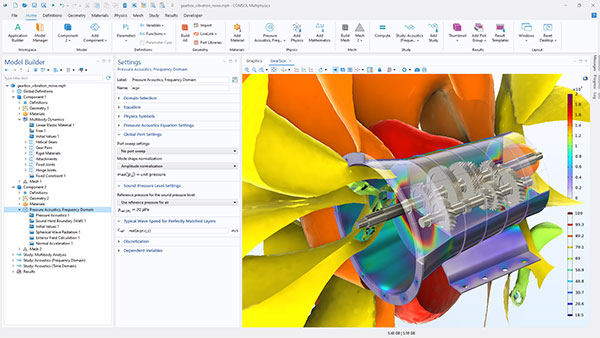
A COMSOL gearbox multiphysics simulation. Image courtesy of COMSOL.
Sound testing is part of the NVH (noise, vibration, and harshness) study in automotive design. Prior to digital simulation, sound testing often involved driving the prototype vehicle on the road to evaluate the audible squeaks and grumbles. But advancement in physics and increased computing capacity changed the practice. Now acoustic simulation is the favored approach. “Now we can make much better predictions of cabin sound. We can also visualize them in 2D and 3D. We can also hear sounds,” says Senthooran.
Dassault Systèmes offers CST Suite, for 3D electromagnetic simulation; Manatee, for electromagnetic noise and vibrations study; Simpack, for simulation multibody system (useful to study motion and roll); Wave6, for vibro-acoustic analysis; PowerFLOW, for aeroacoustic simulations; and Abaqus, for structural vibrations simulation.
In standard structural analysis and flow simulation, engineers want to see the concentration of stress, deformation, and flow patterns in the results. This gives them insights into the geometry changes necessary to counteract the design’s vulnerabilities. In sound simulation, the software can literally let you listen to a cabin that has not been built yet, by producing an audio file based on simulation.
“You have three types of noises: noise from the structure itself; noises from the operating environment, like wind, rain, tires, and honking from the nearby cars; and noises created within the cabin, like conversation, music, and warning indicators,” says Kottalgi. “So you want to study how the shape or cavity of the cabin responds to these noises.”
“You want to see the sound distribution patterns and hear the sounds. Both are important,” says Jinlin Huang, principal applications engineer, Acoustics and Vibrations, COMSOL. “You want to study the key listening positions, like the area around the driver’s head.”
COMSOL offers multiphysics simulation modules under the COMSOL Multiphysics software suite. The Acoustic Module, an add-on package, provides tools for modeling and studying the acoustics and vibrations in speakers, mobile devices, microphones, mufflers, sensors, sonar, flowmeters, rooms, and concert halls, among others.
“You want to be able to measure certain engineering data from the simulation, like sound pressure level, how it’s distributed throughout the cabin. But you also want to see how the intensity changes over time, so that may be a time-dependent graph,” says Kottalgi. Ansys offers Ansys Sound, for studying and optimizing sound quality; and Ansys Mechanical and Ansys LS-Dyna, for simulating Aero-Acoustic, Vibro-acoustics, and non-linear multiphysics acoustic events.
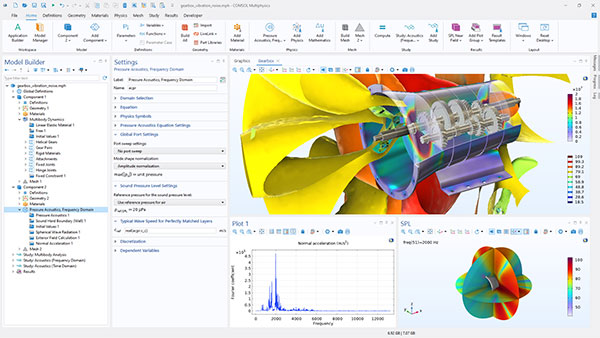
In COMSOL Multiphysics, you can model and simulate a gearbox’s vibration and noise. Image courtesy of COMSOL.
Typically, music, human speech, and everyday noises fall between 20 Hz and 20 kHz, considered the audible spectrum for healthy humans. In COMSOL, acoustic simulation allows you to see the frequency responses. “It contains both magnitude and phase data, so it’s very useful for spotting peaks caused by cabin resonance, or dips caused by phase cancellation. It also lets you judge the tonal balance: whether the bass is too heavy or the treble is too sharp,” says Huang.
COMSOL can also provide impulse responses or conveniently convert frequency responses to impulse responses and vice versa. “These are two sides of the same coin,” notes Huang. “Impulse responses let you see how the sounds from different sources arrive at a listener. COMSOL can export them as wave files you can listen to.”
High-accuracy acoustics simulation relies on full-wave modeling up to the highest practical frequencies, making it computationally intensive. “It helps that we now have GPU acceleration. With it, we have seen 20 to 50 times speedup in acoustic analyses,” says Huang. “COMSOL supports the use of not just one but multiple GPUs.”
Sound simulation output is much more reliable—that is, much closer to what you would hear—if the source file used as input is derived from the real world. In other words, you use the actual recording of a device instead of an idealized sound or generic approximation to represent the source audio.
“Usually, there’s a sound source, like the wind outside, the speaker inside, or the powertrain. Figuring out the travel of the sound waves inside the cabin is a multiphysics calculation, so you might use a mix of tools,” says Senthooran. The simulation could involve structure mechanics and acoustic vibrations, among others.
“Tire noise, like when you’re traveling at 30 mph or 80 mph, or when someone rolls down the window and it creates buffeting sounds, or when it’s raining outside— these are very difficult to obtain, even if you have a vehicle or a prototype,” says Kottalgi. “If you don’t, then simulation is the only way to get it.”
For in-cabin acoustic analysis, a detailed CAD model of the cabin is important. So are the interior surface properties available from measurement or simulation. “You use it to figure how sound interacts with cabin components, like roof and carpet surfaces, windshield, seat, even human passengers,” says Huang. “Surface conditions are very important. They have properties like reflection, scattering, absorption, and impedance, which affect the frequency responses. COMSOL created an app that lets you extract frequency-dependent surface properties of configurable sound absorbers for use in larger simulation models, with adjustable materials, backing conditions, and layer geometries.”
“If you’re going to look at conditions that influence the audio quality, then you need to know the wind speed, the type of road you’re traveling on, the type of tires involved, the insulation inside, and the shape of the cabin, among other things,” says Senthooran. “Many engineers also want to look at the frequency, amplitude, and changes in decibel over time.”
Fixing an acoustic issue might involve changing the speaker mount, swapping out one surface material for another, adding surface treatment (like coating) to change its behavior, and identifying and addressing the acoustic dead zones. “When you’re speaking to your passenger, if they cannot hear you well, that’s not a good experience,” notes Kottalgi.
“The goal is usually to get a more uniform sound distribution inside the cabin,” says Huang.
When something is about to break down, your sensor-equipped smart car will likely become aware of the problem before the driver does. Therefore, it will issue critical warnings and alerts. In this case, instead of eliminating the sound, you may want to find ways to amplify it.
“One solution is to increase the number of sound sources—that means, adding more speakers,” says Kottalgi. “The reverse is to introduce white noise to cancel out the harsh noises, to make the cabin quieter. A quieter car means whisper-level sound, usually 30-50 dB. But how can you achieve it if the engine itself is running at 60 dB?”
Cars are not only making sounds but also listening. This is especially true of autonomous vehicles equipped with sensors. In the future, with AI and machine learning, cars may be able to distinguish and label the voices of the occupants, which opens new opportunities for providing a personalized experience.
“Cars are now connected to Google or Android, so you can tell it to set your destination, find the nearest gas station or restaurant, turn down the volume, or turn up the air conditioner,” notes Kottalgi. “So it’s important to place the receiver microphones in the correct position to get these instructions from the driver and passengers.”
“The downside of working in this field is that, now, when I am driving or riding, I notice more flaws than others,” says Senthooran.


Synopsys, Inc. (Nasdaq: SNPS) is the Silicon to Software™ partner for innovative companies developing the electronic products and software applications we rely on every day. As the world's 15th largest software company, Synopsys has a long…

Kenneth Wong is Digital Engineering's resident blogger and senior editor. Email him at [email protected] or share your thoughts or suggestions at digitaleng.news/facebook.
Follow DE
Join over 90,000 engineering professionals who get fresh engineering news as soon as it is published.






About Us · Contact Us · Editorial Team · Advertising · Privacy Policy · Subscriber Services · © 2026 Digital Engineering 24/7 · Peerless Media