Helping design and engineering professionals discover, evaluate and specify technologies and processes that shorten the design cycle and enable success.


Sponsored

Digital Engineering April 2026
In the latest issue of Digital Engineering, we take a look at the latest innovations in design for additive manufacturing, including the use of natural language inputs, social media cosplayers, and AI integration. The issue also includes a feature…

January Special Focus Issue: Design for Additive
In this Special Focus Issue of Digital Engineering, learn about the latest advancements in design for additive manufacturing, including new software tools, additive in automotive, custom medical devices, and more.
One hundred meters beneath the mountains of Switzerland and France sits the Large Hadron Collider (LHC) – the world’s largest and most powerful particle accelerator ever built. This impressive construction is used by the European Organization for Nuclear Research (CERN) to conduct high-energy physics research under four key experiments.
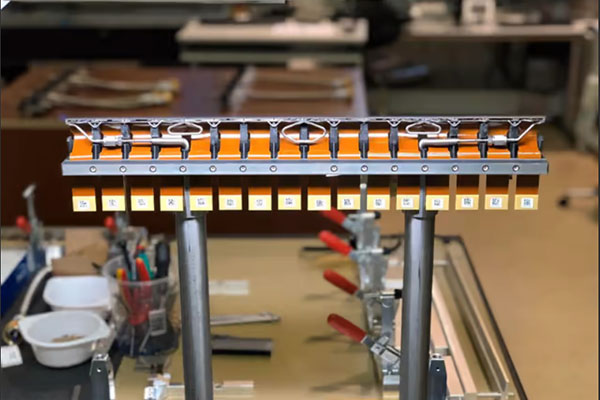
Stretching a full 27 kilometers to allow particle acceleration to get up to speed, the observable reactions take place at four beam-crossing points, instrumented with large particle detectors. Within the detection volume of the LHCb Experiment, a long and extremely narrow photon-detector strip must be cooled to -40˚C in order to preserve the reaction for study. This strip runs roughly 140 meters in length, is less than two millimeters wide, and is attached to 3D printed titanium cool-bars that perform 100% of the cooling operation.
These cool-bars are the result of a collaboration between Nikhef, the Dutch National Institute for Subatomic Physics, and 3D Systems Customer Innovation Center, and were produced using 3D Systems’ direct metal printing (DMP) technology. For its contribution to the successful upgrade of the experiment, 3D Systems was honored with the 2019 LHCb Industry Award.
Particle collisions within the LHC happen inside detectors, which are extremely sophisticated systems that make it possible to gather information about fundamental particle properties. Modern detectors include layers of subdetectors, among which are tracking devices like the LHCb SciFi tracker – short for scintillating fibers – that reveal the path of a particle. Through other subdetector systems it is also possible to measure a particle’s energy and radiation.
Antonio Pellegrino works at Nikhef and is a leader on the SciFi tracker project at CERN under the Large Hadron Collider beauty (LHCb) experiment. He explains that the complexity of the cooling system was the result of several unavoidable factors: the incredibly limited space in which the cool-bars are required to fit, the heat that needs to be dissipated within that short space, the temperature uniformity required over the length of the entire photon-detection strip, and the flatness of the cool-bars necessary to preserve the detector efficiency and resolution. “The effect of this is that you have to be very efficient in how you construct your cooling,” he says.
Nikhef project engineer Rob Walet began developing the cool-bar by designing a part that perfectly answered performance requirements. “This design was so beautiful,” says Pellegrino, “but it was not producible in the usual ways.” One major issue that complicated manufacturability through conventional means was the required wall thinness. For maximum efficacy, it was important to have minimal material between the coolant and the surface to be cooled. For the length of the part (263 mm), this thinness could not be machined.
After early experimentation with manual prototyping, CERN quickly determined a manual approach to production was not practical. Not only was it labor intensive, but it was not easy to make in a reproducible way. With this awareness the team began to research other options and explore capabilities in metal 3D printing.
Although CERN optimized its cool-bar design for final function, it was not yet optimized for additive manufacturing (AM). Awareness of this shortcoming informed CERN’s choice of manufacturing partner.
Pellegrino:
“Out of a few possible companies, we chose 3D Systems because it seemed to me that the engineers there were capable of actually transforming our design into something that could be produced.”
CERN leveraged the application engineering expertise housed within 3D Systems’ Customer Innovation Center (CIC) in Leuven, Belgium, to accelerate its path forward with additive manufacturing. 3D Systems CICs are global facilities equipped with the experience and technology to support additive manufacturing applications in the high technology, aerospace, healthcare, transportation and motorsports markets.
3D Systems CICs can advise and assist on projects at any stage, from application development and frontend engineering, to equipment validation, process validation, part qualification, and production.
As both a manufacturer and user of additive manufacturing solutions, 3D Systems is home to a unique feedback loop between application engineers and machine engineering groups. This open communication fuels constant refinement of 3D Systems’ software, hardware, materials, and printing processes to enable better equipment and better outcomes.
Through a collaborative iterative process of design, printing, and testing, the engineering teams at CERN and 3D Systems worked together to modify the cool-bar design to meet the requirements for manufacturing as well as final function.
Performance requirements included:
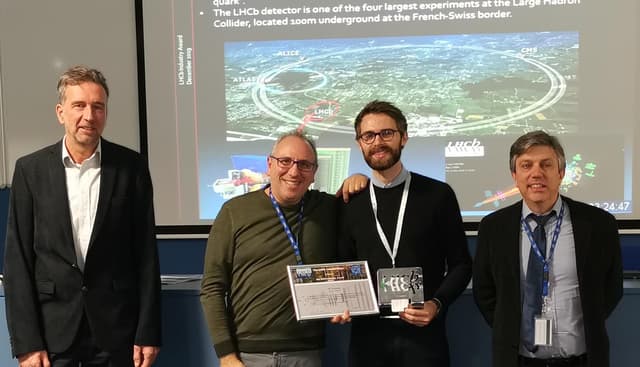
3D Systems was honored with the 2019 LHCb Industry Award for its contribution to the successful upgrade of the LHCb Experiment.
Optimizing the cool-bar design for production was critical to effectively achieving the final order of more than 300 precision units. According to Pellegrino, the major value of using 3D printing for production was the cost-efficiency of the process relative to the extreme complexity of the components, as well as the ability to achieve the uncommon tolerances that were necessary for the success of the final application. “We needed a reliable way to get both the part and the performance we were after,” says Pellegrino.
In addition to having ISO 9001, ISO 13485 and AS/EN9100 certified facilities, 3D Systems is partner to hundreds of critical applications across industries where quality and performance are paramount. 3D Systems’ systematized approach to transitioning and scaling from prototyping to production ensured a streamlined path to qualified AM parts.
Manufacturing guidance included:
Based on stress testing, the cool-bars are predicted to last a minimum of ten years. Although Pellegrino says only time will tell, he believes the cool-bars will prove more reliable due to the limited assembly enabled by AM, and the ability to build an optimized form in a single material.
According to Pellegrino, the problem-solving additive manufacturing enabled was a major benefit to the team at CERN, and the success of this project has sparked interest in AM from colleagues who have not used it before. “3D printing really brings in new possibilities,” says Pellegrino. “You can really push it.”
In terms of his own experience working with 3D Systems, Pellegrino says he has already engaged the company’s application experts on new projects.

From digitization, design and simulation through manufacturing, inspection and management, our comprehensive portfolio of technologies provides a seamless, customizable workflow designed to optimize products and processes while accelerating…
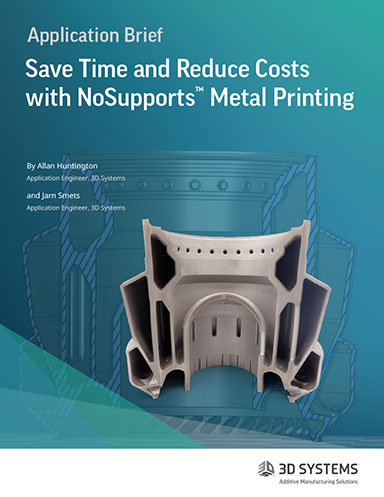
Save Time and Reduce Costs with NoSupports™ Metal Printing
Metal 3D printing is a high energy process in which it is possible for unmanaged heat and stress to build up and impact part quality, this guide presents a step-by-step methodology for how to apply NoSupports to a hot end section of a larger turbomachinery part.

Join over 90,000 engineering professionals who get fresh engineering news as soon as it is published.






About Us · Contact Us · Editorial Team · Advertising · Privacy Policy · Subscriber Services · © 2026 Digital Engineering 24/7 · Peerless Media