Helping design and engineering professionals discover, evaluate and specify technologies and processes that shorten the design cycle and enable success.


Alert!
Digital Engineering ceased publication on July 1, 2026. This website remains available as an archive of engineering content.
For inquiries or information, please email [email protected].
Sponsored

Digital Engineering April 2026
In the latest issue of Digital Engineering, we take a look at the latest innovations in design for additive manufacturing, including the use of natural language inputs, social media cosplayers, and AI integration. The issue also includes a feature…

January Special Focus Issue: Design for Additive
In this Special Focus Issue of Digital Engineering, learn about the latest advancements in design for additive manufacturing, including new software tools, additive in automotive, custom medical devices, and more.
The phrases “additive manufacturing,” "rapid prototyping," and "3D printing" among others, are all kind of lumped together in the popular consciousness to describe manufacturing technology that produces a hard copy of a digital representation. As a reader of this fine publication, you know that. And you’re well aware that design engineers use additive manufacturing technologies for concept modeling, prototyping, low-volume end-use parts, and things like jigs and fixtures. But did you know that additive manufacturing technologies also produce parts for tooling around? Not that tooling, but “Easy Rider” tooling around.
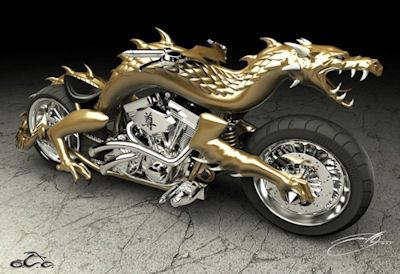 |
You see, it seems that this guy -- I guess it was a guy -- approached Orange County Choppers (OCC) with an idea for a custom-designed motorcycle. This was no granny ride. This motorcycle was to be outfitted with a high-performance S&S 100 cubic inch engine and one of Rolling Thunder’s custom frames. This, I’m told, is street legal in China. But the topper is that this guy wanted his machine to look like a Chinese dragon.
OK, so OCC agrees to see what they can do. At one point in time, when OCC worked on a motorcycle most of the custom, one-off parts were machined from aluminum billets or carved from high-density foam. That meant tedious things like CNC coding, making fixtures, and so forth that ate up time and complicated everything. But that was the process you used. The worst thing about it, however, was not the tedium but that the process often produced heavy parts. This time around OCC used a different approach.
First, instead of cutting the dragon’s head out of high-density foam and using at least a dozen setups to get all of the undercuts and angles to where they wanted them, OCC designed the dragon’s head using Autodesk’s 3ds Max 3D modeling, animation, rendering, and compositing tool. If you’re reading the HTML version of this message, you can see from the picture over there that this dragon’s head has a ton of details that might remind you of an old significant other of yours: scales, horns, dagger teeth, flaring nostrils, and a tongue lashing like a whip.
Anyway, 3ds Max enables the designer to let his imagination run with the idea. He says that he did not have to fret about such intricate details since he planned to use a Fortus 400mc 3D Production System from Stratasys to build the head. Now, the Fortus 400mc uses FDM (Fused Deposition Modeling) as its additive manufacturing technology. Basically, FDM extrudes thin layers of a production-grade engineering thermoplastics on its build table (the Fortus 400mc can use nine different thermoplastics, BTW), eventually building up your part one layer at a time.
So, the designer gets the look of the dragon head he wants. He then exports the model to STL, sends the STL to the 3D printer, and turns his attention to another project since the Fortus doesn’t need an operator hanging around tending to it. Later, he had a fully detailed dragon head, including the ribs on the dragon’s hard palate.
After the client approved the design, OCC’s designer was able to fine-tune the dragon head with internal voids, helping to reduce the weight of the final product. That sort of internal geometric tweaking in a solid part, easy enough to do with additive manufacturing technologies like FDM, is not really something you can do with a CNC machine.
Today’s Check it Out link over there takes you to a cool video case study about this customized motorcycle. It’s just a 2-and-a-half minute show, but you really got to see this dragon motorcycle and hear what OCC has to say about additive manufacturing. Suffice to say, this story and this bike add new meaning to the phrase drag(on) racing.
Thanks, Pal. – Lockwood
Anthony J. Lockwood
Editor at Large, Desktop Engineering


Anthony J. Lockwood is Digital Engineering's founding editor. He is now retired. Contact him via [email protected].
Follow DE






About Us · Contact Us · Editorial Team · Advertising · Privacy Policy · Subscriber Services · © 2026 Digital Engineering 24/7 · Peerless Media