Helping design and engineering professionals discover, evaluate and specify technologies and processes that shorten the design cycle and enable success.



Digital Engineering April 2026
In the latest issue of Digital Engineering, we take a look at the latest innovations in design for additive manufacturing, including the use of natural language inputs, social media cosplayers, and AI integration. The issue also includes a feature…

January Special Focus Issue: Design for Additive
In this Special Focus Issue of Digital Engineering, learn about the latest advancements in design for additive manufacturing, including new software tools, additive in automotive, custom medical devices, and more.
Stratasys is operating the S1 from AM Solutions—3D post-processing technology, a brand of the Rösler Group, at its Additive Manufacturing Center in Rheinmünster, Germany. The company improves the surface quality of its parts with the SAF process, according to AM Solutions.
Post-processing plays a key role at the Additive Manufacturing Center in Rheinmünster, where parts are produced for industries such as automotive, medical, aerospace, and defense across the EMEA region—from prototypes and tooling components to end-use parts.
“While the printing process itself is already highly automated, many post-processing steps remain time-consuming and partly manual. Automated solutions make it possible to standardize these processes, reduce lead times, and ensure consistently high, reproducible quality,” explains Dennis Kronimus, Additive Manufacturing Center manager, Stratasys EMEA.
SAF (Selective Absorption Fusion) is Stratasys’ powder-based additive manufacturing technology, designed for industrial-scale polymer part production. Until recently, Stratasys used an automated cleaning solution from another supplier that relied on glass beads—without any additional surface finishing. The decision in favor of the S1 from AM Solutions was driven by its improved surface quality and the benefits for downstream processes such as dyeing.
“Thanks to the S1, we can now perform cleaning and surface finishing in a single cycle using just one media—previously we needed two separate systems for this. As a result, we have significantly increased the efficiency of our SAF post-processing, achieving a 25% time savings along with better surface finishes. Furthermore, the system requires considerably less floor space—an important factor in our technology center, which houses numerous machines,” says Kronimus.
Whereas the previous cleaning process used glass beads, the S1 now operates with polybeads, which are more durable and deliver a better surface finish, according to Stratasys. The longevity of the blasting media is further enhanced by the S1’s media conditioning system. Filters, cyclones, and media screens are coordinated to separate the blasting media from the powder.
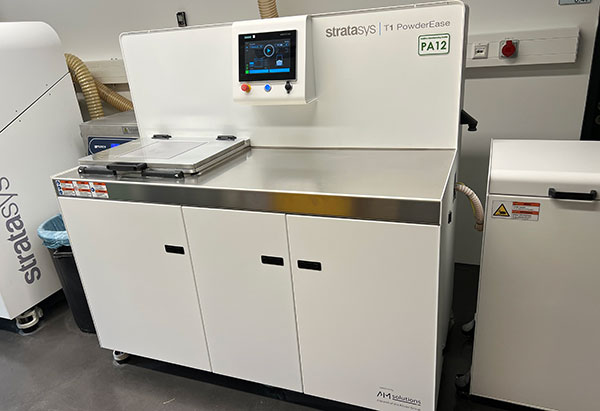
In addition to the S1, Stratasys also uses the jointly developed PowderEase T1 at its Rheinmünster site. Designed specifically for the H350 SAF printer and manufactured at AM Solutions’ facility in Untermerzbach, the system combines automated unpacking, powder recovery, and dosing for up to six printers.
Stratasys also utilizes the C1 from AM Solutions for the automated removal of support material from 3D-printed parts produced using PolyJet and industrial FDM processes. According to the company, the solution enhances workplace safety, while the process fluid requires less frequent replacement than with other systems, thanks to continuous sieving. Coarse support structures can be removed from the bath without being dissolved.
Sources: Press materials received from the company and additional information gleaned from the company’s website.


Every day, our customers find simpler, smarter approaches to stubborn design problemsand greater confidence to confront towering human and technological challenges. Less hindered by the usual constraints, they can imagine, design, iterate and…
Rapid Prototyping in The Automotive Industry
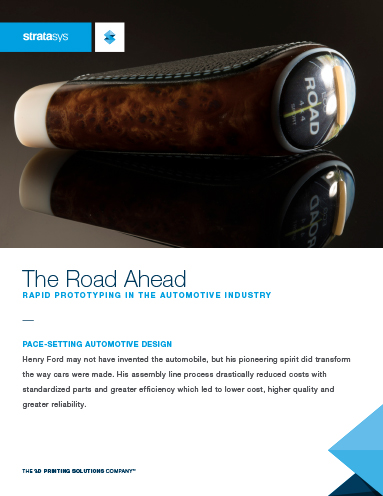
Henry Ford may not have invented the automobile, but his pioneering spirit did transform the way cars were made. His assembly line process drastically reduced costs with standardized parts and greater efficiency which led to lower cost, higher quality and greater reliability.

DE's editors contribute news and new product announcements to Digital Engineering. Press releases may be sent to them via [email protected].
Follow DE
Join over 90,000 engineering professionals who get fresh engineering news as soon as it is published.






About Us · Contact Us · Editorial Team · Advertising · Privacy Policy · Subscriber Services · © 2026 Digital Engineering 24/7 · Peerless Media