Helping design and engineering professionals discover, evaluate and specify technologies and processes that shorten the design cycle and enable success.


Sponsored
 Dear Desktop Engineering Reader:
Content — documentation and data — is king. But in heavily regulated industries, say medical devices or aerospace, it’s more than just that. It’s everything.
Coping with the burden of compliance and quality requirements is the reason why companies put a high priority on their quality and compliance initiatives. You have to demonstrate to auditors and potential clients vetting you that you have your GRC (governance, risk management and compliance) act together.
Often, however, pulling up a quality and compliance proof can cause chaos because data is spread across disciplines, departments, geographic locations and enterprise systems such as document management, PLM (product lifecycle management) and others. You have the data, but you cannot grasp it readily.
So, ask yourself: If interdependent initiatives and systems are vital to your organization, does it make sense to manage your content separately from quality and compliance? That’s the central question posed by the white paper “Content: The Driving Force Behind Governance, Risk, and Compliance” from M-Files Inc. The answer is unequivocally no and that there are solutions that tie your content with your quality and compliance initiatives.
EIM (enterprise information management) melds your GRC initiatives with your data silos. Its form is a centralized system and approach that classifies and stores information for maintaining version control. The key is that EIM drives your daily quality and compliance processes.
EIM organizes and simplifies the four key processes that fall under the GRC rubric: audit management, risk management, compliance and policy management and change management. It brings secured access to your enterprise data through the cloud, internal networks or a hybrid cloud/on-site setup. It provides a mechanism to find what you need when you need it no matter where the data resides. That means you don’t have to know where the latest data is for an auditor, new client or internal assessment. EIM delivers it.
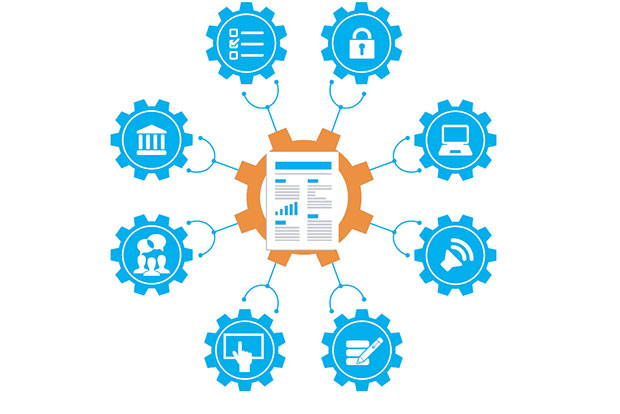 When an EIM (enterprise information management) system and approach converges with GRC (governance, risk and compliance) initiatives, highly-regulated companies can reap benefits ranging from transparency to improved process management and from content retrieval to smoother preparation for auditing. Image courtesy of M-Files Inc.
The paper covers familiar processes that organizations need to maintain for quality and to prove compliance – workflow automation, process management, versioning, approvals, archiving and more. It explains how EIM is a comprehensive solution that automatically binds these processes with a company's information assets to support quality and compliance management.
Fascinating and important stuff. There’s a lot more going on in this paper than touched upon here. Download your copy from today’s Check it Out link and learn more. Well worth your time.
Thanks, Pal. – Lockwood
Anthony J. Lockwood
Editor at Large, Desktop Engineering
Access "Content: The Driving Force Behind Governance, Risk, and Compliance" here.


Anthony J. Lockwood is Digital Engineering's founding editor. He is now retired. Contact him via [email protected].
Follow DE
Join over 90,000 engineering professionals who get fresh engineering news as soon as it is published.






About Us · Contact Us · Editorial Team · Advertising · Privacy Policy · Subscriber Services · © 2026 Digital Engineering 24/7 · Peerless Media