Helping design and engineering professionals discover, evaluate and specify technologies and processes that shorten the design cycle and enable success.



Digital Engineering April 2026
In the latest issue of Digital Engineering, we take a look at the latest innovations in design for additive manufacturing, including the use of natural language inputs, social media cosplayers, and AI integration. The issue also includes a feature…

January Special Focus Issue: Design for Additive
In this Special Focus Issue of Digital Engineering, learn about the latest advancements in design for additive manufacturing, including new software tools, additive in automotive, custom medical devices, and more.
Desktop Metal has launched 316L stainless steel for the Studio System, a metal 3D printing system for prototyping and low-volume production. A fully austenitic steel known for its corrosion resistance and mechanical properties at extreme temperatures, 316L is suited for applications in industrial environments, including saltwater in marine applications, caustic cleaners found in food processing environments and chemicals in pharmaceutical manufacturing.
“The addition of 316L enables engineers to print metal parts for a wide range of applications, including engine parts, laboratory equipment, pulp and paper manufacturing, medical devices, chemical and petrochemical processing, kitchen appliances, jewelry and even cryogenic tools and equipment,” says Ric Fulop, CEO and co-founder of Desktop Metal. “Teams are now able to iterate quickly on 316L prototypes, print complex geometries that are not possible with most manufacturing methods, and produce end use parts cost-effectively.”

Early applications of 316L parts printed with the Studio System confirm the diverse and promising results across multiple industries:
The UHT Atomizer, manufactured by John Zink Hamworthy Combustion, is a fuel oil atomizer for use with atomizing medium such as steam or air. It is typically installed in an HXG marine burner which are used on steam propulsion boilers on LNG tankers. The objective of the atomizer is to improve low load burner performance, thus allowing the burner to run on a lower fuel oil throughput. 316L stainless steel has been a key material for the part due to its mechanical properties at high temperatures. Printed with the Studio System, the atomizer can be redesigned to function in a more fuel-efficient manner than those produced through traditional metalworking means.
“Unlike many of the parts that John Zink designs and manufactures, this UHT Atomizer can only be fabricated utilizing additive manufacturing. Design constraints of casting, machining and other methods that have bound our thinking for decades can be eliminated as additive manufacturing technology continues to evolve and progress,” says Paul Newman, general manager at John Zink Hamworthy Combustion, UK.
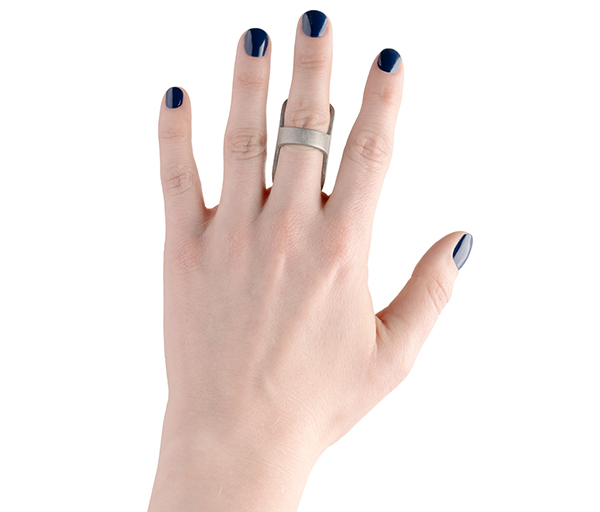
Ring splints, a common medical device, are designed to immobilize or limit the range of motion of injured limbs. Ring splints are typically made of injected-molded plastic in standard sizes and parts often break after a relatively short lifetime. Due to traditional manufacturing methods, finger splints cannot be customized to improve fit. Now, by 3D printing in 316L, ring splints can be custom-printed, on-demand to the desired size, with the added benefit of an aesthetic finish and increased durability.
“Being able to 3D print medical grade steel parts like this finger splint, which is customized to the patient anatomy, offers many advantages as compared to previous fabrication methods that take longer and may have lower efficacy,” says Jim S. Wu, MD, chief of Musculoskeletal Radiology and Intervention at Beth Israel Deaconess Medical Center, and Associate Professor at Harvard Medical School.
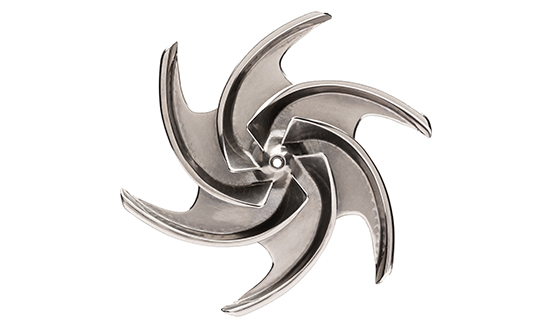
Commonly used across a variety of industries, impellers are an essential component of pumps to move fluid through systems. Impellers require complex vanes to optimize pressures in the pump for different fluids and applications. With chemical impellers, 316L is the choice material for its chemical resistance and mechanical properties at extreme temperatures, such as those found in cryogenic, salt water, and petroleum pumps. The impellers are geometrically complex, with prototypes typically costing $1,000 or more. With the Studio System, this impeller was printed in 316L for $70.
“The oil and gas industry will be a major beneficiary of advances in metal 3D printing,” says Ahmad Khowaiter, chief technology officer of Saudi Aramco.
“As innovative companies across multiple industries adopt metal 3D printing, it's critical to help accelerate this growth by expanding the portfolio of desired materials,” says Fulop. “Our materials science team is pushing the boundaries to enable printing metal parts for a growing range of applications in as wide a material portfolio as possible. The introduction of 316L is another step on our path to fundamentally change the way metal parts are designed and manufactured.”
316L joins 17-4 PH stainless steel in the Studio System’s materials library. With more than 30 materials in development, Desktop Metal plans to introduce additional core metals to its portfolio throughout 2019, including tool steels, superalloys, and copper.
Sources: Press materials received from the company and additional information gleaned from the company’s website.


Desktop Metal was started to address a problem—how to make metal 3D printing accessible for engineering teams. In 2013, CEO Ric Fulop began collaborating with world-leading experts in materials science, engineering, and 3D printing. Their work…

DE's editors contribute news and new product announcements to Digital Engineering. Press releases may be sent to them via [email protected].
Follow DE
Join over 90,000 engineering professionals who get fresh engineering news as soon as it is published.






About Us · Contact Us · Editorial Team · Advertising · Privacy Policy · Subscriber Services · © 2026 Digital Engineering 24/7 · Peerless Media