Helping design and engineering professionals discover, evaluate and specify technologies and processes that shorten the design cycle and enable success.


Alert!
Digital Engineering ceased publication on July 1, 2026. This website remains available as an archive of engineering content.
For inquiries or information, please email [email protected].


Dear DE Reader:
November 7th is a date which will live in history in the PR and marketing departments at 3D Systems. They had to coordinate a slew of announcements—multiple new additive manufacturing systems, new build materials, software upgrades and an assortment of service- and/or business-related announcements. They did well, but we have room just for the 3D printing systems.
Four of them. That’s right—four new 3D printing systems ranging from desktop size to full-scale, industrial production systems.
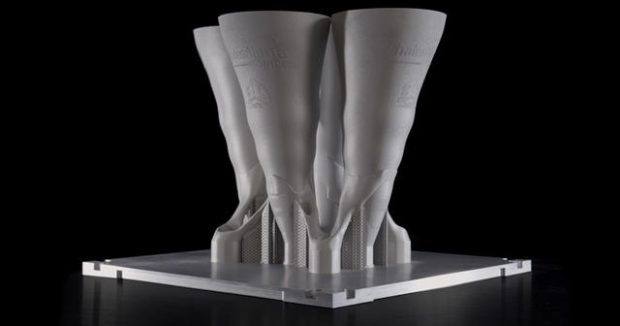 3D Systems says that its new DMP 8500 Factory Solution metal 3D printing system is engineered for uniform, repeatable part quality and high productivity with a low total cost of operations (TCO). Image courtesy of 3D Systems Inc.
First up is the FabPro 1000. It marks 3D Systems' entry into the desktop industrial 3D printing market. A $5,000-ish unit for designers, engineers, artisans and the like, this unit handles a variety of materials, including engineering plastics and castable resins. It'll be available in the first half of next year.
The new ProX SLS 6100 extends the company's line of SLS (selective laser sintering) production systems. It makes end-use parts and functional prototypes. It has an automated material handling system, a new air-cooled laser that eliminates the need for a chiller and software to optimize part builds. Three new nylon materials were introduced along with it, including an aluminum-filled nylon and a fire-retardant nylon.
Mass-production factory additive manufacturing sees a lot of action. First is the DMP 8500 Factory Solution. This is a metal 3D printing system intended for high-productivity with a low total cost of operations. It's made up of function-specific, integrated modules. For example, its removable print module moves between the printer and powder modules for a continuous production workflow. This gives you the potential for 24/7 fabrication. 3D systems says that the DMP 8500 builds uniform, repeatable part quality, including seamless, large metal parts, as well as parts with the largest diameter available in the industry.
Finally, there's the Figure 4, a modular, scalable platform. According to 3D systems, it produces small, plastic parts quickly and delivers up to a 20% lower part cost than current manufacturing processes. It handles a range of industrial, dental and custom materials that, 3D Systems says, enable true replacement of injection molding and urethane casting. Interestingly, the Figure 4 line is configurable as a single stand-alone unit as well as a highly customized, in-line production system of multiple units.
Each of these new 3D printers is linked off of today's Editor's Pick of the Week write-up, and all have a video that show off more of its features. Click here to learn more.
Thanks, Pal. – Lockwood
Anthony J. Lockwood
Editor at Large, DE


Anthony J. Lockwood is Digital Engineering's founding editor. He is now retired. Contact him via [email protected].
Follow DE






About Us · Contact Us · Editorial Team · Advertising · Privacy Policy · Subscriber Services · © 2026 Digital Engineering 24/7 · Peerless Media