Helping design and engineering professionals discover, evaluate and specify technologies and processes that shorten the design cycle and enable success.


 Dear DE Reader:
Sometimes your toolset needs options and you don’t have them. Take for example your ambition’s pause when you go to hang grandmother’s picture on drywall and all you have is an 18-lb. sledge. 3D scanners often present engineering and manufacturing outfits this conundrum. Sometimes you need to scan a small wingnut and sometimes you need to scan in an oil pipeline. Today’s Pick of Week sounds like a cool instrument that could bring scanning flexibility to your outfit.
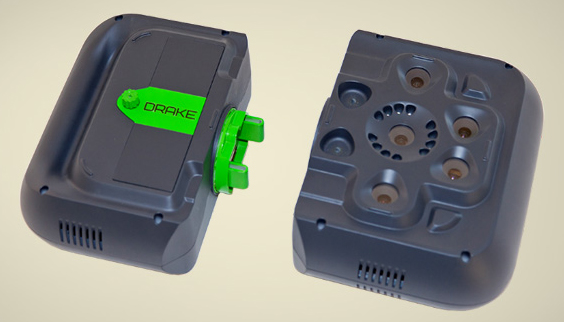
Thor3D has announced the availability next month of a new wireless, hand-held 3D scanner called Drake—as in the global circumnavigator Sir Francis, not the world-renown rapper. This white-light scanner has a number of attractive characteristics: It’s battery-powered and wireless. You can take it where you need to be and transmit data to a workstation over Wi-Fi. You can also dump data to a USB drive to work on later.
But the number one aspect to focus on is that you can equip it with one of three lens sets, each of which has a different field of view. That means Drake is available with lenses for scanning in small, medium or large objects.
Now, the lens sets come separately. But nothing is stopping you from opting for all three. See, you can swap out and swap in lens sets like switching lenses on a camera. The potential here is enormous. For one, you could have a single multipurpose scanner for use anywhere in your organization. Two, you can take Drake to big jobs across town or use it on small jobs on your workbench.
Thor3D says that you don't have to calibrate the lens and you can achieve maximum accuracy somewhere between 40 and 200 microns, depending on the set of lenses you use. The maximum resolution range is between 0.15 and 1.00mm.
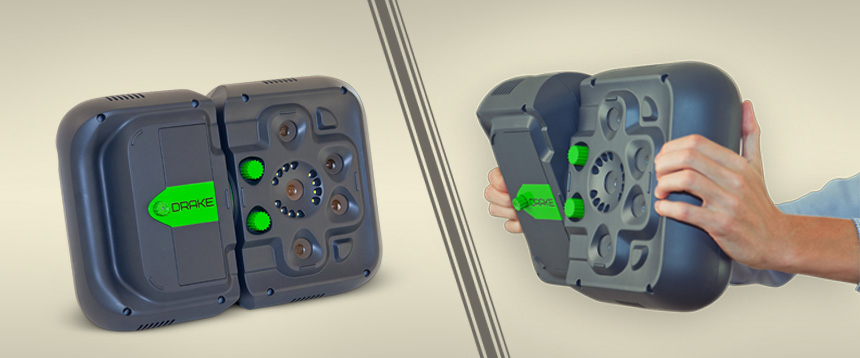 Developer Thor3D says that, depending upon the optional lens set deployed, the multipurpose, white-light Drake 3D scanner can scan objects of any size. Image courtesy of Thor3D.
Your takeaway is this: If your outfit needs to scan in a variety of objects but doesn't always have the right-sized tool for the task, the Drake could be what you're looking for. You can learn more about the Drake hand-held 3D scanner from today’s Pick of the Week write-up. It's so new that not a lot of details are available yet, but hit the link to the Thor3D website and check out their news section. These guys are out there telling you what they're doing and why in a most entertaining way.
Thanks, Pal. – Lockwood
Anthony J. Lockwood
Editor at Large, DE


Anthony J. Lockwood is Digital Engineering's founding editor. He is now retired. Contact him via [email protected].
Follow DE
Join over 90,000 engineering professionals who get fresh engineering news as soon as it is published.






About Us · Contact Us · Editorial Team · Advertising · Privacy Policy · Subscriber Services · © 2026 Digital Engineering 24/7 · Peerless Media