Helping design and engineering professionals discover, evaluate and specify technologies and processes that shorten the design cycle and enable success.


Ansys software and services reduce obstacles to enable customers to solve complex engineering challenges. Engineering simulation has expanded beyond specialized experts and into mainstream product design and development. At the same time, engineering complexity now require organizations to scale like never before, driving demand for advanced computing resources and cross-discipline engineering solutions, the company reports.
The new products, technologies and tools that make up Ansys 2022 R1 enable experts to go deep with custom workflows for industry-specific applications while extending ease-of-use features that turbocharge collaboration across teams.
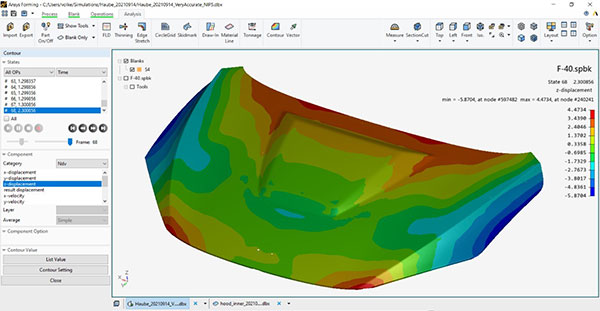
Ansys 2022 R1 includes a dedicated aerospace workspace in Ansys Fluent that tailors the user interface to external aerodynamics simulations, enabling aircraft designers to evaluate aircraft efficiency and study dynamics from subsonic to very high-speed flows. Similarly, the new Ansys Forming product enables engineers to digitally design and validate every step of the sheet metal forming process commonly found in automotive, appliances, aerospace, and packaged goods industries. Ansys RF Advisor On Demand is targeted specifically to help engineers solve the challenge of radio frequency interference for high-tech devices.
With 2022 R1, Ansys continues to bring new technologies to address printed circuit board (PCB) and 3D IC (integrated circuit) package design challenges as well as advancements in 5G, autonomous and electrification simulation. The introduction of the Phi Plus meshing technology brings speed and robustness to complex system simulation including 3D IC packaging challenges.
New workflows and integrations in Ansys 2022 R1 produce more insight into product performance. In this latest release, Ansys Sherlock features a new, semi-automated workflow that uses integrations with Ansys AEDT Icepak to deliver more predictively accurate thermal analysis simulations for PCBs.
Ansys 2022 R1 delivers product offerings that complement traditional multiphysics with safety, reliability, cybersecurity, digital mission engineering, and digital twins.
The optical technologies offered by Ansys span from Ansys Lumerical at the microscale, to Ansys Zemax at the macroscale, to human and sensor perception for systems with Ansys Speos. The Ansys 2022 R1 release delivers increased functionality supporting Ansys' comprehensive solution for the design of optical and photonic devices in datacom, consumer electronics, automotive, aerospace and healthcare.
On the other end of the scale are enormous simulations to support digital mission engineering like Ansys STK (Systems Tool Kit) that now includes enhanced tools to support large satellite mega-constellations being evaluated and designed across the commercial space industry. In between are examples from industries where fast, high-fidelity simulations of complex phenomena are needed to meet product development deadlines.
With Ansys 2022 R1, many more applications support Ansys Cloud and use the power that the latest graphics processing units (GPUs) can provide. For example, a new Multi-GPU solver available in Fluent accelerates steady-state computational fluid dynamics (CFD) simulations.
Ansys 2022 R1 also expands Ansys Discovery's astonishing live physics in thermal management through adding coupled fluid-solid multiphysics simulation. This fast, fault-tolerant approach means that the simulation of heat exchangers, liquid cooling devices, and exhaust systems is now easier to perform and faster.
"Speed, fidelity, and scalability are crucial to integrating simulation across the enterprise, enabling engineers to connect with global collaborators to keep pace with innovation in high-growth areas, such as autonomous vehicles, electrification, and artificial intelligence," says Shane Emswiler, senior vice president of products at Ansys. "The new features in Ansys 2022 R1 enable engineers to both solve more complex challenges and expand the reach of simulation's benefits."
To learn more about Ansys 2022 R1, click here.
Sources: Press materials received from the company and additional information gleaned from the company’s website.

Engineering simulation is our sole focus. For more than 45 years, we have consistently advanced this technology to meet evolving customer needs.ANSYS develops, markets and supports engineering simulation software used to predict how product…
Study on HPC and Cloud Computing for Engineering Simulation
This new research report explores how companies are using HPC and simulation on the cloud.

DE's editors contribute news and new product announcements to Digital Engineering. Press releases may be sent to them via [email protected].
Follow DE
Join over 90,000 engineering professionals who get fresh engineering news as soon as it is published.






About Us · Contact Us · Editorial Team · Advertising · Privacy Policy · Subscriber Services · © 2026 Digital Engineering 24/7 · Peerless Media