Helping design and engineering professionals discover, evaluate and specify technologies and processes that shorten the design cycle and enable success.



May 2026 Special Focus: Artificial Intelligence in Design and Simulation
In this Special Focus Issue, learn about the latest developments in the integration of artificial intelligence into engineering workflows.

Design & Simulation Software Guide 2025
In this Special Issue, Digital Engineering presents its second annual guide to design and simulation software vendors.
Last June, the Probabilistic Analysis Consortium for Engines (PACE), managed by the Ohio Aerospace Institute (OAI) under contract with the Air Force Research Laboratory (AFRL), announced “a collaboration with SmartUQ to develop a probabilistic framework for quantifying uncertainties in the secondary flow and heat transfer models for turbine engines.”
Since a combustion engine is a complex system in which performance is driven by a combination of mechanical thrusts, thermal loads, and vibrations, you’d need to simulate it using multiphysics simulation programs. But due to the intense computation required, most engineering firms will be limited to just a few such simulation runs.
This is where SmartUQ’s probabilistic calculations can augment the primary simulation.
“The primary simulation method you use to determine if the engine is safe, involves certain parameters, such as temperature and pressure attributes,” said Dr. Mark Andrews, SmartUQ’s Technology Steward. “We use the physics-based simulation to build a statistical model -- a surrogate model, if you will.”
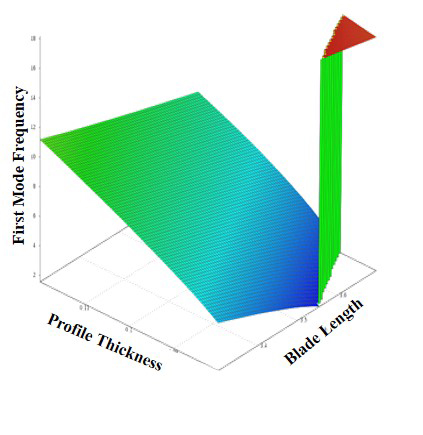 SmartUQ analytics tools were used to perform a robust design on the rotor blade. A subset of the blade variants tended to undergo vibrational mode switching. SmartUQ’s mixed input surrogate model had a discrete parameter to represent the mode switching. The figure shows the first mode response surface with respect to blade length and profile thickness (image courtesy of SmartUQ).
The surrogate model numerically mimics the interconnected relationships of the critical parameters in the primary simulation model. If the mechanical thrust affects the thermal load, which in turn puts stresses on the engine blade and produces vibration during the engine’s operation, then these inputs will be similarly linked in the surrogate model.
“Using advanced statistical algorithms that mimic the physics-based simulation results, we condense these relationships into a surrogate model,” said Dr. Andrews. “That way, we can make a complex system much more manageable.”
Solving the numerical equations is significantly quicker than meshing and solving a 3D assembly structure in finite element analysis (FEA). Therefore, with SmartUQ's approach, the computing cost is significantly lower on the user.
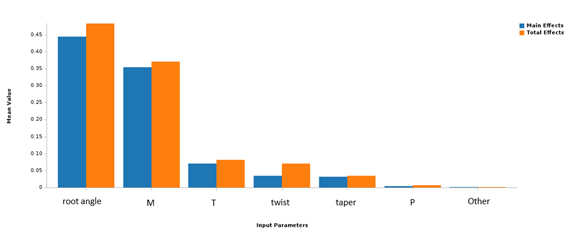 The sensitivity analysis of the first mode where the root angle appears to have the greatest effect on the first mode frequency. This information can help the engineer decide how to improve the rotor blade design (image courtesy of SmartUQ).
SmartUQ describes its main software offering as “a powerful uncertainty quantification (UQ) analytics software tool.”
“Some uncertainties are unavoidable, just part of nature’s randomness,” explained Dr. Andrews. “If you run a physical test on the same material five times, you still get slight variations in your results. That’s just nature. Then, there’s uncertainty that comes from a lack of knowledge.”
With the PACE project, Dr. Andrews said SmartUQ would be developing a system to account for uncertainties under different scenarios. The goal is for SmartUQ to “deliver a new tool that the manufacturers can use to conduct engine analysis,” said Dr. Andrews.
Companies that have historically relied on deterministic approaches -- running physical tests and hands-on experiments, for example -- may have a difficult time embracing the probabilistic approach, Dr. Andrews acknowledged.
But he sees evidence of a mindset change. “Aerospace has embraced the probabilistic approach,” he added. “And automotive is starting to use it.”


Kenneth Wong is Digital Engineering's resident blogger and senior editor. Email him at [email protected] or share your thoughts or suggestions at digitaleng.news/facebook.
Follow DE
Join over 90,000 engineering professionals who get fresh engineering news as soon as it is published.






About Us · Contact Us · Editorial Team · Advertising · Privacy Policy · Subscriber Services · © 2026 Digital Engineering 24/7 · Peerless Media