Helping design and engineering professionals discover, evaluate and specify technologies and processes that shorten the design cycle and enable success.



Digital Engineering April 2026
In the latest issue of Digital Engineering, we take a look at the latest innovations in design for additive manufacturing, including the use of natural language inputs, social media cosplayers, and AI integration. The issue also includes a feature…

January Special Focus Issue: Design for Additive
In this Special Focus Issue of Digital Engineering, learn about the latest advancements in design for additive manufacturing, including new software tools, additive in automotive, custom medical devices, and more.
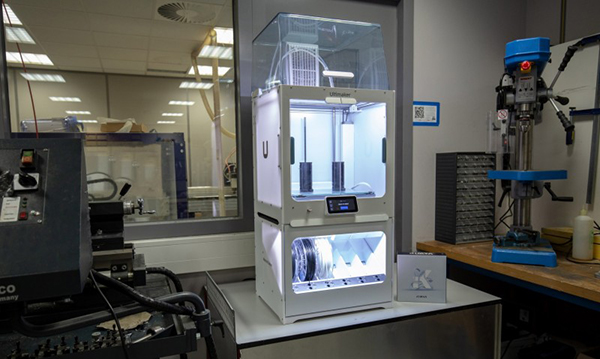
Ultimaker reports that Hänssler Group, German company dedicated to sealing technology, plastics technology and additive manufacturing, uses the Ultimaker S5 and Kimya’s ABS-ESD (acrylonitrile butadiene styrene - electrostatic discharge) to cost-effectively produce 300 accurate sealant parts annually with anti-electrostatic properties. These parts, designed to be integrated within an existing production line, provide thermal protection between two components within a machine. The optimized material printing profile combined with the Ultimaker S5, result in parts with minimal batch-to-batch dimensional variation.
Surface defects impact ESD performance, which would alter the dissipation of charges, as Ultimaker explains. Hänssler’s parts must be reproducible for ESD behavior and dimensional accuracy, in addition to meeting visual and integrity requirements. To assess the surface quality of the prints, engineers performed a high-resolution 3D scanning analysis on a select number of parts, using a GOM Atos Core 3D scanner. This showed relative deviations between the ideal CAD model and the printed part. A pass/no-pass filter for dimensional accuracy with a threshold of 0.3 mm, enabled Hänssler to create an optimized ABS-ESD printing profile to print parts on the Ultimaker S5 with minimal tolerance limits.
Read more detailed information and measurements in the blog here.
Sources: Press materials received from the company and additional information gleaned from the company’s website.


From the very beginning, our mission has been to accelerate the world’s transition to local manufacturing and digital distribution. Our passion is to deliver a 3D printing system that drives business success across the world. That’s why…

Insider Q&A: 3D Printing End Use Parts
In this Insider Q&A, the experts at Ultimaker explain how 3D printing can be used for spare parts, jigs and fixtures in a production environment.

DE's editors contribute news and new product announcements to Digital Engineering. Press releases may be sent to them via [email protected].
Follow DE
Join over 90,000 engineering professionals who get fresh engineering news as soon as it is published.






About Us · Contact Us · Editorial Team · Advertising · Privacy Policy · Subscriber Services · © 2026 Digital Engineering 24/7 · Peerless Media