Helping design and engineering professionals discover, evaluate and specify technologies and processes that shorten the design cycle and enable success.



Digital Engineering April 2026
In the latest issue of Digital Engineering, we take a look at the latest innovations in design for additive manufacturing, including the use of natural language inputs, social media cosplayers, and AI integration. The issue also includes a feature…

January Special Focus Issue: Design for Additive
In this Special Focus Issue of Digital Engineering, learn about the latest advancements in design for additive manufacturing, including new software tools, additive in automotive, custom medical devices, and more.
Obviously planes can’t be grounded every time a pilot spots a snowflake, so regulatory bodies around the world require that planes be designed and certified to continue operations in inclement conditions. Because engineers of every stripe realize that computer simulations must be verified, actual aircraft testing is conducted in supercooled wind tunnels, where ice is allowed to build up on the wings.
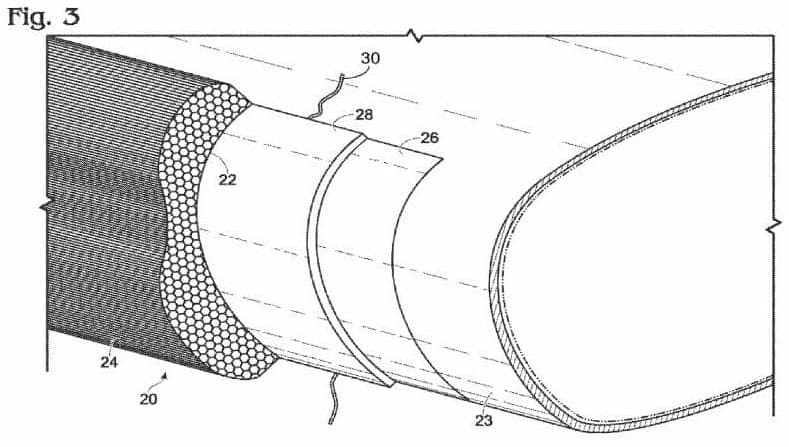 Boeing's patent filed with the US Patent Office displaying faux ice buildup on a plane's wing. Courtesy of the US Patent Office.
Technicians then make faux ice masses based on the buildup from glassfiber and resin and bolt them onto a plane’s wings. Pilots then must demonstrate the plane is still flight-worthy for an aircraft to receive its certifications.
Boeing isn’t enamored of the process, complaining it takes too long and is too expensive. Rather than just complain, however, the company turned its creative minds toward a practical solution. The end result was using 3D printing to build mock ice masses that simulate the qualities of ice buildup on wings, without actually requiring the ice.
Icy masses are designed in CAD before being printed out in whatever material seems most appropriate. As a result of 3D printing the masses, the masses fit snugly on a wing and can be held in place with adhesive rather than bolts. This reduces the chances of causing damage to the expensive machines.
Rather than a single type of test mass, 3D printed masses can be built in a variety of shapes, with different textures and densities. The result is better simulated ice, according to Boeing. Each fake chunk of ice can even be printed to include labels and identification markers to ensure they are properly placed.
For now, the idea sits at the patent office, but it may not be too long before your safety is the result of 3D printing. Below you’ll find a short video that explains the perils of ice buildup on aircraft wings.
Source: Gizmag, US Patent Office


John Newman is a Digital Engineering contributor who focuses on 3D printing. Contact him via [email protected] and read his posts on Rapid Ready Technology.
Follow DE
Join over 90,000 engineering professionals who get fresh engineering news as soon as it is published.






About Us · Contact Us · Editorial Team · Advertising · Privacy Policy · Subscriber Services · © 2026 Digital Engineering 24/7 · Peerless Media