Helping design and engineering professionals discover, evaluate and specify technologies and processes that shorten the design cycle and enable success.



May 2026 Special Focus: Artificial Intelligence in Design and Simulation
In this Special Focus Issue, learn about the latest developments in the integration of artificial intelligence into engineering workflows.

Design & Simulation Software Guide 2025
In this Special Issue, Digital Engineering presents its second annual guide to design and simulation software vendors.
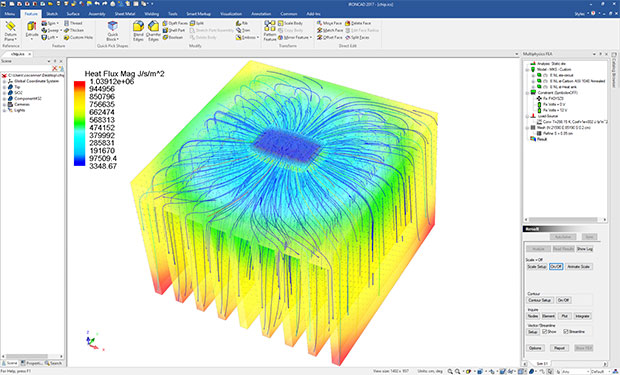
MPIC, an integrated multiphysics simulation tool for the IronCAD suite of 3D and 2D design collaboration solutions, provides fully coupled multiphysics for stress, thermal, electrostatic and fluid analyses. Its strain-enriched finite element analysis (Sefea) technology gives users capabilities to test their designs at lower mesh levels, according to the company.
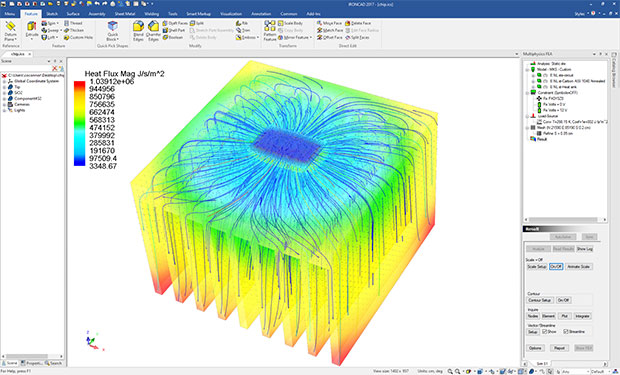 IronCAD has released what it says is a “major” update to Multiphysics for IronCAD (MPIC), its integrated multiphysics simulation tool for the IronCAD 3D/2D suite of mechanical design and collaboration applications. Image courtesy of IronCAD LLC.
Sefea is an enriched finite element (FE) formulation developed specifically for CAD design simulation that uses automatic four-node tetrahedron elements commonly used in CAD simulation. It achieves the same accuracy as second-order elements but is more robust and without mid-side-node noise, according to IronCAD.
XMD is a patented model definition language developed by AMPS Technologies that allows models to be exchanged with any XMD-compatible model.
“As such, MPIC model can be opened, edited, exchanged, solved on any AMPS XMD application such as AMPS Designer or Multiphysics product lines, the upcoming cloud version or any other XMD-embedded CAE (computer-aided engineering) products,” explains David Tzai, development manager at AMPS Technologies in an e-mail exchange with DE. “For a simple change, the user can also use an XML editor to edit the model without using any AMPS product. It contains a single entry to all AMPS model descriptions of the multiphysics simulation system controls, material and boundary condition information.”
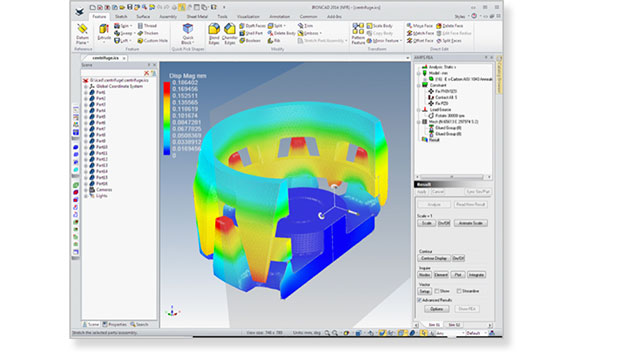 Multiphysics for IronCAD works directly in the IronCAD user interface and provides fully coupled multiphysics for stress, thermal, electrostatic and fluid analyses. An advanced package that extends functionality for specialized applications is also available. Image courtesy of IronCAD LLC.
From the user's point of view, adds Tzai, they are “assured the model is expandable/compatible with any product new function and, if computing power is needed, a cloud support can be accessed. And they have direct upgrade from MPIC to more advanced AMPS modules such as electro-magneto applications.”
Analysis types included with MPIC are static/steady state, dynamic and transient response, modal and vibration modes, instability buckling and frequency domain. Standard features include an Auto Solve button to generate results and built-in model associativity. Add-on functionality is available for specialized analyses that involve such phenomena as flow impact, large deformation and large rotation.
IronCAD reports that MPIC's new automatic parts contact/impact analysis now serves as the default setting. This, it says, helps CAD users solve general mechanical contact/impact problems.
 The latest update of Multiphysics for IronCAD can now handle difficult stamping springback and deep drawing problems in its default setting. On the left, the sheet was not fully constrained and the stamping process produced an unwanted shape. On the right, the sheet was properly constrained, and the desired stamped shape was produced. Image courtesy of IronCAD LLC.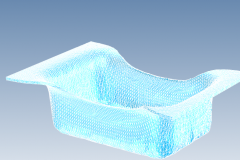
Additionally, complex contact analyses such as deep drawing or stamping springback problems now can be handled using the default setting. The company explains that a deep-draw model is done with the minimum mesh density while preserving the physics of a stamping process. When a sheet is properly constrained, the desired stamped shape is produced.
Other enhancements in the latest release of MPIC include the following:
MPIC capabilities—such as stress, thermal, electrostatics and fluids—come with the IronCAD free 30-day trial (link follows). For more information on Multiphysics for IronCAD, click here.
Watch a video series on basic workflows in MPIC.
Download the latest MPIC release notes.
Download an evaluation copy of IronCAD.
Go here for details on what's new in the 2017 release of IronCAD.
Access the IronCAD video training library.
See why DE's Editors selected Multiphysics for IronCAD as their Pick of the Week.
Sources: Press materials received from the company and additional information gleaned from the company's website.


Anthony J. Lockwood is Digital Engineering's founding editor. He is now retired. Contact him via [email protected].
Follow DE
Join over 90,000 engineering professionals who get fresh engineering news as soon as it is published.






About Us · Contact Us · Editorial Team · Advertising · Privacy Policy · Subscriber Services · © 2026 Digital Engineering 24/7 · Peerless Media