Helping design and engineering professionals discover, evaluate and specify technologies and processes that shorten the design cycle and enable success.



May 2026 Special Focus: Artificial Intelligence in Design and Simulation
In this Special Focus Issue, learn about the latest developments in the integration of artificial intelligence into engineering workflows.

Design & Simulation Software Guide 2025
In this Special Issue, Digital Engineering presents its second annual guide to design and simulation software vendors.
Although many would consider conceptual "back-of-the-envelope"calculations as peripheral to real design, these steps are oftencritical in managing design parameters as well as determining thedesign approach for the automated design phase. Without the right toolsand structure to capture these steps, however, the methodology becomesad hoc and difficult to replicate. All of us have felt the pains ofrecovering from a departing engineer who left the final design filesbut nobody could deduce how he got to the design.
We all need to "do the math" as a fundamental part of engineeringdesign. However, when things go wrong, very often it is due to amathematical error in the early design stages. If flaws are notidentified during the design stages the result can be costly, or evendeadly. We are all aware of the big news stories such as the ChallengerShuttle disaster through a faulty O-ring calculation, or the loss ofthe Mars Climate Orbiter due to a simple unit error. But this isn'tjust about "rocket science." Math is used in the design and developmentof almost every product we experience today. Millions of calculationsare performed daily to support design decisions for products we willuse in the future. And every day, hundreds of engineering teams arewrestling with problems that stem from design flaws that were due tocalculation errors.
Faulty Beginnings
It is for this reason that billions of dollars a year are invested inCAE, MCAD, EDA, FEA, CFD, and other design analysis tools. In thesetools, the math is buried deep inside the software as rich sets ofmodels and algorithms that describe and facilitate simulations of realsystems in order to validate the designs.
But what about all the work and thought processes that go into thedesign at the conceptual stages? It is at this stage that the scope forerror and delay can be the greatest. So why do we treat our initialdesign calculation so casually? Why, when we need to make a designdecision, we still reach for a notepad, pen, and calculator to performsuch a critical task? The answer for many designers is that there areno viable alternatives. Specifically, they don't believe that computers"do math" in the way that they do—equation formulation, algebraicmanipulations, simplifications, and so on.
This is true if one simply views computation tools like spreadsheets orprogramming languages as "doing math" on computers. And for manycomputer-savvy engineers, this is exactly what has happened. I havepersonally encountered many engineering projects where supportingcalculations end up locked inside cryptic spreadsheet formulas like((B12 + 2*$A$1)/A12)*2.3128.
The software system Maple (from Maplesoft) is an example of a genre ofsoftware—broadly categorized as interactive math systems—thatexplicitly manages math information in a way that is closer to the wayengineers work. Maple offers a range of solvers that cover all of theprincipal areas of engineering math and more.
Dynamic System Modeling and Control Using Maple
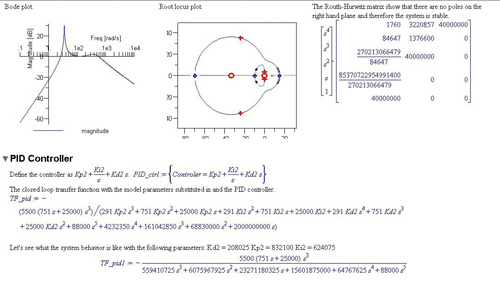
Engineers can use Maple to describe a dynamic system in a numberof representations—differential equations, transfer functions,state-space matrices—analyze the system and then develop thecontroller. Maple has all the power needed to derive and solve thesystem equations in order to analyze the time and frequency response,and stability, of the system (below).
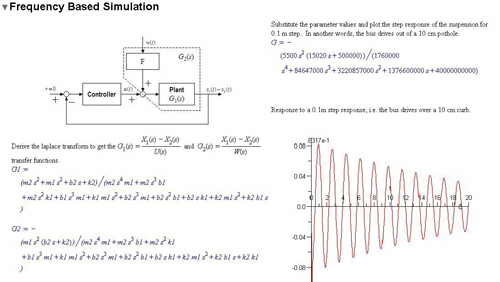
The controller can then be developed and tested, and implementedas C-code for implementation in a microcontroller (above). The entireprocess is captured in a readable "self-checking" report that not onlydocuments the solution but the thought process that went intodeveloping it. This knowledge can be readily reused for other projects.— PG
Units and Dimensional Analysis
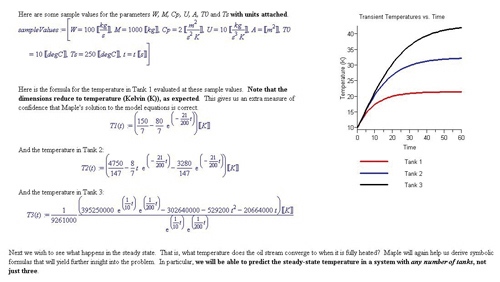
Interactive math tools like Maple can do more than solve equations,they can incorporate dimensional information for each variable that canthen be mapped to any system of units. Beyond providing a ready meansof converting from one unit to another, Maple mathematically combinesthe individual dimensions in an expression, simplifies the result, andthen maps it to another unit, if available (below). In this way, therisk of units error in the calculations is virtually eliminated.
— PG
Many call packages like Maple "spreadsheets on steroids" referring tothe depth and speed of the math solvers. This is a grossoversimplification as the fundamental paradigm of these systems issubstantially different from that of spreadsheets and most otherpackages used by engineers to do math calculations. These interactivemath systems are becoming increasingly important as daily productivitytools for engineers of all flavors for some very important reasons:
Paul Goossens is the director of commercial market development forMaplesoft. Send your feedback on this article through e-mail c/o [email protected].
Product Information
Maple
Maplesoft
Waterloo, Ontario
maplesoft.com


DE's editors contribute news and new product announcements to Digital Engineering. Press releases may be sent to them via [email protected].
Follow DE
Join over 90,000 engineering professionals who get fresh engineering news as soon as it is published.






About Us · Contact Us · Editorial Team · Advertising · Privacy Policy · Subscriber Services · © 2026 Digital Engineering 24/7 · Peerless Media