Helping design and engineering professionals discover, evaluate and specify technologies and processes that shorten the design cycle and enable success.



May 2026 Special Focus: Artificial Intelligence in Design and Simulation
In this Special Focus Issue, learn about the latest developments in the integration of artificial intelligence into engineering workflows.

Design & Simulation Software Guide 2025
In this Special Issue, Digital Engineering presents its second annual guide to design and simulation software vendors.
|
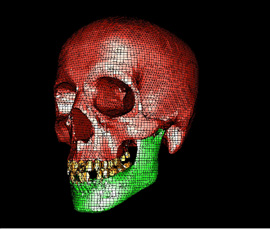
This detailed surface meshing of a skull is used for study of craniofacial surgery, growth, and development. A 3D wireframe was created in SolidWorks, exported in .STL format, then meshed with CEI's Harpoon. The mesh is easily imported into an FEA program such as MSC.MARC for analysis to determine the correct placement and size dental implant. |
While military applications and crash simulations have long been hot areas for computational solid mechanics, advanced computer software is bringing biomechanics—with its highly complex structures and morphologies—deeper into the fold. Research in cell behavior, the nervous system, and even dental implants and fillings are all benefiting from timesaving advances in meshing technology typically used in the automotive and aerospace industries.
Dr. Ronald Sakaguchi, associate dean for technology and innovation at Oregon Health and Science University in Portland, studies the mechanics of biomedical devices. His team's research into dental implants and restorations under varying loads helps improve designs for manufacturers.
Meshing the Threads
Analysis of meshes is a critical component of biomedical device research. In the case of FEA (finite element analysis) of threaded dental implants, meshing the helical threads, especially the root of the threads, presents challenges because it typically results in tetrahedral elements with poor aspect ratios. Until recently, meshing was done by manually creating individual elements, which required several weeks or months of effort.
| |
|
|
| |
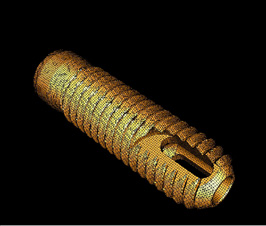
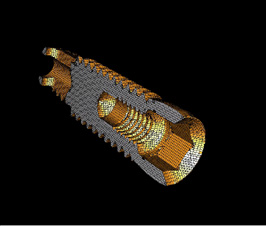
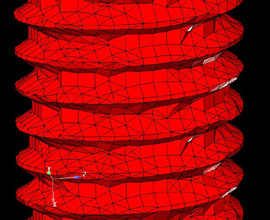
A full view and cross-section of a dental implant assembly including the section that is embedded in bone, the abutment that connects the implant to the tooth replacement (crown), and the internal screw that retains the abutment to the implant. The closeup view (bottom) shows the detailed meshing of helical threads accomplished by Harpoon, which uses hexahedral elements to speed the process and cut down on cleanup. |
Speed Plus Accuracy
Harpoon meshing software is based on proprietary meshing algorithms that provide fast processing and enable automated clean up of CAD files. Developed over two years, the program's goal is to erase the traditional bottlenecks associated with meshing for complex CFD (computational fluid dynamics), FEA, and other simulations.
In solving for biomedical devices such as dental implants, designers must confront complex geometries. The quality of a mesh starts with the CAD file, which often has such problems as holes and non-watertight surfaces with gaps, overlaps, and intersecting facets. Harpoon automatically fixes these hindrances in the course of creating boundary-fitted cells, and it does this at speeds of two million cells per minute or more on standard laptops, according to CEI.
Speed, of course, is worthless if the quality of the mesh is poor. If the user needs to go through several time-eating iterations to get a quality mesh, the speed at which the mesh is generated is irrelevant. Ideally, a mesh would consist entirely of perfect cubes; that is what Harpoon strives to do. It deviates from ideal cells only when needed, typically near model boundaries and surfaces. And the non-cubic cells are created with an optimization method that is said to ensure the highest possible accuracy.— KW
Company Information
Harpoon
Computational Engineering
International — CEI
Apex, NC
ceintl.com
MSC.Marc
MSC.Software Corp.
Santa Ana, CA
mscsoftware.com
SolidWorks
SolidWorks Corp.
Concord, MA
solidworks.com


DE's editors contribute news and new product announcements to Digital Engineering. Press releases may be sent to them via [email protected].
Follow DE
Join over 90,000 engineering professionals who get fresh engineering news as soon as it is published.






About Us · Contact Us · Editorial Team · Advertising · Privacy Policy · Subscriber Services · © 2026 Digital Engineering 24/7 · Peerless Media