Helping design and engineering professionals discover, evaluate and specify technologies and processes that shorten the design cycle and enable success.



Digital Engineering April 2026
In the latest issue of Digital Engineering, we take a look at the latest innovations in design for additive manufacturing, including the use of natural language inputs, social media cosplayers, and AI integration. The issue also includes a feature…

January Special Focus Issue: Design for Additive
In this Special Focus Issue of Digital Engineering, learn about the latest advancements in design for additive manufacturing, including new software tools, additive in automotive, custom medical devices, and more.
The four-year old 3D printing tech startup Mosaic, headquartered in Toronto, is releasing Palette 2, an add-on to your existing 3D printer. You can think of Palette 2 just like an external hard drive or a removable blu-ray player, something that adds new capabilities to the primary hardware. In this case, Palette 2 gives your single-color, single-material FDM (fused deposition modeling) 3D printer the ability to print in multiple colors (up to four) and multiple materials.
"Single-color, single-material 3D printers are capable of printing high quality parts, but they also limit the type of things we can print," explains Mitch Debora, CEO and cofounder of Mosaic. "We'd like to enable both multi-color and multi-material printing because we think they're equally important."
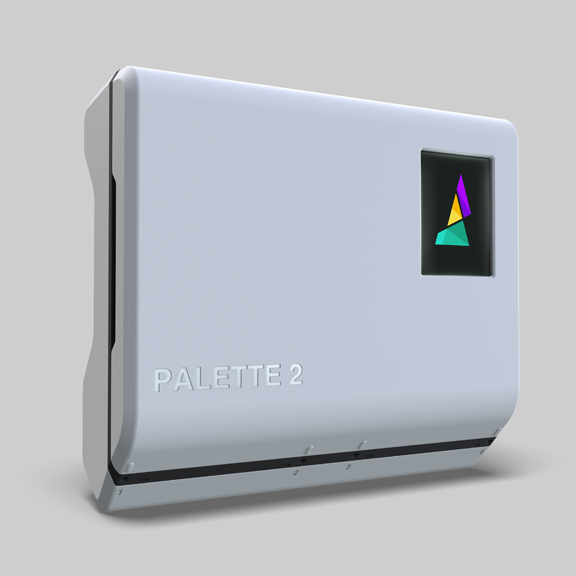 Mosaic's Palette 2 is an add-on to turn single-color, single-material FDM printers into multi-color, multi-material printers (image courtesy of Mosaic).
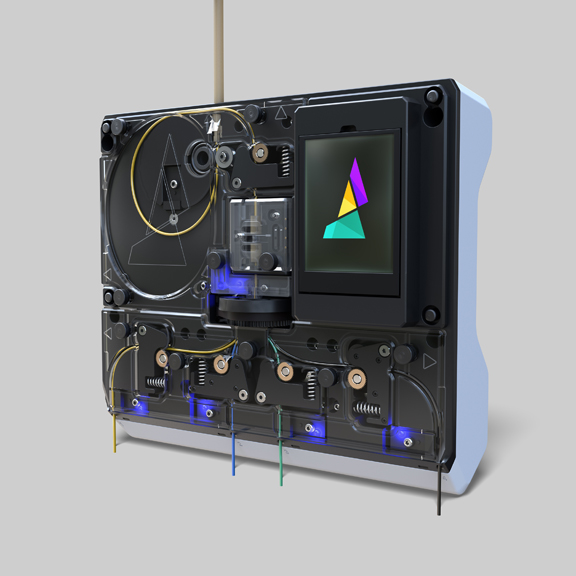 A view of the filament consolidation and slicing mechanism inside Mosaic's Palette (image courtesy of Mosaic).
Multi-color and multi-material 3D printers are available from some leading vendors. For example, the Connex Object series from Stratasys is capable of color printing with PolyJet digital materials. The ProJet product line from 3D Systems are full-color printers. And da Vinci from XYZ Printing is a full-color 3D printer.
Palette employs FDM technology, which uses a continuous thermoplastic filament. This is different from the powder-based, polymer-based inkjet 3D printing, which is commonly used to achieve colors. Because of the thermal binding involved, FDM parts are generally considered much more durable than inkjet-style printing. Thus, for end-use parts, FDM may be more suitable; and for concept models, inkjet-printed parts may be adequate.
"With Palette, you don't need to make any modification to your existing printer," says Debora. "It sits next to your printer. You load the Palette with multicolor filaments. Palette turns them into a single filament and feeds it into your printer."
Printing multi-material colored parts on a printer originally designed to print monochrome parts in a single material does have an impact on the speed, because the printer's single extruder must operate differently to cope with color-switching operations. The more complex the intersecting colors are, the greater the impact on the speed might be.
Debora says Palette is compatible with all printers that use standard 1.75mm filaments. There could be issues, however, with 3D printers that restrict users to use their proprietary firmware (the slicing and preparation software). To prepare the print job with Palette, you need to use Mosaic's software, CANVAS.
The company's list of compatible 3D printers include the Raise3D N series, MakerGear M2/M3, Makerbot Replicator 2/+, SeeMe CNC, Ultimaker 2/3, and more.
"To go from single-material, single-color printing to multi-material, multi-color is not trivial," explains Debora. "It involves reconfiguring the extruder setup. With four extruders [to accommodate multi-color, multi-material printing], the printer itself could get bigger and unwieldy."
This, Debora points out, is the reason printer makers should look at Mosaic as a potential partner rather than a competitor. Mosaic recently struck up partnerships with six printer makers to integrate its technology directly into their products.
Palette was born out of a Kickstarter campaign that ran back in April 2015. With 464 backers, the 30-day campaign raised CA$ 231,803 (US $179,314). It garnered coverage in Wired, Engadget, and Gizmodo, among others.
Palette 2 is priced $499 currently for preorder. Its regular price will be $599. Palette 2 PRO, with aluminum housing to protect the slicing mechanism, sells for $699 on preorder. Its regular price is $799.
Palette 2's predecessor Palette was sold through the online retailer Amazon. Debora says Palette 2 will also be available through Amazon.


Kenneth Wong is Digital Engineering's resident blogger and senior editor. Email him at [email protected] or share your thoughts or suggestions at digitaleng.news/facebook.
Follow DE
Join over 90,000 engineering professionals who get fresh engineering news as soon as it is published.






About Us · Contact Us · Editorial Team · Advertising · Privacy Policy · Subscriber Services · © 2026 Digital Engineering 24/7 · Peerless Media