Helping design and engineering professionals discover, evaluate and specify technologies and processes that shorten the design cycle and enable success.



Design & Simulation Software Guide 2025
In this Special Issue, Digital Engineering presents its second annual guide to design and simulation software vendors.

Special Focus Issue: Artificial Intelligence in Simulation
In this Special Focus Issue of Digital Engineering, we look at the latest trends in integrating AI and machine learning with design and simulation tools. The issue includes features on synthetic data, open-source AI for modeling, AI-powered…
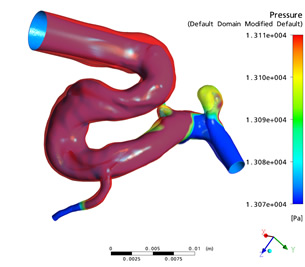 Imagecourtesy of ANSYS, Inc. |
ANSYS, Inc. announced that the @neurIST project has completed a major milestone toward its goal of helping clinicians understand and manage cerebral aneurysms. The project teamed with ANSYS to incorporate high-end engineering simulation, which is being increasingly used in the fields of biomedicine and healthcare.
The @neurIST project successfully demonstrated its underlying series of linked tools — called a “toolchain” — using software from ANSYS, which automates complex tasks such as aneurysm modeling and simulation. The project is now moving toward developing patient-specific treatment for this devastating condition.
An aneurysm is the ballooning of a weakened artery wall (with cerebral aneurysm occurring in the brain), with the constant threat that it may burst, leading to uncontrolled bleeding and often death. Ultimately, the @neurIST project expects to provide individualized aneurysm rupture predictions. The toolchain is a critical part of the project’s infrastructure: It combines diverse, independent tools into an integrated suite, in which the output of one tool becomes the input for the next. The resulting automated workflow brings together multiple strands of patient data — including CT scans, X-rays, angiograms, and other routine test results — transforming them into 3-D representations that are the basis for dynamic simulations performed with ANSYS software. The resulting information can be used in other @neurIST software systems by doctors, researchers and engineers at hospitals, universities, and medical device companies to develop patient-specific treatments. Project partners are now collecting and analyzing clinical data in expectation of developing best practices and, perhaps, identifying the underlying causes of the condition.
“There is a demonstrated need for the use of computer-based imaging and monitoring not just to diagnose disease, but also for patient-specific simulations to test alternative treatments,” says Jim Cashman, president and chief executive officer at ANSYS, Inc. “@neurIST is a comprehensive example of this. It fuses diagnostic, modeling and simulation data into a coherent representation of a patient's condition. ANSYS is at the foundation of the project because of our commitment to advancing the use of engineering simulation in new and innovative applications — things that previously were never imagined. The company has long served the biomedical industry with leading-edge technology that enables advances in solving unique and complex problems.”
For more information, visit ANSYS and @neurIST.
Sources: Press materials received from the company and additional information gleaned from the company’s website.


DE's editors contribute news and new product announcements to Digital Engineering. Press releases may be sent to them via [email protected].
Follow DE
Join over 90,000 engineering professionals who get fresh engineering news as soon as it is published.






About Us · Contact Us · Editorial Team · Advertising · Privacy Policy · Subscriber Services · © 2026 Digital Engineering 24/7 · Peerless Media