Helping design and engineering professionals discover, evaluate and specify technologies and processes that shorten the design cycle and enable success.



Digital Engineering April 2026
In the latest issue of Digital Engineering, we take a look at the latest innovations in design for additive manufacturing, including the use of natural language inputs, social media cosplayers, and AI integration. The issue also includes a feature…

January Special Focus Issue: Design for Additive
In this Special Focus Issue of Digital Engineering, learn about the latest advancements in design for additive manufacturing, including new software tools, additive in automotive, custom medical devices, and more.
Nexa3D and Henkel debut immediate commercial availability of xMED412, a polypropylene-like material made for manufacturing a variety of biocompatible, medical and wearable devices. Manufactured by Henkel, xMED412 is entirely based on its Loctite MED412 material and is covered by all of its associated clearances, tests and certifications.
“We developed and tested with Nexa3D’s NXE400 3D printer a multitude of approved workflows designed to unleash the full potential of xMED412’s outstanding physical properties and biocompatibility," says Ken Kisner, Henkel’s head of Innovation for 3D printing. "Nexa3D and Henkel have provided a digital manufacturing solution for a growing number of medical devices, athletic wearables and personalized audio products. Especially with regard to the current COVID-19 pandemic, we are pleased that nasopharyngeal swabs manufactured with xMED412 on the NXE400, in accordance with our published procedures, have already been cleared through clinical trials and are in compliance with ISO 10993 testing and FDA Class I Exempt classification.”
“We are very excited to jointly bring to market with Henkel a second production-grade material, particularly at this time of persisting requirements for PPE’s and other mission-critical devices,” says Izhar Medalsy, Nexa3D’s chief operating officer. “This is our second joint material introduction in as many months with Henkel to develop a portfolio of co-branded performance photopolymers through our expanding global channels. We are continuing to jointly address specific high throughput industrial production opportunities leveraging our leading print speed, large build volume and intelligent resin management technology to convert Henkel performance resins into functional parts made on the NXE400 3D printer.”
xMED412 was developed by LOCTITE to deliver part performance with functionality. The medical-grade material is a very strong and durable photopolymer with mechanical attributes similar to polypropylene with elongation, impact strength and compression strength. xMED412 parts printed on Nexa3D’s NXE400 require post-processing and cleaning in accordance with the company’s recommendations and can be machined, tapped or polished to deliver desired production finishes.
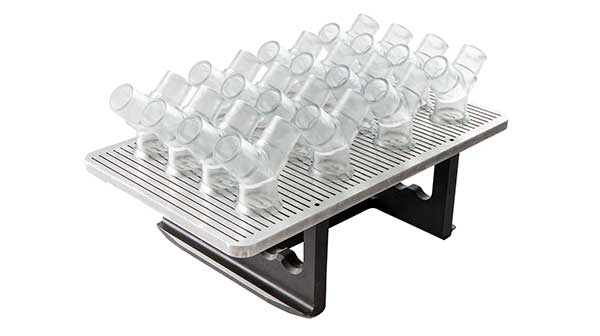
“We are very pleased to see the marketplace’s overwhelmingly positive response to xMED412 parts manufactured on the NXE400 3D printer,” says Michele Marchesan, Nexa3D’s chief growth officer. “In the U.S., we quickly qualified and scaled up single printer production capacity to 5,400 swabs a day at our Nexa3D flexible factory in support of the ongoing demand for nasal swabs. Elsewhere, customers are printing ventilators and other medical device parts, including venturis and connectors at productivity and scale, which are fast achieving the new standard for flexible series production.”
xMED412 is a lightweight yet sturdy material that comes with inherent insulating properties, designed to withstand impact, moisture and vibration. These features and attributes are ideal for devices that might need to be sterilized or disinfected, and are shipped around the world for use in home care and health care settings, the companies say. To learn more about how Nexa3D and Henkel are unlocking the full potential of series production of medical and athletic devices, there is a webinar on August 4; more details are here.
To advance the miniaturization of biocompatible, medical and wearable devices, design engineers are incorporating new materials into device designs for added product lifecycle flexibility. For companies that manufacture single-use medical devices, or reusable devices, many components need to bend and flex for use on or near a patient’s body. Such components and substrates must be pliable, elastic and often kink-resistant.
Both the NXE400 and xMED412 are immediately available for purchase through Nexa3D’s network of resellers.
Sources: Press materials received from the company and additional information gleaned from the company’s website.


DE's editors contribute news and new product announcements to Digital Engineering. Press releases may be sent to them via [email protected].
Follow DE
Join over 90,000 engineering professionals who get fresh engineering news as soon as it is published.






About Us · Contact Us · Editorial Team · Advertising · Privacy Policy · Subscriber Services · © 2026 Digital Engineering 24/7 · Peerless Media