Helping design and engineering professionals discover, evaluate and specify technologies and processes that shorten the design cycle and enable success.


Alert!
Digital Engineering ceased publication on July 1, 2026. This website remains available as an archive of engineering content.
For inquiries or information, please email [email protected].
Sponsored
 Dear Desktop Engineering Reader:
Mcor Technologies and its paper-based 3D printing and prototyping systems have generated a good amount of buzz in the media. But who are these guys? Where did they come from? And what’s this paper-based model business all about anyway? Today’s Check it Out takes you to a PDF that answers those questions and provides additional food for thought. Assuming that you don’t get a letter with a check for a gazillion bucks for being a good person, this might be the most interesting thing you’re going to read all day.
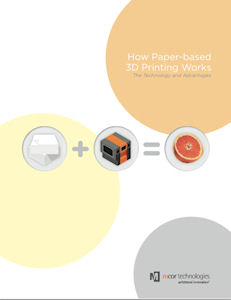 “How Paper-Based 3D Printing Works: The Technology and Advantages” begins with an unexpectedly warm personal note on the company’s history. The short of it is that two brothers from Ireland got the 3D printing bug in the early days of the technology when it was so expensive only the select few could use it. They wanted develop a robust, eco- and user-friendly 3D printer with low operating costs and quick ROI (return on investment) so that 3D printing would be accessible to people in settings as diverse as engineering, manufacturing, entertainment and education. And from that vision began Mcor Technologies and its paper-based 3D printing technology.
Both monochrome and full-color 3D printers from Mcor leverage what is called SDL (selective deposition lamination) technology. SDL is an additive technology with a minor subtractive element. “How Paper-Based 3D Printing Works” gives you in-depth details on the process. But, basically, the process stacks, glues, heats, presses and cuts around patterns on sheets of standard letter-sized paper to build your model.
Post printing, you peel away – they call it weeding – and discard the excess paper in your office paper recycling bin. There’s no dunking parts in a chemical bath, vacuuming powder or things like that. If you want a part to be drilled, threaded, or water resistant, you can apply or dip it in a common finish.
The part you get is not origami delicate, although you can build fragile features. Resolution is 0.00047 in. (0.012 mm) and dimensional accuracy is 0.004 in. (0.1 mm), so you get good details. Parts are described as being hard and “essentially reconstituted wood.”
The paper provides a detailed explanation of the supplied Windows-based software you use to prep your part. This is what you’d expect here: You import a file in a standard format and position your model. The software takes care of slicing the model into printable layers and the rest of the tricky work. For color printing, you also use a second application to apply color to your 3D digital files.
The color printing process is interesting. The Mcor IRIS system can print more than one million colors simultaneously. Its color capability is 5760 x 1440 x 508 dpi. The water-based ink permeates the paper, which means a model’s undersides, overhangs and sidewalls are fully colored.
After explaining SDL technology, the discussion turns to costs. Here, Mcor makes the argument that its 3D printers are cost-effective and therefore accessible for all types of users, whether engineering, commercial or educational. Mcor claims that its part costs are about 5% of those of other technologies. That, in turn, projects to a five-year ROI one-fifth that of other 3D print technologies.
Materials are key. You don’t need specialized plastics, powders or infiltrants. Literally, you can go to your local office supply store and buy paper, and you can even reuse paper from your office. The company backs up these claims with an image gallery of objects created with its units. Each image provides the actual component size and its production cost in both dollars and euros. The image of a 3D printed orange for less than three bucks is incredible.
“How Paper-Based 3D Printing Works: The Technology and Advantages” runs 10 pages. If you had been wondering about SDL paper-based 3D printing systems from Mcor Technologies and what could possibly be in it for you, this is as definitive account as you’re going to find. Hit today’s Check it Out link and download a complimentary copy to see for yourself.
Thanks, Pal. – Lockwood
Anthony J. Lockwood
Editor at Large, Desktop Engineering
Download “How Paper-Based 3D Printing Works: The Technology and Advantages” here.


Anthony J. Lockwood is Digital Engineering's founding editor. He is now retired. Contact him via [email protected].
Follow DE






About Us · Contact Us · Editorial Team · Advertising · Privacy Policy · Subscriber Services · © 2026 Digital Engineering 24/7 · Peerless Media