Helping design and engineering professionals discover, evaluate and specify technologies and processes that shorten the design cycle and enable success.



Design & Simulation Software Guide 2025
In this Special Issue, Digital Engineering presents its second annual guide to design and simulation software vendors.

Design & Simulation Software Guide
In this Special Issue, Digital Engineering presents its inaugural guide to design and simulation software vendors, including listings for CAD, CAM, simulation, generative design, PLM, rendering and visualization, design for additive manufacturing,…
Newcomer Parabola is hoping to change that dynamic. Its new software aims to reduce busywork and automate processes via an easy-to-use, drag-and-drop interface that can be used to facilitate certain tasks in lieu of software coding. The toolset is aimed at making non-engineers more productive by allowing them to work with data in new ways without the need to write code, maintain any infrastructure, or be fully reliant on IT.
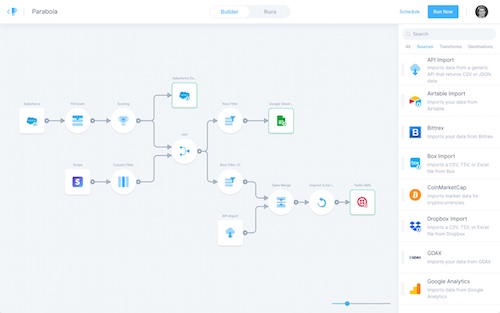
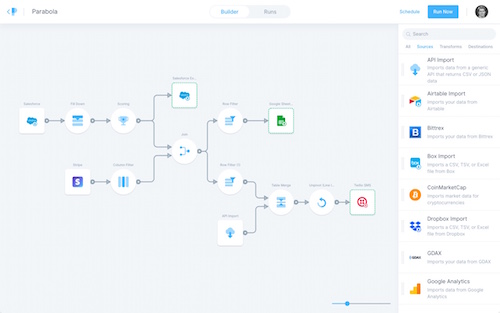 Via a simple drag-and-drop interface, Parabola enables non-programmer engineers to easily pull in live data from IoT sources to inform designs. Image courtesy of Parabola.
Consider the engineer working on an IoT-enabled product used in an agriculture application. There might be dozens of sensors distributed throughout the fields and on industrial equipment pulling in all sorts of real-time data—from moisture and temperature readings to rotation speed on a particular part. For an engineer to glean insights from any of that raw data, they would typically need to rely on software engineers and data scientists to write scripts and algorithms that would access, integrate, and interpret the data or alternatively, rely on their own programming skills.
“Parabola is useful for working with data more efficiently,” says Alex Yassen, who co-founded the company along with Mike Lang, a former software engineer who built the RESTful web service layer for one of Yahoo’s APIs. “You’re able to build what a software engineer writes Python scripts for—to take in sensor data and work effectively with it without doing manual stuff in spreadsheets, dusting off your scripting skills, or calling in an actual software engineer.”
Yassen describes Parabola as a visual programming tool that anyone can use to create functional data flows by dragging and dropping applications and assigning flow to live data sources wherever they may exist. The tool transforms the data in any required structure, again using a visual flow, and the software will automatically route data to any destination without requiring manual uploads of CSV files. Flows can also be scheduled to run on a weekly or daily basis, further easing the burden of collecting sensor data from IoT products to in turn, run analytics and visualizations that will glean insights that can inform designs.
While the software is not necessarily aimed at design engineers, the segment, particularly those designing IoT-related products, can greatly benefit. “We are enabling people to spend time on their specific discipline of designing a device and not get stuck mucking around or manipulating data so they can analyze it,” Yassen explains. “In that way, they can focus on what they’re really good at and not struggle with failed code or wasting time in Excel.”


Beth Stackpole is a contributing editor to Digital Engineering. Send e-mail about this article to [email protected].
Follow DE
Join over 90,000 engineering professionals who get fresh engineering news as soon as it is published.






About Us · Contact Us · Editorial Team · Advertising · Privacy Policy · Subscriber Services · © 2026 Digital Engineering 24/7 · Peerless Media