Helping design and engineering professionals discover, evaluate and specify technologies and processes that shorten the design cycle and enable success.



Design & Simulation Software Guide 2025
In this Special Issue, Digital Engineering presents its second annual guide to design and simulation software vendors.

Design & Simulation Software Guide
In this Special Issue, Digital Engineering presents its inaugural guide to design and simulation software vendors, including listings for CAD, CAM, simulation, generative design, PLM, rendering and visualization, design for additive manufacturing,…
That was the takeaway from a recent survey conducted by PLM consultancy CIMdata, which sought to explore how companies were deriving value from their PLM investments. The upshot of the research: The engineering function remains sold on the importance of PLM, but industrial companies are still struggling to move these implementations beyond traditional product data management (PDM) workflows. According to the survey, 83% of respondents use PLM to orchestrate engineering and change management, 81% for engineering data management, 70% for configuration management, and 55% for product engineering processes.
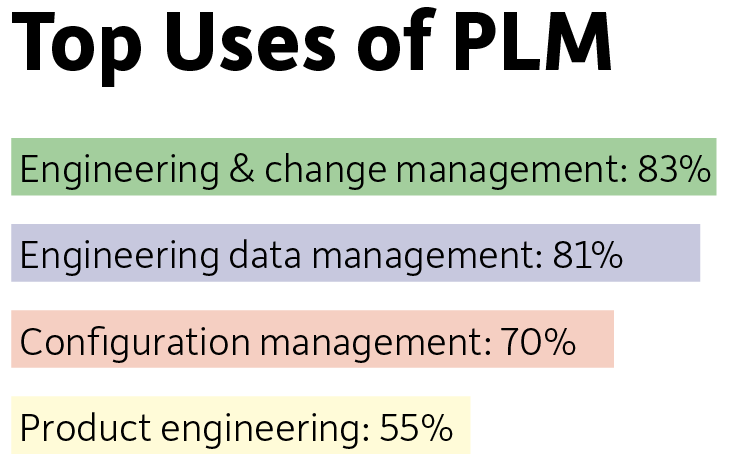 Source: CIMdata PLM Status & Trends Research, March 2018.
As far as communities of users, the CIMdata survey found that product engineering was by far the most avid user of PLM, by nearly a quarter of respondents, followed by research and development (18%) and manufacturing engineering (12%). Upstream users in service (6%) and sales and marketing (4%) as well as suppliers (4%) were far less likely to engage with PLM as part of their regular workflows.
“The roots of PLM are still based in engineering,” says Peter Bilello, CIMdata president, explaining that ownership of the initiative, including oversight of the budget, is still very much grounded in engineering groups as opposed to being viewed as an enterprise initiative. Even more telling, Bilello says, is the fact that many companies, even larger enterprises, are still managing complex product development using CAD data management capabilities, conducting configuration management activities with Microsoft Excel, and doing manual reentry of data into manufacturing systems.
CIMdata’s survey also showed some PLM bright spots. Even with its limited user base, PLM budgets are on the rise. The CIMdata survey found budgets increasing at 43% of respondents, with 33% staying on course with the previous two years. Looking ahead, respondents were also bullish on PLM budget expansion, with 48% confirming they expected increases over the next two years. New PLM investments are expected to be directed to expanding business process scope (70% of respondents) and improving business processes (67%). Slightly less than half (48%) expect the new investments to expand use of PLM to additional users.
Looking toward the future, respondents to the CIMdata survey expect their PLM investments to be focused on global enablement and driving faster, better, cheaper product development, particularly through configurability. Newer capabilities such as artificial intelligence and machine learning are still five years away for most of the survey respondents, despite the high volume of industry chatter.
One surprise emanating from the research: There is still confusion over where the major enterprise platforms of PLM, MES, and ERP intersect, Bilello says.
Moving forward, Bilello says it’s possible that the rise of the internet of things (IoT) and connected products could play a role in breaking the logjam and making PLM relevant to a wider audience. “IoT provides the capability to create a closed-loop lifecycle better than we’ve had before,” he says. “We need an end-to-end perspective, and PLM needs to play a key role.”
Watch this video to get a peak at what CIMdata is planning for its upcoming 2018 PLM Market & Industry Forum, including its take on PLM and industry 4.0.


Beth Stackpole is a contributing editor to Digital Engineering. Send e-mail about this article to [email protected].
Follow DE
Join over 90,000 engineering professionals who get fresh engineering news as soon as it is published.






About Us · Contact Us · Editorial Team · Advertising · Privacy Policy · Subscriber Services · © 2026 Digital Engineering 24/7 · Peerless Media