Helping design and engineering professionals discover, evaluate and specify technologies and processes that shorten the design cycle and enable success.



Digital Engineering April 2026
In the latest issue of Digital Engineering, we take a look at the latest innovations in design for additive manufacturing, including the use of natural language inputs, social media cosplayers, and AI integration. The issue also includes a feature…

January Special Focus Issue: Design for Additive
In this Special Focus Issue of Digital Engineering, learn about the latest advancements in design for additive manufacturing, including new software tools, additive in automotive, custom medical devices, and more.
Let’s begin today’s Roundup with a look at materials. Solid Concepts has released information about its new Polyjet Over-Mold process. Using an Objet Connex500, the over-mold combines PolyJet White with PolyJet Flex Black to create over-molded prototypes more quickly than is possible with the usual casting methods. A single object can incorporate shore hardness between Shore 27A to Shore 95A.
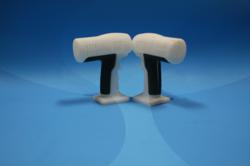
"PolyJet Over-Mold is excellent for tactile feedback for locating fingerings on products," according to Solid Concepts. "The elastomeric material portrays and conveys buttons, skins, rubber boots—any piece of equipment requiring elastomeric materials. The accuracy of PolyJet is also ideal for reveals of industrial design features."
Moving on, apps aimed at some area of 3D printing seem to be growing in popularity, and Shapeways is looking to get in on the action. The company has released the Shapeways API to assist and encourage design and development of new apps for its AM printing service. The application programming interface offers improvements to finer grain controls when uploading designs, and real-time pricing for services, based on materials and finishing processes required for each object.
Assuming they are supported with any kind of marketing effort, apps are a good way to hook new consumers into customizable 3D printed products, mainly thanks to ease of use. Even people who might not be interested in Shapeways can still play around with the apps and share the information with their friends.
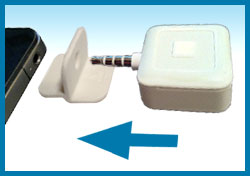
Next, if you’ve visited a small business in the last year or so, you may have seen or used a Square. The device is a small card reader that can plug in to an iOS device to finalize sales, charging a meager 2.75% service fee per swipe. The only problem with the Square is that the plug-in can sometimes swivel, possibly resulting in bad swipes.
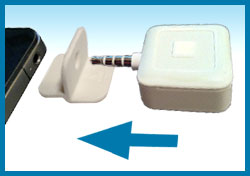
Chris Milnes identified this problem and came up with a solution. Using a MakerBot Replicator, Milnes developed and now sells the Square Helper: a 3D printed holder for the Square. This is a great example of how AM opens up possibilities for new small businesses. Prior to AM, Milnes would probably have sold his idea to another company, but the Replicator allows him to manufacture and sell the Square Helper as an individual.
Last for today, we already noted how apps can help draw more attention to AM and we have one more example to offer. Sculpteo and Infinate Dreams have teamed up to offer the Let’s Create! app. This new app acts like a virtual pottery wheel, allowing users to design and color unique objects like vases or cups. The finished design can then be printed out, or shared via an online community.
“Integrating our 3D printing platform into Let’s Create! Pottery app shows how easy it is to integrate 3D printing into online shops,” said Clément Moreau, CEO and Co-Founder of Sculpteo. “This partnership demonstrates how ineluctably the division between the digital world and real world is disappearing thanks to 3D printing technology.”
Below you’ll find a short video about the Let’s Create! app.
Sources: Forbes, VentureBeat, PRWeb, programmableweb


John Newman is a Digital Engineering contributor who focuses on 3D printing. Contact him via [email protected] and read his posts on Rapid Ready Technology.
Follow DE
Join over 90,000 engineering professionals who get fresh engineering news as soon as it is published.






About Us · Contact Us · Editorial Team · Advertising · Privacy Policy · Subscriber Services · © 2026 Digital Engineering 24/7 · Peerless Media