Helping design and engineering professionals discover, evaluate and specify technologies and processes that shorten the design cycle and enable success.



Digital Engineering April 2026
In the latest issue of Digital Engineering, we take a look at the latest innovations in design for additive manufacturing, including the use of natural language inputs, social media cosplayers, and AI integration. The issue also includes a feature…

January Special Focus Issue: Design for Additive
In this Special Focus Issue of Digital Engineering, learn about the latest advancements in design for additive manufacturing, including new software tools, additive in automotive, custom medical devices, and more.
When engineers want to measure a material’s strength, they typically do so by using a tensile testing machine, according to experts. A small sample is printed and put under a large force until it snaps. The force projected on the part divided by the surface of the center intersection at the time of breaking will express its strength.
But for the teams at Ultimaker, Covestro and the Royal Dutch Navy, they decided to take an unconventional approach to understand how strong 3D-printed parts can be. To illustrate their test, they needed to lift something heavy. But what would work? A motorbike? A car? A large Jeep? The Royal Dutch Navy then asked: “Why not an armored vehicle?”
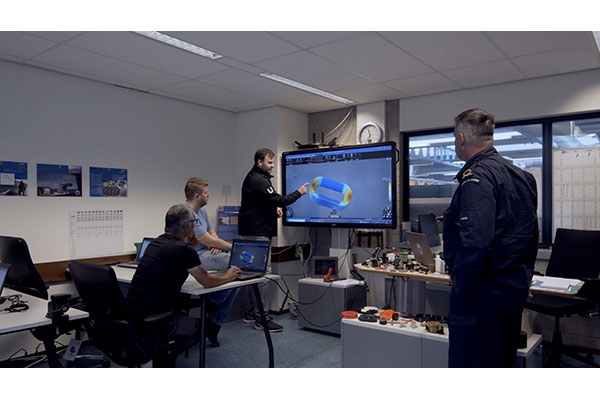
To lift a heavy vehicle using a 3D printed part, the engineers first needed to analyze the hardware. The Royal Dutch Navy had a special lifting tank at its disposal that used two openable steel rings to connect to their crane and to the cables attached to the lifted vehicle. An elongated O-shaped link would be able to connect these two metal rings and lift the heavy vehicle.
After importing the geometry of the steel rings into CAD software, Ultimaker Application Engineer Lars de Jongh was able to create the initial design for the link. For the design to work, the link required a flat side for a stable 3D print and needed to be printed with layer lines in the same direction as the forces projected on the part. In addition, the printed part and metal rings’ interacting surface should be as large as possible to spread forces evenly.
Once the design was complete, the engineers needed a material that would be strong and able to absorb short peak forces. Going through the Ultimaker Marketplace, with its hundreds of materials, they landed on Addigy F1030 CF10 from Covestro carbo, which matched the set requirements. This nylon-based polymer is loaded with carbon fiber and can be printed using the Ultimaker S5 and CC print core.
It takes less time to 3D print a solid 2-kg link than producing it with traditional methods. However, the number of iterations necessary to validate the right geometry meant that time was still a factor. That’s why the design was optimized before printing using computer simulations.
Covestro digitally applied the forces on the design using software that knows the exact physical properties of its carbon fiber nylon material. By running simulations, the engineers could identify where the design needed to be adjusted and where material could be removed. This created an optimized design that could lift more weight, while needing less material.
Before they could lift the heavy vehicle, the engineers needed to verify the printed part’s calculated strength physically. Two designs were generated for two sizes. The first was a 1-kg link estimated to withstand 12 tonnes. The second weighing roughly 3 kg was estimated to be able to withstand 38 tonnes. The Royal Dutch Navy has an on-site industrial tensile tester, able to project up to 343 kilonewtons of force on an object. The initial and optimized versions were tested, for the large and small version.
The difference between the tested results and the simulated numbers was close, just 1% off on average. This made this workflow accurate.
After several months of designing, printing, testing and planning, two links were about to lift a military heavy vehicle. On a Dutch Army base in the south of the Netherlands, the 13th Light Rhino Brigade assisted the teams with their armoured recovery vehicle. Their Leopard 2 “Buffalo” has a crane mounted on the front and is designed to recover heavy vehicles such as trucks and battle tanks.
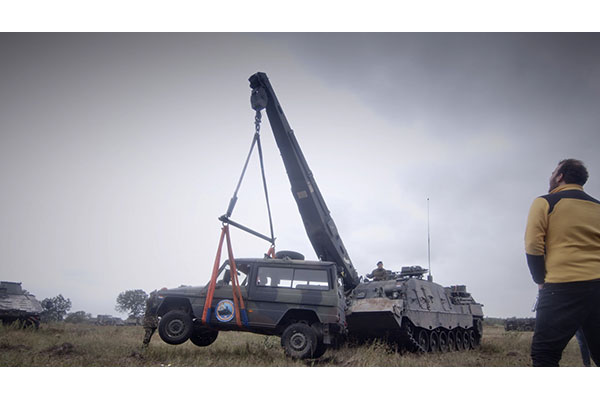
As a warm-up, the 1-kilo link was used to lift a military version of a Mercedes jeep weighing over two tonnes. This was not a problem at all, and the vehicle was easily lifted up. Then, it was time for something bigger.
The 2-kilo solid carbon fiber reinforced nylon link was placed between the M113 armored vehicle and the Buffalo crane. The metal rings were tightened in place, and four cables were attached from the lower hook to the vehicle. The crane slowly started to move up, putting the cables and 3D printed part under tension. Then, the 12-tonne vehicle slowly rose up, hovering above the ground, hanging from a 3D printed link. The Buffalo drove around, backward, forward, turning around, but the link held up perfectly.
The collaboration produced a very successful result.


From the very beginning, our mission has been to accelerate the world’s transition to local manufacturing and digital distribution. Our passion is to deliver a 3D printing system that drives business success across the world. That’s why…

Insider Q&A: 3D Printing End Use Parts
In this Insider Q&A, the experts at Ultimaker explain how 3D printing can be used for spare parts, jigs and fixtures in a production environment.

DE's editors contribute news and new product announcements to Digital Engineering. Press releases may be sent to them via [email protected].
Follow DE
Join over 90,000 engineering professionals who get fresh engineering news as soon as it is published.






About Us · Contact Us · Editorial Team · Advertising · Privacy Policy · Subscriber Services · © 2026 Digital Engineering 24/7 · Peerless Media