Helping design and engineering professionals discover, evaluate and specify technologies and processes that shorten the design cycle and enable success.



April 2026 Special Focus Issue: Generative Design
In this Special Focus Issue, Digital Engineering takes a look at how generative design solutions can be used across different types of design problems and with a variety of manufacturing approaches to accelerate design space exploration, and…

Electrum utilizes the 3DEXPERIENCE platform on the cloud to develop their new electric motorcycle
Electrum, a new brand of electric motorcycles, utilizes the 3DEXPERIENCE platform. Their mission is to support Indonesia’s shift to low-carbon, sustainable transport and to ultimately help the country’s government achieve its vision of net…
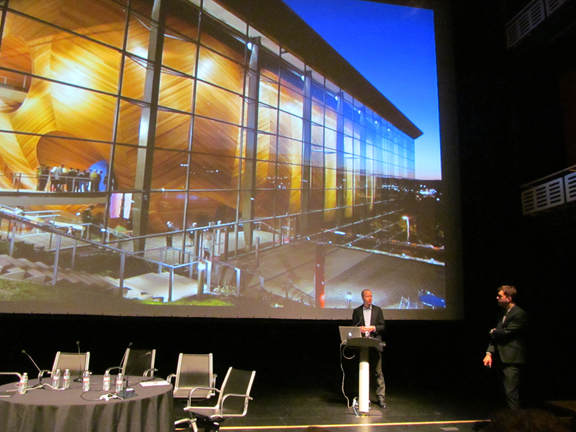
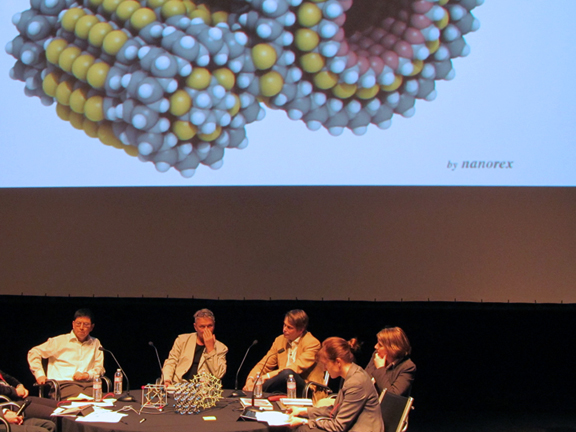
Under normal circumstances, you wouldn't find a cell biologist and a textile specialist talking about how they might work together. Nor would you find a keynote speech on crystallography (the art of atom placement and manipulation) immediately followed by another on building skins. But this was SmartGeometry, an annual conference known for bringing together academics, practitioners, and technology providers from radically different disciplines.
SmartGeometry 2012 (sg2012) came to a close on March 24, following a series of workshops and a public symposium. Each year, the international event moves to a new city. In 2009, San Francisco played host to the event. In 2010 and 2011, it passed through Barcelona and Copenhagen, respectively. This year, it landed in Troy, New York, home of the Rensselaer Polytechnic Institute (RPI).
Between March 19 to 23, several working groups -- known as clusters in sg speak -- set up temporary headquarters inside the RPI’s Experimental Media and Performing Arts Center. With a perfect blend of academics and professionals in each cluster, they set out to explore the year’s theme by combining theory, practice, and prototypes. The focus for 2012 was Material Intensities: Simulation, Energy, and Environment. The clusters investigated, among others, bio-responsive building envelopes, acoustic environments, and fiber-enforced polymer behaviors.
The clusters’ workflow and progress are guided by leaders. But, as sg veteran Shane Burger (Director of Design Technology at Woods Bagot) pointed out, “It’s not a student-teacher relationship; it’s a champion who came up with the idea, and collaborators who made it happen.”
Often, sg participants employ programming; electrical components; parametric modeling software (such as Bentley Systems’ GenerativeComponents and Rhino plug-in Grasshopper); handmade prototypes; and 3D-printed prototypes to test their ideas. On the last day of the event, participants present their experience to a wider audience at a symposium. As previous years, this year’s presentations yielded some nuggets of wisdom.
Striking a cautionary note against over-reliance on digital simulation tools, one participant said, “If you don’t know the answer, you shouldn't be using a tool.” Ironically it was Dru Crawley, Bentley Systems’ director of Building Performance Products, who made the observation.
“The problem of mimicking biology [in material engineering] is scale … Material behaves differently at different scale,” another participant noted. In other words, the bending behavior of bamboo at 4 x 4 ft. scale may not easily be reproduced in a 40 x 40 ft. structure. Another shared his wisdom not in a declaration but by raising a question. “Do we abandon mass-produced materials? Do we create custom materials?”
Annual sg conferences are sponsored and supported by Bentley Systems, 3D Systems, and other technology suppliers. The event usually takes place on the premise of an academic institution. Past hosts included Center for Information Technology and Architecture (Copenhagen), Royal Academy of Fine Arts School of Architecture (Copenhagen), and Institute for Advanced Architecture of Catalonia (Barcelona).
The strength of sg conferences comes from the participants’ commitment to produce, usually in time for the symposium, a scale model or a physical prototype representing the solution they are proposing. This tradition forces clusters to collaboratively troubleshoot, use creative methods (or brute force), and work in a multidisciplinary environment.
The output -- the proud result of the participants' sleep deprivation, frustration, ingenuity, and mastery -- offers a glimpse of the future, where homes are enclosed in bio-responsive walls, rooms can be reconfigured on the fly to muffle or amplify sound, and living quarters can remember occupants' preferred ambiance light and temperature.


Kenneth Wong is Digital Engineering's resident blogger and senior editor. Email him at [email protected] or share your thoughts or suggestions at digitaleng.news/facebook.
Follow DE
Join over 90,000 engineering professionals who get fresh engineering news as soon as it is published.






About Us · Contact Us · Editorial Team · Advertising · Privacy Policy · Subscriber Services · © 2026 Digital Engineering 24/7 · Peerless Media