Helping design and engineering professionals discover, evaluate and specify technologies and processes that shorten the design cycle and enable success.



Digital Engineering April 2026
In the latest issue of Digital Engineering, we take a look at the latest innovations in design for additive manufacturing, including the use of natural language inputs, social media cosplayers, and AI integration. The issue also includes a feature…

January Special Focus Issue: Design for Additive
In this Special Focus Issue of Digital Engineering, learn about the latest advancements in design for additive manufacturing, including new software tools, additive in automotive, custom medical devices, and more.
Voxeljet AG has launched several specialty materials for its High Speed Sintering line of 3D printers, including polypropylene and thermoplastic polyurethane.
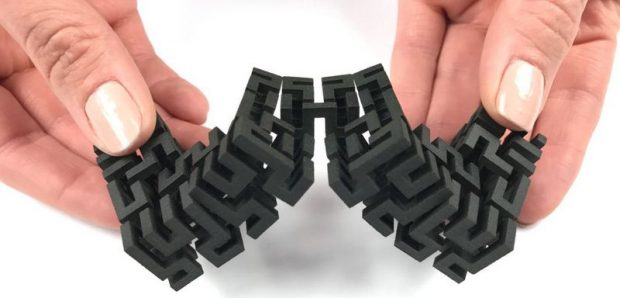 A flexible HSs cube made of polyamide 12. Image courtesy of voxeljet.
“We are really excited about the speed we see in the qualification of new materials for our High Speed Sintering process. In less than nine months we were able to qualify various grades of polyamide powders and are successfully printing several types of thermoplastic polyurethane (TPU),” says voxeljet CEO Dr. Ingo Ederer.
“We are also working on some very customer-specific materials including polypropylene, which is one of the most widely used plastic materials in the world," he adds. "Polypropylene features extremely interesting properties and addresses a broader set of applications. We are successfully printing PP on our smaller VX200 HSS systems and do expect a smooth transition to our larger and automated production system, VJET XHSS, which we anticipate making commercially available at the end of 2019.”
 Image courtesy of voxeljet.
The move to the VJET XHSS platform is expected to enable the company to mass commercialize its technology in target industries that will likely be interested in the new materials.
According to the company, the use of polypropylene in 3D printing could be beneficial in automotive, electronic, industrial and consumer goods applications. Polypropylene provides electrical and chemical resistance at higher temperatures, as well as less stress-cracking and a good impact/stiffness balance.
TPU, on the other hand, allows for the printing of flexible objects with high resolution. It could be used in construction, automotive and footwear applications.
“We believe these technology and material combinations have the potential to change our industries in the long term. voxeljet has always been committed to bring the best innovations to our customers at every level and we are doing so in a powerful way,” Ederer says.
Source: Voxeljet


Brian Albright is the editorial director of Digital Engineering.
Contact him at [email protected].

Join over 90,000 engineering professionals who get fresh engineering news as soon as it is published.






About Us · Contact Us · Editorial Team · Advertising · Privacy Policy · Subscriber Services · © 2026 Digital Engineering 24/7 · Peerless Media