Helping design and engineering professionals discover, evaluate and specify technologies and processes that shorten the design cycle and enable success.


Sponsored
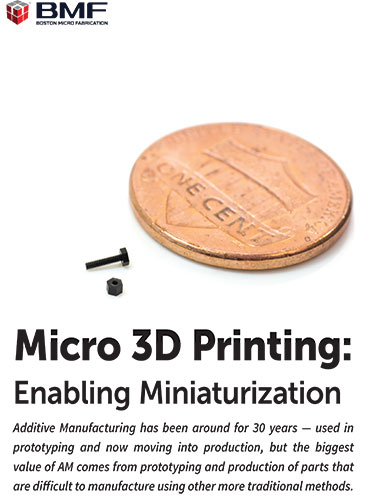
As all the noise settles concerning the benefits and drawbacks of additive manufacturing, what becomes most clear is that when fabricated parts are easy to make using standard machining methods, additive manufacturing becomes less and less necessary as a tool. Yet, when that is not the case, additive manufacturing becomes a very beneficial tool.
Additive manufacturing is an important and valuable solution when customers need to produce parts that are difficult to fabricate using standard machining methods, such as parts that include complex design features like internal cavities and geometries that cannot be machined in, and structural elements that make other machining processes too cumbersome or difficult to complete effectively.
It is a common understanding that nothing is more difficult to produce — for prototypes or production parts — than when miniaturization is critical.
Because miniaturization is a continual trend in most industries, especially medical devices, electronics connectors, and micro-electromechanical systems (MEMS), providing a way to use additive manufacturing becomes an important alternative to other production methods. In fact, the smaller the part that needs to be produced, the more valuable it is to have a machine that can manufacture those parts quickly and accurately.

Boston Micro Fabrication is the world leader in micro-precision 3D printers utilizing Projection Micro Stereolithography (PµSL) technology. Many leading companies worldwide are adopting PµSL to 3D print true microstructures with ultra-high…

Ultra-high Accuracy, Precision, and Resolution Micro 3D Printed Medical Device Manufacturing
Discover how the use of micro-precision 3D printing is aiding medical device producers to tackle two common issues through this white paper.




About Us · Contact Us · Editorial Team · Advertising · Privacy Policy · Subscriber Services · © 2026 Digital Engineering 24/7 · Peerless Media