Helping design and engineering professionals discover, evaluate and specify technologies and processes that shorten the design cycle and enable success.



Digital Engineering April 2026
In the latest issue of Digital Engineering, we take a look at the latest innovations in design for additive manufacturing, including the use of natural language inputs, social media cosplayers, and AI integration. The issue also includes a feature…

January Special Focus Issue: Design for Additive
In this Special Focus Issue of Digital Engineering, learn about the latest advancements in design for additive manufacturing, including new software tools, additive in automotive, custom medical devices, and more.
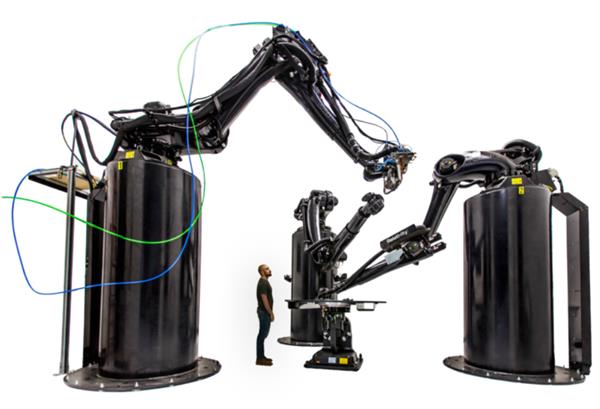
Relativity Space (founded by some Blue Origin and SpaceX veterans) has designed its own massive 3D printers that use robotic arms to create fuel tanks and other components. The company claims that by eliminating human labor from the process, it could bring the cost of a launch down from $100 million to just $10 million.
“This is the right direction,” said CEO Tim Ellis in an interview with Bloomberg. “The 3D printing and automation of rockets is inevitable.”
The company’s 3D printer (dubbed Stargate) can print a fuel tank in a few days and a rocket engine in less than two weeks.
The printer that Relativity has designed includes 18-ft.-tall robotic arms with lasers that melt aluminum wire. They can conceivably print an entire rocket body as a single piece. They have already printed a 7x14-ft. fuel tank as well as an engine.
“We believe autonomous manufacturing … really gets us to that point where we save a lot of money,” Ellis said.
The company is also developing custom alloys for its rocket components, and hopes to greatly consolidate the number of parts on a typical rocket. “The space shuttle had 2.5 million moving parts,” Ellis said. “We think SpaceX and Blue Origin have gotten that do
wn to maybe 100,000 moving parts per rocket. We want to get to 1,000 moving parts, fewer than a car.”
Relativity plans to print a 90-ft. rocket with a 2,000-lbs. payload capacity by the middle of 2020. A prototype launch could happen as early as 2021.
Source: Bloomberg


Brian Albright is the editorial director of Digital Engineering.
Contact him at [email protected].

Join over 90,000 engineering professionals who get fresh engineering news as soon as it is published.






About Us · Contact Us · Editorial Team · Advertising · Privacy Policy · Subscriber Services · © 2026 Digital Engineering 24/7 · Peerless Media