Helping design and engineering professionals discover, evaluate and specify technologies and processes that shorten the design cycle and enable success.



Digital Engineering April 2026
In the latest issue of Digital Engineering, we take a look at the latest innovations in design for additive manufacturing, including the use of natural language inputs, social media cosplayers, and AI integration. The issue also includes a feature…

January Special Focus Issue: Design for Additive
In this Special Focus Issue of Digital Engineering, learn about the latest advancements in design for additive manufacturing, including new software tools, additive in automotive, custom medical devices, and more.
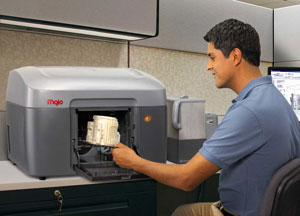 Stratasys’ Mojo 3D printer. |
Just as the market for consumer and hobbyist 3D printers is heating up, prices of professional-level 3D printers are coming down. Granted, there is a big difference between $500 and $10,000, but pros need to consider more than just the sticker price before purchasing a 3D printer.
To produce 3D printers more affordably, hobbyist 3D printers have to make sacrifices. That might mean you have to assemble the 3D printer, fine tune it before getting acceptable output, use difficult software, wait longer for parts to be printed, and cut, sand and file away support structures to get the final output you want. Those trade-offs may be perfectly acceptable if you are 3D printing as a hobby, but they don’t cut it for most professionals.
“A business-class system is meant to be run hour in and hour out, and is expected to have a long lifecycle,” says Todd Grimm, president of T. A. Grimm & Associates, a rapid prototyping consultation firm. “If you get into business-class technology, whatever you throw at it you should expect to get good output from it. The capabilities in consumer class systems are not quite there.”
Breaking Price Barriers
Grimm was speaking at the unveiling of Mojo, Stratasys’ new professional grade 3D-printing system. When purchased as part of a print pack that includes everything you need to get up and running -- the printer, material, support material, and support-removal system -- Mojo sells for $9,900. That’s about $1,000 less than 3D Systems’ ProJet 1000. Stratasys calls Mojo the lowest-priced professional-grade 3D-printing system on the market, but their definition might be different than Asiga’s, a relative newcomer that offers its Freeform Pico 3D printer starting at $6,990. The diminutive Pico has an 8.6-in. footprint and a small envelope (1.57x1.18x2.95 in.) suited to jewelry or small medical parts. By contrast, Mojo has a build size of 5x5x5 in. and the Projet 1000 has a build size of 6.75x8x7 in.
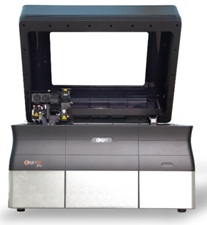 The Objet30 Pro. |
Beyond the $10,000 mark, users can find more options, such as color 3D printing in the Stratasys uPrint SE Plus, and 3D Systems’ ProJet 1500 and ZPrinter 150. Prices for each are around $15,000. Blueprinter, a Denmark-based manufacturer, plans to begin competing at this price point as well with its Selective Heat Sintering system that should be available later this year.
Moving up from there is Objet’s Objet24 at $19,900, and Objet30, which can build with five different materials, for $30,000. The company also just announced its Objet30 Pro, which can print with seven materials, including high-temperature and clear options, for $43,000.
“There are lots of designers and others dying to jump into 3D printing, but products like the Makerbot are not going to meet their needs, and they don’t want to spend $150,000, so they’ve been sitting on the sidelines,” says Objet’s Bruce Bradshaw.
Choices, Choices
Beyond what many would consider “low-cost” are larger build sizes, faster speeds, additional material options and different additive manufacturing technologies. However, even engineers on a budget can get a taste of higher-end systems by using a service provider, such as 3D Systems’ QuickParts or 3Dproparts, Stratasys’ RedEye On Demand, or Solid Concepts’ ZoomRP.com.
There is no shortage of options when it comes to 3D printing and additive manufacturing. When deciding where to invest, begin with outlining your needs. What’s most important to you? Cost, speed, accuracy, build size, color, ease of use, materials? The answer may lead you to a combination of technologies and service providers that can best fit your needs.
Jamie Gooch is Managing Editor of Desktop Engineering. Send e-mail about this article to [email protected].
MORE INFO


Jamie Gooch is the former editorial director of Digital Engineering.
Follow DE
Join over 90,000 engineering professionals who get fresh engineering news as soon as it is published.






About Us · Contact Us · Editorial Team · Advertising · Privacy Policy · Subscriber Services · © 2026 Digital Engineering 24/7 · Peerless Media