Helping design and engineering professionals discover, evaluate and specify technologies and processes that shorten the design cycle and enable success.



Digital Engineering April 2026
In the latest issue of Digital Engineering, we take a look at the latest innovations in design for additive manufacturing, including the use of natural language inputs, social media cosplayers, and AI integration. The issue also includes a feature…

January Special Focus Issue: Design for Additive
In this Special Focus Issue of Digital Engineering, learn about the latest advancements in design for additive manufacturing, including new software tools, additive in automotive, custom medical devices, and more.
The company says that the new printer’s enhanced safety, accessibility, and efficiency will significantly improve customers’ bottom lines. These benefits, it believes, will help sweep away market reticence and facilitate applications that have long been considered sweet spots for AM technology.
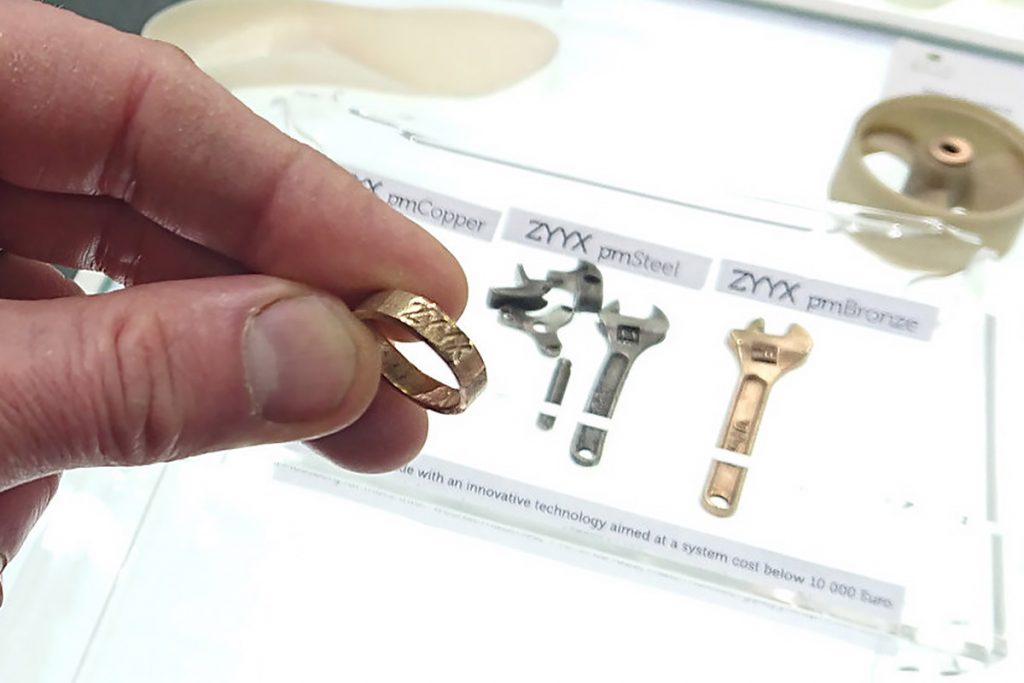 Magicfirm Europe’s ZYYX metal printer combines metal powder with a binder, making it safe to handle and use without any special measures, opening the door for the system to be used in design and development work environments. These improvements, along with a significantly reduced price, could bring 3D printing within reach of more businesses.
Raising hopes for change, the advent of 3D printing promised to sweep aside all these problems, enabling suppliers to make parts on-demand locally — close to where the parts are needed — and revolutionizing product design in the process. Unfortunately, achieving this vision has proven to be elusive.
The fact is most professional organizations are aware of 3D printing as a prototyping tool and a means of producing parts, but few have fully embraced the technology. Why the reluctance? Most 3D printers are too expensive, too complex to operate, and cannot be deployed close to development and production teams because of safety and health risks.
This is where Magicfirm plans to make a difference, starting with a low price tag and then bringing down the total cost of ownership by making improvements in key areas like accessibility, safety, and simplicity. “In this application, the printing cost in itself is normally not the major expense, but instead, the overhead time in getting access to the printer and the complexity of using the printer will be the highest cost,” says Mats Moosberg, CEO of Magicfirm Europe. “The material cost for printing with our technology will be comparable with the current FDM-based [Fused Deposition Modeling] metal printing solutions, but the ease of use and accessibility will be much higher than the currently available competing solutions and therefore greatly reduce our customers costs in their product development processes.”
“Compared to other metal printing solutions, we have found a way to eliminate the need for any toxic substances in the processing steps leading up to getting the solid metal object,” says Moosberg. “We only use metal powder contained in a binder, which does not emit any metal particles or toxic fumes, providing a huge safety gain.”
Basically, the ZYYX metal printer works in three stages. In the first stage, the printer builds up the object — the so-called “green body” — which consists of loosely bound metal powder. Here, an FDM-like process can create high-resolution (about 50 micrometers) geometries that can contain voids and lattice structures.
Next, the system removes the binder to create the “brown body,” which essentially consists of a fragile metal powder object that contains small metal particles located close enough together that they can be sintered into solid metal. In this stage, the system uses nontoxic substances to remove the binder.
In the final stage, the system sinters the brown body, forming a solid metal part. The company says that it has implemented several techniques that simplify this part of the printing process compared with other systems, but it has not provided any details about these improvements.
Magicfirm states that objects created using this method will have “comparable resolution and mechanical properties” to results from existing filament-based solutions, even though the technology is different. The ZYYX metal printer currently sees “a sintering level of more than 98%, and experiences shrinkage of about 21%."
Currently, the ZYYX metal printer works with copper, bronze, brass, and steel. Magicfirm says that it will expand the system’s metals portfolio as the technology progresses.
The company expects the three-step binder-based metal 3D printing system will become available as early as 2019.


Tom Kevan is a freelance writer/editor specializing in engineering and communications technology. Contact him via [email protected].
Follow DE
Join over 90,000 engineering professionals who get fresh engineering news as soon as it is published.






About Us · Contact Us · Editorial Team · Advertising · Privacy Policy · Subscriber Services · © 2026 Digital Engineering 24/7 · Peerless Media