Helping design and engineering professionals discover, evaluate and specify technologies and processes that shorten the design cycle and enable success.



May 2026 Special Focus: Artificial Intelligence in Design and Simulation
In this Special Focus Issue, learn about the latest developments in the integration of artificial intelligence into engineering workflows.

Design & Simulation Software Guide 2025
In this Special Issue, Digital Engineering presents its second annual guide to design and simulation software vendors.
Think of the size of a hair follicle, with a diameter between 40 and 100 micrometers. That is usually the largest channel width involved in microfluidic devices, which are used to deliver or analyze tiny amounts of fluid. Microfluidic devices range from diagnostic and analysis tools to lab-on-a-chip (LOC) systems, such as: COVID-19 test kits, pregnancy test kits, glucose monitoring systems, and cell sampling systems.
“Strictly speaking, microfluidic means that the characteristic width of your channel ranges between 10 and hundreds of microns,” says Marc Horner, distinguished engineer, Ansys. However, he noted he has also seen the term loosely applied to devices with millimeter-scale channels.
Mranal Jain, senior applications engineer at COMSOL, adds, “Computational fluid dynamics (CFD) plays a vital role in advancing microfluidic technologies by enabling detailed multiphysics analysis of fluid flow, heat transfer, and mass transport at the microscale.”
At a scale easily observable by human eyes, the laws of continuum mechanics hold true: solid objects and fluids can be treated as continuous bodies. In other words, you can ignore the presence of the atoms that make up each object. This allows you to calculate mass, momentum, and displacement using time-tested formulas. Even at microscale, materials still follow these same rules.
“This is the realm we work in. So standard fluid physics still apply, and so does our simulation technology. This law doesn’t break down until you get below the 100-nanometer scale. At that level, you’re dealing with molecules instead of clusters of molecules, so our standard formulas for things like viscosity start to lose their accuracy,” says Horner. Ansys offers Ansys Fluent and Ansys CFX, both CFD software packages for analyzing flows.
DNA analyzers are one example of a system that uses microfluidic processes. At one point, they trigger a polymerase chain reaction that makes many, many copies of specific DNA sequences. This is done by temporarily raising the temperature to body temperature to activate the enzyme that copies the DNA of interest. The sample moves on for further processing after the DNA copies have been made.
“So you need to make sure there’s no leakage of heat,” notes Horner. This could prove challenging because “under the hood, these devices have a lot of heat sources, like chips and power sources for fans.”
Horner also notes that there are times when CFD by itself may not be able to accurately model the physics occurring in a microfluidic system. For example, in cell sorters or other systems that handle particles, he notes, “You may have a red blood cell, which is about 8 microns in diameter, traveling through a channel with a 50-micron diameter. In that case, the large size of the particle relative to the channel width causes disruptions to the flow patterns in the region of the particle, so you may need to use discrete-element methods to model the particle’s interaction with the fluid and vice versa.” For this scenario, Ansys offers Ansys Rocky, a package for multiphysics particle dynamics simulation.
In the realm of LOC, fluid physics collides with thermal physics. LOC systems are generally microchips designed with integrated laboratory functions.
“They exploit multiphysics phenomena—such as electrokinetics, electrothermal flows, dielectrophoresis (DEP), and acoustophoresis—for flow control, mixing, reactions, and bioparticle manipulation. Conducting CFD on such microfluidic devices therefore requires integrated modeling of electromagnetics, acoustics, fluid flow, and heat and mass transfer,” says Jain.
To model dielectrophoresis (DEP), where a force is exerted on a polarized particle when placed in a non-uniform electric field, engineers may use multiphysics simulation, specifically, to model the electromagnetics and fluid flow coupled with particle tracing.
“Designers can explore various electrode arrangements and operating frequencies to analyze the electric field distribution and forces on the particle. The insight gained from this multiphysics analysis can then be used to maximize the separation efficiency and selectivity,” says Jain.
Veryst Engineering provides multiphysics simulations and failure analysis, using COMSOL, Ansys, Abaqus, MATLAB, and Mathematica in the workflow. For medical device manufacturers, it provides simulation services to support product development from the drawing board to the market. Veryst also develops custom test methods to understand product variability and failure and recommends solutions to improve product performance. Public examples of Veryst’s work in microfluidic device development include the design of artificial liver devices, microfluidic heat exchangers, and microphysiological systems.
Microscale CFD is governed by the same equations as those at the macroscale: the Navier-Stokes equations, which represent the conservation of mass and momentum in fluid dynamics. The microscale flow regime is primarily laminar and viscous.
“However, due to the small scale, surface forces and geometry matter a lot more,” notes Matthew Hancock, principal at Veryst Engineering. In microfluidic device analysis, engineers are often studying phenomena such as bubbles, leakage, insufficient mixing, unwanted mixing, surface tension-driven flows, and delamination, he adds.
Similarly, Jain also says, “At these dimensions, surface-related phenomena, such as surface tension and surface charge, play a much larger role than volumetric forces. For instance, many microfluidic devices rely on capillary action, electroosmotic flows, or other nontraditional mechanisms to drive fluid flow.”
Joseph Barakat, lead engineer at Veryst Engineering, notes, “One key thing to keep in mind is, at the microscale, turbulent boundary layers are entirely absent. At the macroscale, these boundary layers are critical to capturing skin friction drag, heat transfer rates, and other surface properties in turbulent flows. At the microscale, you have near-parabolic viscous flow, and the emergence of new physics and new boundary layers: for example, concentration depletion layers and electrical double layers.”
The good news is, many aspects of the flow behavior in microfluidic devices can be represented by simple one-dimensional models.
“If you’re not concerned with the 3D nature of the flow, you may be able to express the flow by a 1D model, which can give you a good view of system-level performance,” says Hancock. “Maybe you need to model the mixer in 3D, but the liquid flow in connecting channels is simple, so you don’t need 3D.”
Tools like COMSOL’s Pipe Flow Module and MATLAB’s Simscape Fluids package are developed for solving these 1D “flow-circuit” models.
“When you reduce the dimension of the flow channel, some types of physics get suppressed, while other types of physics become much more important,” says Barakat. For example, Taylor dispersion occurs when a solute is sheared along the length of a macrochannel, but this phenomenon is mostly suppressed in shorter microchannels.
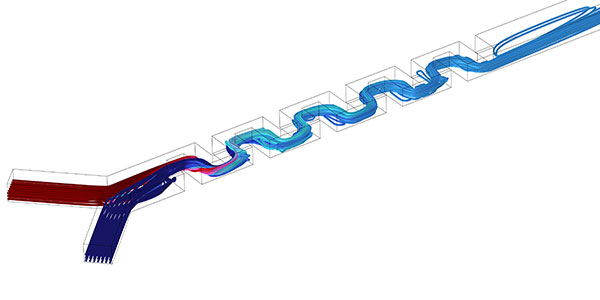
On the other hand, small voltages applied at embedded electrodes can drive electroosmotic flows in microchannels, something that cannot be easily done at the macroscale. Also, mixing is much more challenging at the microscale, because you don’t have the benefit of turbulent eddies. Instead, you have to employ complex geometric elements, like bends, baffles, and grooves, to induce chaotic mixing in microfluidic devices.”
“At the microscale, your choice of mesh resolution is very important,” Hancock says. “When simulating chemical transport and diffusion, sharp concentration gradients may exist that require a fine computational mesh to resolve properly. When simulating mixing, if your mesh is too coarse, it might seem like the solutions are mixing really well, but it’s the result of your CFD settings, not the underlying physics.”

Engineering simulation is our sole focus. For more than 45 years, we have consistently advanced this technology to meet evolving customer needs.ANSYS develops, markets and supports engineering simulation software used to predict how product…

Study on HPC and Cloud Computing for Engineering Simulation
This new research report explores how companies are using HPC and simulation on the cloud.

Kenneth Wong is Digital Engineering's resident blogger and senior editor. Email him at [email protected] or share your thoughts or suggestions at digitaleng.news/facebook.
Follow DE
Join over 90,000 engineering professionals who get fresh engineering news as soon as it is published.






About Us · Contact Us · Editorial Team · Advertising · Privacy Policy · Subscriber Services · © 2026 Digital Engineering 24/7 · Peerless Media