Helping design and engineering professionals discover, evaluate and specify technologies and processes that shorten the design cycle and enable success.



Design & Simulation Software Guide 2025
In this Special Issue, Digital Engineering presents its second annual guide to design and simulation software vendors.

Special Focus Issue: Artificial Intelligence in Simulation
In this Special Focus Issue of Digital Engineering, we look at the latest trends in integrating AI and machine learning with design and simulation tools. The issue includes features on synthetic data, open-source AI for modeling, AI-powered…
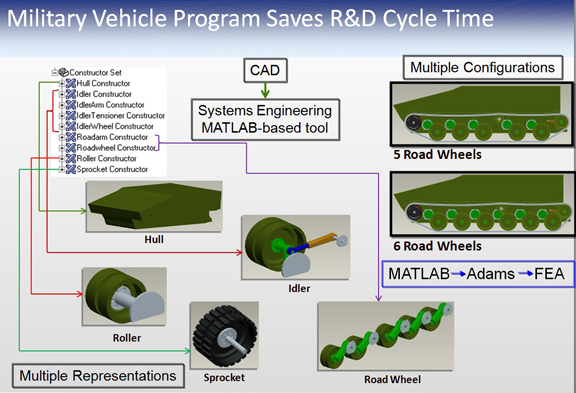
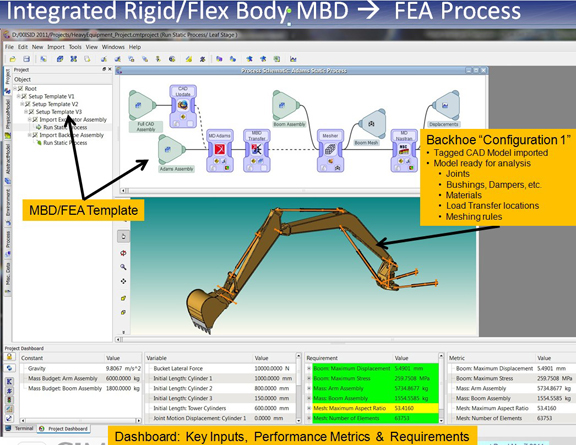
If enabling common people across the Middle East to rally themselves with social media and technology is the source of the recent Arab Spring that has toppled several long-established authoritarian regimes (with more teetering on the edge), then a template-driven approach that makes simulation more accessible to the common folks may be the way to democratize a practice once reserved for the specialists.
In CIMdata’s recent paper titled “The Democratization of Simulation with Intelligent Templates,” the authors argued, “The core enabler for intelligent templates is the idea of an ‘abstract model.’ This functional model of the product and of the associated simulations remains independent of a particular instance of a product design, and independent of the physics or fidelity of a particular performance simulation.” The key to this proposition is, the authors pointed out, “Experts must create the templates, but non-experts can use them reliably.”
Even though simulation is widely practiced among large enterprises, the authors noted, “The promise of simulation-driven design has not been achieved … Today that solutions represents a complex environment requiring a major investment.” To unlock simulation for a wider audience, the paper recommended “[getting] away from single point tools that solve individual problems … [and] moving away from working directly with geometry.”
The expert-created template will ultimately simplify a simulation scenario into a series of inputs non-experts can supply. These input parameters may be “system-level description, CAD-level description, or an optics description,” the paper suggested. “The simulation environment is set up to run the process quickly as the geometry changes … It can keep changing as engineers learn more about the behavior of the product”
CIMdata paper concluded that the template-driven approach is best-suited to “capture and reuse best practices in an executable form.” The paper is written by CIMdata’s Design and Simulation Council. It’s based on a keynote presentation by Malcolm Panthaki, Comet Solutions, at CIMdata’s PLM Road Map 2011 conference. The paper also discussed the role of direct editing tools like SpaceClaim in the simulation workflow. (For more on this topic, read "Direct Modelers as FEA Pre-Processors" in April issue of DE.)


Kenneth Wong is Digital Engineering's resident blogger and senior editor. Email him at [email protected] or share your thoughts or suggestions at digitaleng.news/facebook.
Follow DE
Join over 90,000 engineering professionals who get fresh engineering news as soon as it is published.






About Us · Contact Us · Editorial Team · Advertising · Privacy Policy · Subscriber Services · © 2026 Digital Engineering 24/7 · Peerless Media