Helping design and engineering professionals discover, evaluate and specify technologies and processes that shorten the design cycle and enable success.


Sponsored
 Dear Desktop Engineering Reader:
The Internet of Things (IoT) is shorthand for saying that design engineering is in a new era. That means everything you design, architect and make will be interconnected, controlled and managed in new ways with new technologies. So ask yourself: Can your PLM (product lifecycle management) system adapt to the data loads, product complexities and the sweeping technological changes unleashed by the IoT? Is your data locked into proprietary formats, workflows and functionalities for last generation’s products rather than tomorrow’s connected products? Those are just some of the considerations in today’s Check it Out offering.
Disclaimer: In partnership with Aras Corp., Desktop Engineering produced “Making the Case for Resilient PLM.” This writer had no role in its development.
“Making the Case for Resilient PLM” argues that traditional PLM systems are not architected to evolve and meet the increasing complexity of modern product design. Nor are they engineered to scale gracefully to the future and unforeseen stresses inherent in digital and physical convergence. The paper suggests resilient PLM is the solution.
Broadly, resilient PLM’s architecture can handle modern workflows and quickly adapt for future demands and technological advancements, even ones not dreamed of today. It’s PLM designed to scale with your infrastructure and upgrade with minimal hassles for users and IT. Resilient PLM supports open standards and unlocking your data from proprietary formats.
This paper probes the details of how resilient PLM differs from traditional PLM and the potential benefits for engineering organizations. To make its case, the paper employs three main sections, numerous infographics and two sidebars.
The first section offers an overview of the disruptive changes in product design workflows now underway. It introduces the Aras Innovator PLM platform and explains some of its key architectural components that make resilient PLM possible.
The nine-page paper’s second part provides a handful of quick case studies. Issues of note here are replacing a legacy PLM setup, improving the performance of an R&D process and optimizing quality, time and cost across a product portfolio.
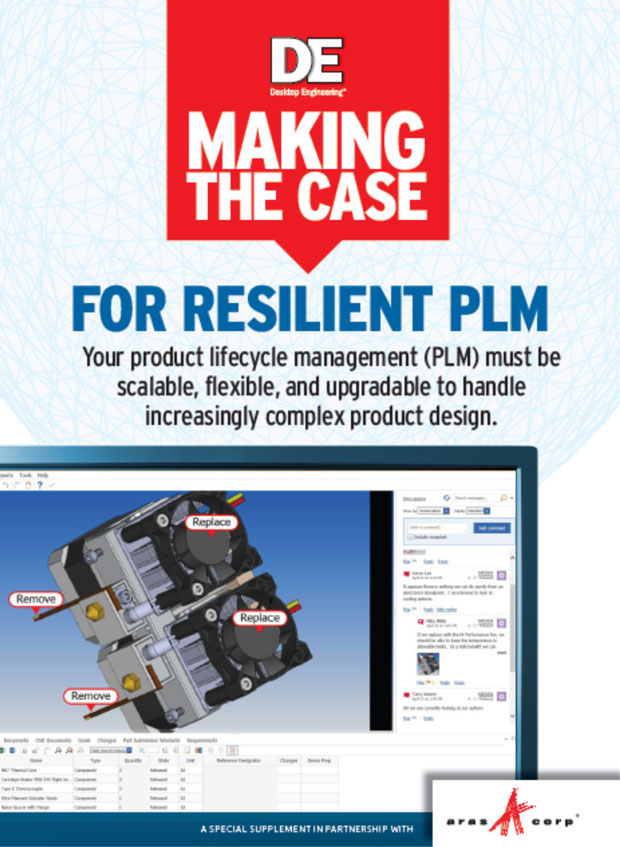 The Internet of Things presses traditional PLM (product lifecycle management) software in ways never imaginable just a few years ago. The “Making the Case for Resilient PLM” paper reasons that a robust PLM system architected for adaptability, scalability and flexibility enables engineering organizations to keep pace with the stresses of changing technologies, design workflows and competitive positions.
The final section maps the Aras Innovator architecture to address such concerns as adaptability and scalability. It also delves into customization, upgradability and economic considerations.
Ultimately, this paper is about natural selection embodied in that old business adage: Adapt or die. “Making the Case for Resilient PLM” is a strong, engaging and timely paper. Click today’s Check it Out link and download your complimentary copy now.
Thanks, Pal. – Lockwood
Anthony J. Lockwood
Editor at Large, Desktop Engineering


Anthony J. Lockwood is Digital Engineering's founding editor. He is now retired. Contact him via [email protected].
Follow DE
Join over 90,000 engineering professionals who get fresh engineering news as soon as it is published.






About Us · Contact Us · Editorial Team · Advertising · Privacy Policy · Subscriber Services · © 2026 Digital Engineering 24/7 · Peerless Media