Helping design and engineering professionals discover, evaluate and specify technologies and processes that shorten the design cycle and enable success.



Digital Engineering April 2026
In the latest issue of Digital Engineering, we take a look at the latest innovations in design for additive manufacturing, including the use of natural language inputs, social media cosplayers, and AI integration. The issue also includes a feature…

January Special Focus Issue: Design for Additive
In this Special Focus Issue of Digital Engineering, learn about the latest advancements in design for additive manufacturing, including new software tools, additive in automotive, custom medical devices, and more.
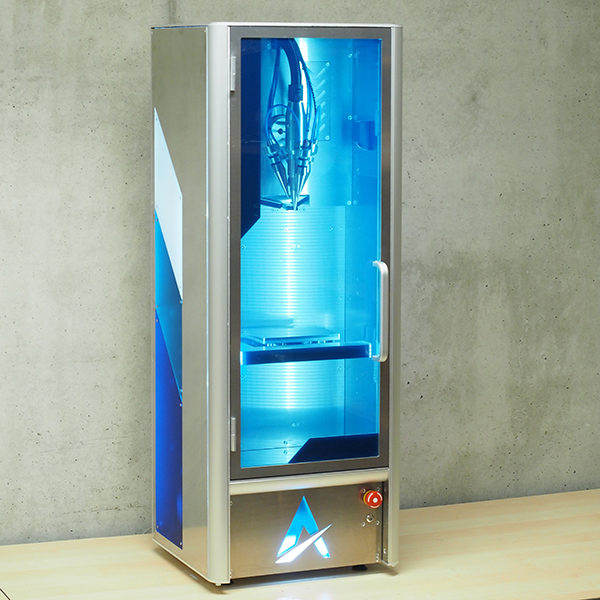
Additec advances directed energy deposition 3D printing with the μPrinter, a desktop machine capable of producing complex metallic components from both, wire and powder feedstock using Additec´s unique LMD-WP (Laser Metal Deposition-Wire Powder) process. The ability to produce parts from wire feedstock makes operation and material handling very clean, as well as ensuring material efficiency, the company reports.
Switching between wire and powder is reportedly fast, does not require a nozzle change and can be done automatically on the same part, the company adds. The process works by having multiple high-power diode laser sources arranged around the central axis of the deposition head. Wire is fed through a central wire guide, while powder is fed through an annular gap nozzle around the wire guide.
Because wire based coaxial deposition is not as common as powder LMD, Additec developed its own process control structure, that not only adjusts the processing parameters on the fly, but also measures the height of the individual layers, and adjusts nozzle to part distance automatically. Further, to grant users maximum flexibility, as all process parameters can be set in g-code. To easily change parameters for certain sections of a build, a macro utility is provided. The printer can be controlled either via a locally hosted web interface, or through USB.
Despite the compact outer dimensions, the print envelope is 120x160x450mm (XYZ) . The build chamber is fully inert, and the small volume makes filling quick, affordable and safe. In addition to additive manufacturing, it is also suitable for Cladding and Repair work on small components.
The μPrinter is based on Additec’s patented LMD-WP process. To lower the barrier of entry, Additec now offers complete systems, starting with the μPrinter.
Sources: Press materials received from the company and additional information gleaned from the company’s website.


DE's editors contribute news and new product announcements to Digital Engineering. Press releases may be sent to them via [email protected].
Follow DE
Join over 90,000 engineering professionals who get fresh engineering news as soon as it is published.






About Us · Contact Us · Editorial Team · Advertising · Privacy Policy · Subscriber Services · © 2026 Digital Engineering 24/7 · Peerless Media