Helping design and engineering professionals discover, evaluate and specify technologies and processes that shorten the design cycle and enable success.


Alert!
Digital Engineering ceased publication on July 1, 2026. This website remains available as an archive of engineering content.
For inquiries or information, please email [email protected].

Digital Engineering April 2026
In the latest issue of Digital Engineering, we take a look at the latest innovations in design for additive manufacturing, including the use of natural language inputs, social media cosplayers, and AI integration. The issue also includes a feature…

January Special Focus Issue: Design for Additive
In this Special Focus Issue of Digital Engineering, learn about the latest advancements in design for additive manufacturing, including new software tools, additive in automotive, custom medical devices, and more.
The U.S. Navy has successfully used ADDiTEC’s liquid metal jetting (LMJ) technology to produce functional parts on a ported ship. LMJ technology is made for high-strength aluminum alloys such as Al-6061, according to ADDiTEC.
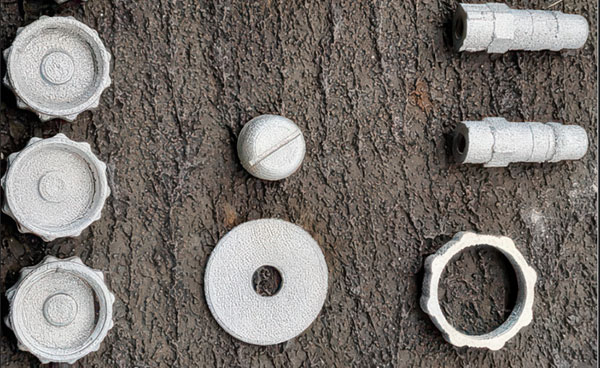
Navy sailors printed essential parts using a containerized ElemX 3D printer on the USS San Diego at port in San Diego, according to ADDiTEC. The printed parts were evaluated for quality and performance, with results indicating that the components were acceptable and fully functional for intended applications.
“We are thrilled with the performance of the ElemX 3D printer,” says Garth Hobson, director of the Consortium for Advanced Manufacturing, Research and Education, at the Naval Postgraduate School in Monterey, CA. “The ease of use and the quality of the printed parts exceeded our expectations. This technology represents a significant enhancement in our ability to maintain and repair equipment while at sea.”
LMJ technology uses molten metal droplets to create additive parts. According to ADDiTEC, the process exploits the properties of liquid metals to create high-resolution parts without the post-processing used in powder-based metal 3D printing. The technology uses a custom software suite and monitoring system to deposit molten metal droplets in patterns, making it compatible with standard materials, such as Al-4008 and AL-6061.
“We have worked tirelessly to ensure that our 3D printing technologies meets the specific needs of maritime operations, and we are working to continuously enhance their reliability and efficiency, ensuring they are fully mission-ready for any operational demands.” says Brian Mathews, ADDiTEC’s CEO. “Seeing our efforts come to fruition with the successful printing of functional parts at sea is incredibly rewarding. We remain dedicated to our ongoing collaboration with the Navy, focusing on advancing LMJ technology within our innovative new Hybrid Series, which seamlessly integrates both additive and subtractive manufacturing capabilities into a single machine.”
Sources: Press materials received from the company and additional information gleaned from the company’s website.


DE's editors contribute news and new product announcements to Digital Engineering. Press releases may be sent to them via [email protected].
Follow DE






About Us · Contact Us · Editorial Team · Advertising · Privacy Policy · Subscriber Services · © 2026 Digital Engineering 24/7 · Peerless Media