Helping design and engineering professionals discover, evaluate and specify technologies and processes that shorten the design cycle and enable success.



May 2026 Special Focus: Artificial Intelligence in Design and Simulation
In this Special Focus Issue, learn about the latest developments in the integration of artificial intelligence into engineering workflows.

Design & Simulation Software Guide 2025
In this Special Issue, Digital Engineering presents its second annual guide to design and simulation software vendors.
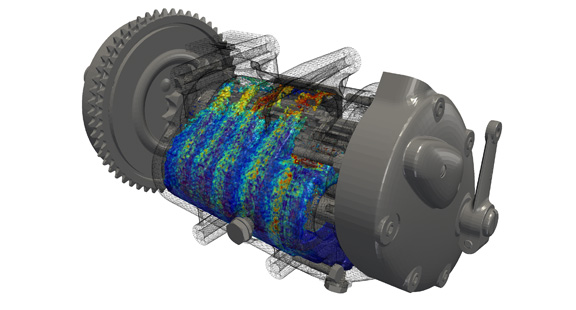
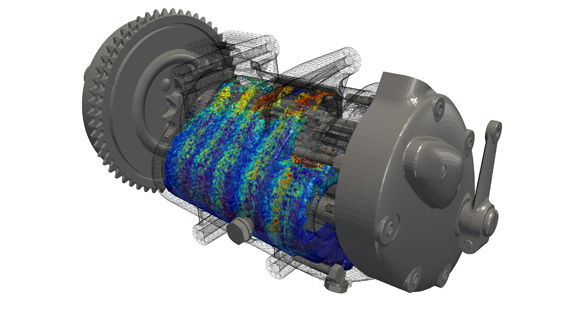 Altair acquires FluiDyna, Germany-based CFD software developer (image courtesy of Altair).
This week, when the U.S. simulation software maker Altair acquired Germany-based FluiDyna, Altair gained a GPU-accelerated flow simulation technology.
The two flagship products from FluiDyna -- ultraFluidX and nanoFluidX -- are developed in NVIDIA's CUDA programming framework. As such, they can take advantage of the GPU's processing cores to run CFD jobs faster.
James Scapa, Founder, Chairman, and CEO at Altair said, “We are excited about FluiDyna and especially their work with NVIDIA technology for CFD applications. We believe the increased throughput and lower cost of GPU solutions is going to allow for a significant increase in simulations which can be used to further impact the design process.”
The acquisition follows a three-year partnership that began in 2014, which gives Altair HyperWorks customers access to Fluidyna's software applications.
CFD, considered highly compute-intensive, is reported to benefit from the parallel processing power of the GPU. "Several ongoing projects on Navier-Stokes models and Lattice Boltzman methods have shown very large speedups using CUDA-enabled GPUs," GPU market leader NVIDIA writes.
In acquiring FluiDyna, Altair has acquired precisely a technology based on the Lattice Boltzman methods referenced in NVIDIA's benchmark tests.
"All our software packages are leveraging the power of NVIDIA GPUs to massively accelerate your workflow thus saving time and money," FluiDyna writes. "Based on the Lattice Boltzmann Method and optimized for GPU technology, simulations can be performed [in FluiDyna's ultraFluidX] within just a few hours on a single workstation."
Altair already has a CFD offering in its own portfolio. Seven years earlier, in 2011, Altair bought ACUSIM, netting the CFD software AcuSolve in the process. AcuSolve supports GPU acceleration on NVIDIA's TESLA GPU lines, targeting the high-performance computing (HPC) market.
Altair promotes AcuSolve as a complementary package to the FluiDyna products.
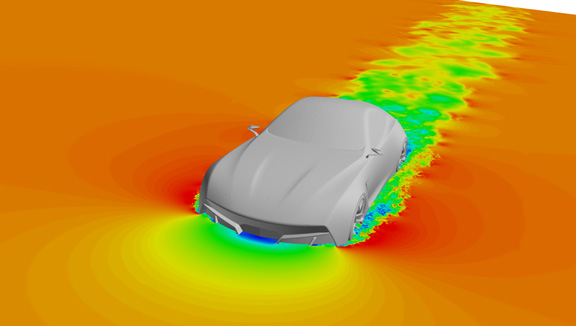 FluiDyna's products are designed to accelerate on the GPU (image courtesy of Altair).
Simulation software developers' interest in the GPU began with GPU maker NVIDIA's initiatives to transform what was once a graphics boosting hardware into a general-purpose computing platform. Whereas geometry-sculpting CAD programs involve mostly serial operations (which must be computed one after another), many modern simulation programs are written to speed up with parallel processing (where many computing operations can occur simultaneously). Simulation programs' use of the GPU's processing cores gets easier with the introduction of CUDA, a GPU programing environment from NVIDIA.
ANSYS Discovery Live (ADL), launched this February, is another example of GPU-accelerated simulation. As a program targeting the designers, it increases its appeal with the speed with which it executes its jobs. A large part of the speed comes from GPU acceleration.
“We wrote [ADL] solvers from the ground up on GPU’s. Where others might augment compute power on GPUs, we did it natively, embracing its massively parallel nature. Modern PCs have 1000s of cores on their GPUs, vs. a handful of CPU cores. In the process, we had to invent new numerical and computational algorithms,” said Mark Hindsbo, VP and GM of ANSYS.


Kenneth Wong is Digital Engineering's resident blogger and senior editor. Email him at [email protected] or share your thoughts or suggestions at digitaleng.news/facebook.
Follow DE
Join over 90,000 engineering professionals who get fresh engineering news as soon as it is published.






About Us · Contact Us · Editorial Team · Advertising · Privacy Policy · Subscriber Services · © 2026 Digital Engineering 24/7 · Peerless Media