Helping design and engineering professionals discover, evaluate and specify technologies and processes that shorten the design cycle and enable success.



May 2026 Special Focus: Artificial Intelligence in Design and Simulation
In this Special Focus Issue, learn about the latest developments in the integration of artificial intelligence into engineering workflows.

April 2026 Special Focus Issue: Generative Design
In this Special Focus Issue, Digital Engineering takes a look at how generative design solutions can be used across different types of design problems and with a variety of manufacturing approaches to accelerate design space exploration, and…
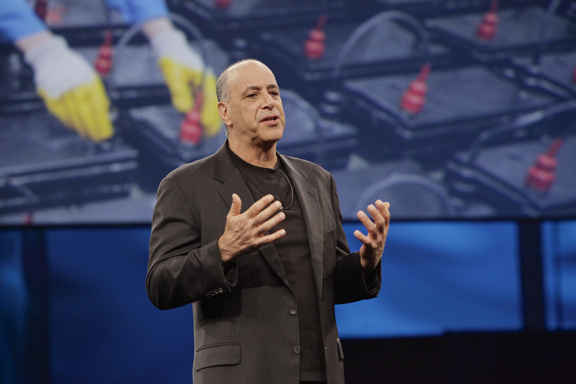 Autodesk CEO Carl Bass discusses the convergence of manufacturing and building processes.
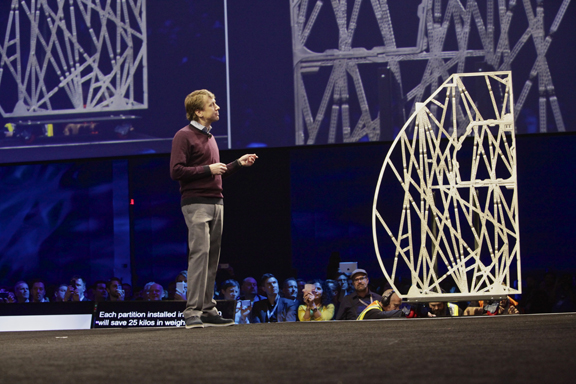 Autodesk CTO Jeff Kowalski presents the Airbus Bionic Partition, designed with algorithm-driven optimization methods.
At this year's Autodesk University Conference (AU2015), Autodesk technical evangelist Lynn Allen got the best escort she could ask for. Down the aisle of the Venetian Hotel's ballroom and onto the main stage, she strolled to the rhythm of the Imperial March, flanked by rows of stormtroopers. Allen was followed by Autodesk CEO Carl Bass and CTO Jeff Kowalski, who spelled out what could be the New Order in design and engineering.
Bass said, "Sometimes a shift is so big we can hardly see it. For years, I've been telling anyone who would listen that the building industry is going to look more and more like manufacturing, but when I saw it in front of me, I kind of dismissed it."
His observation was prompted by a visit to the construction site of the new Apple headquarters, where every beam and panel -- even those destined for the parking garage that few would ever pay attention to -- are marked with RFID tags and tracked throughout the process. "I realize then that the Apple construction site is just an open-air factory," Bass said.
Kowalski said, "Technology makes a quantum leap from passive to generative."
A year ago at AU2014, Kowalski began using the term "generative design" to refer to a process that "starts with your goal. Then it explores all the possible permutations of the solution through successive generations, until the best one is found.”
The project that brings this vision to reality is the Autodesk-Airbus collaboration to design a new airline cabin partition. The ultra-thin, lightweight structure must also hold a foldout seat that can accommodate the weight of two crew members during takeoff and landing. Autodesk wrote in a a blog post, "Dubbed the 'bionic partition,' the component was created with custom algorithms that generated a design that mimics cellular structure and bone growth, and then produced using additive manufacturing techniques. This pioneering design and manufacture process renders the structure stronger and more light-weight than would be possible using traditional processes."
We’ve teamed up w/ @autodesk to build the world’s largest #3Dprinted plane cabin component https://t.co/JaHIImmhkj pic.twitter.com/ziuYDvpt9O
— Airbus (@Airbus) December 1, 2015
The technology is the outcome of Dreamcatcher, a research project by Autodesk. The first product where the technology appears is Autodesk Within, software for generating complex lattice structures. Previously, the intricate geometry from such parts would have been deemed impractical, because they could not be made in standard manufacturing methods (like machining or injection molding). However, additive manufacturing or 3D printing remove the barrier.
"Our human nervous systems tell us everything, but the nervous systems of the things that we make are rudimentary at best," Kowalski observed. But that may soon change. "What's missing is a nervous system that connects all of us to the things that we design, engineer, and make." Such a nervous system can be found in The Hack Rod (a hot rod that's been hacked), designed with Autodesk software by the Bandito Brothers.
The project brought together Autodesk visiting fellow Mickey McManus with Bandito Brothers creative director and CEO Mouse McCoy. (Yes, they recognize the incidental Mickey-Mouse partnership.) Sensor-captured data from the experts' driving sessions in the Mojave dessert is used as input for the software. In turn, the software computes and generates what's mathematically the best -- or optimal -- structure for the chassis, making the finished vehicle a collaboration between human expertise and artificial intelligence (AI). (More on this in the article "The Hack Rod, the World's First AI-designed Car" by Fast Company.)
Up to now, the architects and the design engineers determine the shape of the buildings and everyday objects around us. But in the New Order envisioned by Autodesk, software-driven algorithms and sensor input play a significantly larger role in generating the shape of things to come.
So this just happened… #AU2015 pic.twitter.com/s1nQIFT9YZ
— Shaan Hurley (@ShaanHurley) December 1, 2015


Kenneth Wong is Digital Engineering's resident blogger and senior editor. Email him at [email protected] or share your thoughts or suggestions at digitaleng.news/facebook.
Follow DE
Join over 90,000 engineering professionals who get fresh engineering news as soon as it is published.






About Us · Contact Us · Editorial Team · Advertising · Privacy Policy · Subscriber Services · © 2026 Digital Engineering 24/7 · Peerless Media