Helping design and engineering professionals discover, evaluate and specify technologies and processes that shorten the design cycle and enable success.



Digital Engineering April 2026
In the latest issue of Digital Engineering, we take a look at the latest innovations in design for additive manufacturing, including the use of natural language inputs, social media cosplayers, and AI integration. The issue also includes a feature…

January Special Focus Issue: Design for Additive
In this Special Focus Issue of Digital Engineering, learn about the latest advancements in design for additive manufacturing, including new software tools, additive in automotive, custom medical devices, and more.
Cyclists can now enjoy a quieter, maintenance-free ride with customized parts, such as sprockets, that can be made with igus’ high-performance plastics and the company’s 3D printing capabilities.
igus, a German-based manufacturer of motion plastics, runs its North American operations through its facility in Providence, RI.
Sales of electric bikes have increased dramatically in recent years. In 2017, sales rose by 25% in the United States and 34 million were sold worldwide. Manufacturers are continually looking for steps to expand market share, and bikes are much lighter than previous models. Motors for e-bikes are about 25% smaller than their predecessors, with a weight of slightly less than 7 lbs. The e-bikes are also much quieter, and the igus components further help cyclists since they are lubrication and maintenance free.
Lars Hartmann, an e-bike inventor, focused on reducing the noise generated by a metal sprocket. The sprocket acted as a guide for the chain so that it does not collide with the frame. The metal sprocket caused significant noise during operation, and Hartmann sought ways to reduce that noise.
In search of an answer, Hartmann turned to igus’ 3D printing service. He sent the CAD data of the sprocket to igus and within a few days, received a customized solution for his project.
“The standard metal pinion generates a lot of noise when in use,’’ Hartmann said. “I drew it and had it printed by igus from iglide l3. Getting the part from igus was easy and fast. With the 3D printing service, the appropriate data could be uploaded as a STEP file, the material selected and the desired quantity ordered.”
Hartmann has used the sprockets for about two months, and he has noticed a dramatic reduction in noise in the e-bike.
Hartmann used iglide l3 for the sprocket, which is a material suitable for industrial and small-batch use. The product has coefficients of wear and high strength and is processed by selective laser sintering (SLS). In addition, the manufactured parts can be used directly.
In the test laboratory at igus, plain bearings made from the material have been compared with common materials for SLS. In pivoting, rotating and linear motion, the parts proved to be at least three times more abrasion-resistant than standard materials.
igus develops energy chain cable carriers, chainflex continuous-flex cables, drylin linear bearings and linear guides, iglide plastic bushings and igubal spherical bearings. For more information, visit igus.
Sources: Press materials received from the company.


Join over 90,000 engineering professionals who get fresh engineering news as soon as it is published.






About Us · Contact Us · Editorial Team · Advertising · Privacy Policy · Subscriber Services · © 2026 Digital Engineering 24/7 · Peerless Media
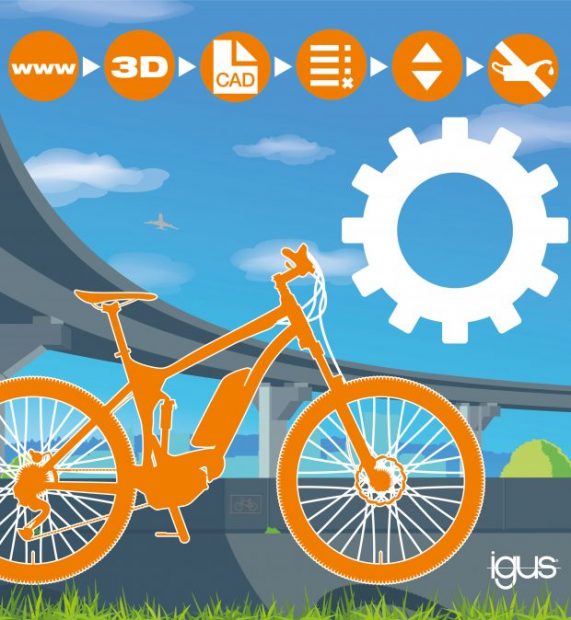 Image courtesy of igus.