Helping design and engineering professionals discover, evaluate and specify technologies and processes that shorten the design cycle and enable success.



Design & Simulation Software Guide 2025
In this Special Issue, Digital Engineering presents its second annual guide to design and simulation software vendors.

Design & Simulation Software Guide
In this Special Issue, Digital Engineering presents its inaugural guide to design and simulation software vendors, including listings for CAD, CAM, simulation, generative design, PLM, rendering and visualization, design for additive manufacturing,…
In March, the National Association of Manufacturers (NAM) released the results from its survey on the effects of COVID-19. The grim picture shows:
Expressing their concerns on supply chain disruptions, some survey participants say they are “manageable at this point,” but do create “some additional costs.” Others mention the need to find “alternative suppliers.” On reopening with the cloud of COVID-19 still hanging overhead, some say “work from home requests” are becoming common. New operations revolve around curtailed travel, workplace sanitation, restricted face-to-face interactions and staggered shifts on the shop floor to help compensate for higher-than-normal absences.”
In the era of social distancing, the role of the digital twins—digital counterparts of real-world products—takes on greater importance. So does their ability to reveal and foretell manufacturing issues before physical production occurs. In a recent DE webinar, part of the DE Hot Seat series, panelists discuss what it takes to elevate simple digital product models into digital twins with predictive capacity.
The DE Hot Seat episode on digital twins was broadcasted on May 14, sponsored by MSC Software and Vertex. Vertex offers 3D remote collaboration software. MSC Software, part of Hexagon, is the company behind well-known simulation solvers, such as MSC Nastran, MSC Apex, and Cradle CFD.
“CAD and FEA can play a critical role in a digital twin, but a digital twin is more than that. There are lots of cases where the digital twin requires no CAD representation,” said Leo Kilfoy, VP of Smart Factory Plant, MSC Software.
While CAD models typically reflect the ideal, or how the product is supposed to look, the actual product put into operation or installed onsite usually includes deviations, resulting from the manufacturing process or wear and tear over time. A true digital twin must account for these deviations; therefore, simply reusing the original CAD model as the digital counterpart is insufficient.
“[The digital twin] has to be connected to a robust set of data sources,” clarified Matt Heying, VP of Product, Vertex. “IOT data is typically what’s connected to the digital twin, but it can also be simulation data.”
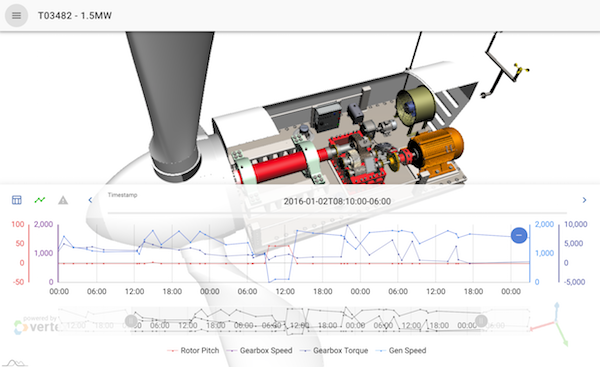
For example, hourly reports of the wind speed, wind load, and power fluctuations a wind turbine endures, are a critical part of the digital twin of the wind turbine installed. The data is unique to a specific site, a specific unit. It points to correlations between operating conditions and recorded failures, giving the predictive algorithm a baseline for drawing inferences.
In May 2017, in the article “Industry 4.0 and the Digital Twin” for Deloitte Insights (www2.deloitte.com), authors Aaron Parrot and Lane Warshaw wrote, “Until recently, the digital twin—and the massive amounts of data it processes—often remained elusive to enterprises due to limitations in digital technology capabilities as well as prohibitive computing, storage, and bandwidth costs. Such obstacles, however, have diminished dramatically in recent years.”
The rise of AWS and other on-demand HPC (high performance computing) vendors solve the storage problem and the need for flexible computing to address the varying peaks and drops of data volume, thus providing a foundation for hosting and maintaining digital twins.
In November 2016, Intel’s then-CEO Brian Krzanich wrote a blog post that points out “data is the new oil in the future of autonomous driving." In his estimate, “each autonomous vehicle will be generating approximately 4,000 GB—or 4 terabytes—of data a day.”
With a steady stream of real-time data from multiple sensors on each unit, a manufacturer wrestling with a fleet of autonomous vehicles, a set of drones, or dozens of factory equipment could quickly get overwhelmed. Aside from the need to hire data scientists to parse and process it, the data storage need alone could add up costs, undermining the value proposition for the digital twin.
“Just because you have a bunch of data doesn’t mean it will make your model better,” said Heying. “If you don’t have data hygiene, your problem is going to get exponentially worse. For example, is it the raw temperature that you care about? Or is it the rate of change in temperature?”
A good starting point, Heying said, is, “What are the questions you are trying to answer?” These questions serve as guidance on the type of data to collect, thus significantly reducing the data-processing and storage burden.
Kilfoy echoed Heying, saying, “You need a good data strategy. Data science is appropriate, but it also takes domain knowledge, so data science is no substitute for prior experience in determining what’s important to capture.”
Heying cautioned, “A digital twin is not a magical solution, where if you have it, you know everything.” However, the current state of technology offers tantalizing possibilities. “If you have a crop of wind turbines, you know the history of issues. So if you’re labeling the data properly, you can use that and identify all the wind turbines with similar characteristics. At this point, you start to get predictive maintenance,” explained Heying.
While no one will likely be surprised by the idea of digital twins of autonomous vehicles, certain breeds of products with digital twins might seem odd, at least at first glance. “The digital twin concept can be applied even to things that like shoes,” said Kilfoy. “If you put telemetry into the shoes, you can provide valuable feedback both to the consumer and the manufacturer.”
In May 2019, footwear giant Nike launched a smartphone-based foot scanner app, called Nike Fit. In the announcement (http://news.nike.com), it’s described as “a new scanning solution that uses a proprietary combination of computer vision, data science, machine learning, artificial intelligence and recommendation algorithms. It does this by measuring the full shape of both feet, offering the ability to know your truly perfect fit for each Nike shoe style.”
If you have collected sufficient data on a user’s force, biometrics, ankle rotations, and other walking behaviors, “for a high-end athlete, with the owner’s consent, Nike could use it to design a better product or extend the life of the product,” said Kilfoy.
As factory floors slowly reopen, manufacturers also face a steep learning curve on how to operate safely. On May 20, Reuters reports, “Ford Motor Co. on Wednesday closed two U.S. assembly plants as the coronavirus pandemic wreaked early havoc with the No. 2 U.S. automaker’s plan to restart North American production and begin making its most profitable vehicles again” (“Ford shuts two U.S. assembly plants due to COVID-19 infections,” www.reuters.com).
Kilfoy observed, “How do we live and work with COVID-19? It’s not going away anytime soon. As we move back to work, it will be critical to minimize physical contact, to reduce the number of people on the floor. A digital model of a mask, for example, can tell you the effectiveness of different sizes and shapes.”
MSC Software’s YouTube channel shows results of an airflow analysis of different sneezing scenarios and the effectiveness of various masks, conducted using the company’s Cradle scFLOW software.
“We’re seeing a lot of interest in some people who want to use digital twins for training,” said Heying. “This helps you understand what behavior you can expect from the product when you actually get to the field.”
You can access the archived original webinar, Can Digital Twins Predict the Future?, on the DigitalEngineering247 website.


MSC Software develops simulation software technology that enables engineers to validate and optimize their designs using virtual prototypes. Customers in almost every part of manufacturing use our software to complement, and in some cases even…
ePowertrain by Design
Electrification is the single largest disruptor that has occurred to mobility in decades and in particular it is impacting the automotive industry faster and more widely than other sectors.

Kenneth Wong is Digital Engineering's resident blogger and senior editor. Email him at [email protected] or share your thoughts or suggestions at digitaleng.news/facebook.
Follow DE
Join over 90,000 engineering professionals who get fresh engineering news as soon as it is published.






About Us · Contact Us · Editorial Team · Advertising · Privacy Policy · Subscriber Services · © 2026 Digital Engineering 24/7 · Peerless Media