Helping design and engineering professionals discover, evaluate and specify technologies and processes that shorten the design cycle and enable success.




Sponsored

Artificial Intelligence for Design and Engineering Workflows
In this white paper, learn how artificial intelligence and machine learning can improve design and simulation.

Technology Focus: Designing for Optimization & Simulation
Simulation is pervasive, with people from different departments and backgrounds discovering new ways to put it to use, in all of its varied forms.
At the NVIDIA GTC event in San Jose in March, Dell Technologies announced new AI PCs, infrastructure, software and services that the company said will advance the adoption of artificial intelligence (AI) in the enterprise.
"Dell is going to be offering a whole line of NVIDIA enterprise IT AI infrastructure systems and all the software that runs on top of it. So you can see that we're in the process of revolutionizing the world's enterprise,” said Jensen Huang, CEO of NVIDIA during his keynote address at GTC.
At the event, Dell unveiled plans to support the new NVIDIA DGX personal AI supercomputer platforms, built on the NVIDIA Grace Blackwell platform – DGX Spark and DGX Station. DGX Spark was formerly called Project DIGITS and is meant to be a small form-factor personal supercomputer for AI workloads. DGX Station is a new high-performance desktop supercomputer, to be powered by the upcoming Blackwell Ultra GPUs.
“DGX Stations are powered by ARM-based CPUs and the upcoming Blackwell Ultra GPUs, with a combined memory of 784GB. So it can accelerate both your CPU-based workflows as well as the GPU-based ones,” said Himanshu Iyer, Manufacturing Industry Manager at NVIDIA. “That will enable creators, developers, and engineers to work with much larger AI models locally.”
Since DGX Stations run on NVIDIA GB300 superchip, the chip that combines the Grace CPU and Blackwell Ultra GPU, they also accelerate processing by reducing the data transfer between CPU and GPU through interconnects.
Dell Technologies was among the first NVIDIA hardware partners to announce upcoming DGX products in its Pro Max line, and will also offer server products that support the NVIDIA Blackwell Ultra platform, featuring up to 288GB of HBM3e memory, known for advanced high bandwidth, and optimized for workloads like Large Language Model (LMM) training.
According to NVIDIA, DGX Spark is the world’s smallest AI supercomputer, built on the NVIDIA GB10 Grace Blackwell Superchip and optimized for the desktop form factor. GB10 features an NVIDIA Blackwell GPU with fifth-generation Tensor Cores and FP4 support, delivering up to 1,000 trillion operations per second of AI compute for “fine-tuning and inference with the latest AI reasoning models, including the NVIDIA Cosmos Reason world foundation model and NVIDIA GR00T N1 robot foundation model,” according to NVIDIA.
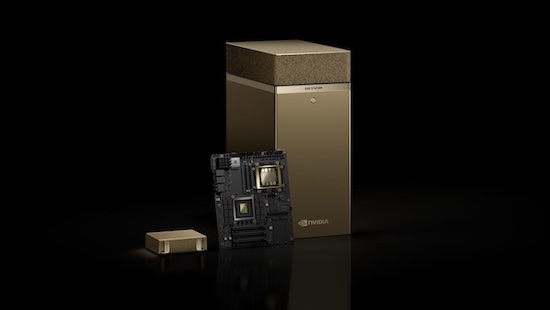
NVIDIA DGX Station desktop systems will be built with the NVIDIA GB300 Grace Blackwell Ultra Desktop Superchip, and feature 784GB of coherent memory space to accelerate large-scale training and inferencing workloads. The GB300 Desktop Superchip features an NVIDIA Blackwell Ultra GPU with latest-generation Tensor Cores and FP4 precision, connected to a high-performance NVIDIA Grace CPU via NVLink-C2C.
Dell Technologies products supporting the NVIDIA DGX technology include:
The Dell Pro Max with GB10 AI developer workstation, which features the NVIDIA GB10 Grace Blackwell Superchip, a system-on-a-chip based on the NVIDIA Blackwell architecture. The workstation offers up to one petaflop (1000 TFLOPs) of AI computing performance and 128GB of unified memory.
The Dell Pro Max with GB300 high-performance PC range brings “server-level compute to a desktop,” the company says. Featuring the new NVIDIA GB300 Grace Blackwell Ultra Desktop Superchip, it provides up to 20 petaflops of AI computing performance, 784GB unified system memory (up to 288GB HBME3e GPU memory and 496GB of LPDDR5X CPU memory) and fast networking with NVIDIA ConnectX-8 SuperNIC.
The new Dell Pro Max notebooks and desktops are equipped with NVIDIA RTX PRO Blackwell Generation GPUs and Intel Core Ultra (Series 2).
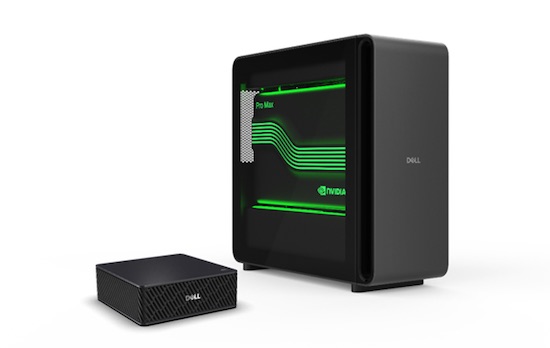
Dell also showcased new PowerEdge servers. The Dell PowerEdge XE8712 is described as its “most advanced research data center server innovations yet.” The system can host up to 144 NVIDIA Blackwell GPUs, with direct liquid cooling.
Dell PowerEdge XE7740 and XE7745 servers will be available with the Dell AI Factory with NVIDIA. The servers are currently available with up to eight NVIDIA H200 NVL GPUs and a five-year subscription to NVIDIA AI Enterprise software. They also support up to eight NVIDIA RTX PRO 6000 Blackwell Server Edition PCIe GPUs.
According to a recent Dell Technologies blog, “The Dell Pro Max portfolio integrates seamlessly as a key infrastructure option within the Dell AI Factory with NVIDIA, offering one consistent experience with NVIDIA AI Enterprise software across systems. This software architecture ensures developers using Dell Pro Max with GB10 and Dell Pro Max with GB300 can move their models between environments – from desktop to DGX Cloud or Dell data center infrastructures – with virtually no code changes, delivering consistency and reducing downtime.”
At GTC, Dell Technologies announced new updates to the Dell AI Factory with NVIDIA. Dell has integrated NVIDIA’s AI-Q Blueprint and AgentIQ Toolkit in the NVIDIA AI Enterprise platform, and the new Dell Accelerator Services for RAG “implement and optimize agentic-based solutions with integrated business data, maximizing ROI,” the company says.
In addition, Dell AI Factory with NVIDIA validates the NVIDIA Run:ai AI orchestration platform, and Dell Services for GenAI Digital Assistants now aligns with NVIDIA’s scalable blueprint architecture. The Dell AI Code Assistant offers a fully on-premises, enterprise-grade coding assistant that includes “the highest standards of flexibility and data privacy.”
Dell also announced AI data management solutions built on its relationship with NVIDIA. The Dell AI Data Platform with NVIDIA helps companies deploy agentic AI and other AI applications securely, through always-on, direct access to high quality structured, semi-structured and unstructured data. The platform combines Dell enterprise storage with NVIDIA accelerated computing, networking and AI software, and integrates with the NVIDIA AI Data Platform reference design. The platform also features Dell Data Management Services and Dell PowerScale storage, which can improve GPU utilization with faster data ingestion and retrieval. Dell Technologies also now supports NVIDIA Dynamo, which frees up GPU memory by offloading KV cache data from GPU-accelerated nodes to Dell storage like PowerScale.


Since its founding in 1993, NVIDIA (NASDAQ: NVDA) has been a pioneer in accelerated computing. The company’s invention of the GPU in 1999 sparked the growth of the PC gaming market, redefined computer graphics, ignited the era of modern AI and…

Cut Retrieval-Augmented Generation (RAG) Hallucinations by 50%
Most teams hit the same wall with enterprise AI: LLMs that hallucinate, pipelines that don’t scale, and infrastructure that’s harder to design than the models themselves.

Brian Albright is the editorial director of Digital Engineering.
Contact him at [email protected].

Join over 90,000 engineering professionals who get fresh engineering news as soon as it is published.






About Us · Contact Us · Editorial Team · Advertising · Privacy Policy · Subscriber Services · © 2026 Digital Engineering 24/7 · Peerless Media