Helping design and engineering professionals discover, evaluate and specify technologies and processes that shorten the design cycle and enable success.


Alert!
Digital Engineering ceased publication on July 1, 2026. This website remains available as an archive of engineering content.
For inquiries or information, please email [email protected].


Sponsored
Artificial Intelligence for Design and Engineering Workflows
In this white paper, learn how artificial intelligence and machine learning can improve design and simulation.
Technology Focus: Designing for Optimization & Simulation
Simulation is pervasive, with people from different departments and backgrounds discovering new ways to put it to use, in all of its varied forms.
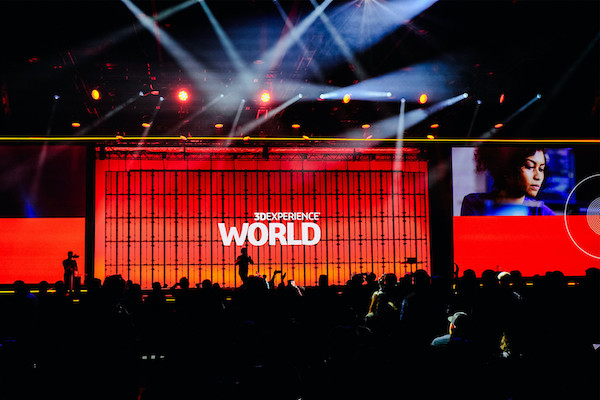
This year, 3DEXPERIENCE World, Dassault Systèmes’ annual user conference, returned to Houston, Texas, home of NASA's space program. The George Brown Convention Center by the Discovery Green saw a confluence of SOLIDWORKS, CATIA, and SIMULIA software users, some veterans proudly bearing decade-old conference badges for nostalgia and bragging rights.
On day one, Monday February 2, SolidWorks CEO Manish Kumar kicked off the general session. "Some tasks will shrink. Some roles will change. AI is just an engine. You are the driver," he said.
Kumar joined the company in 1999 as a software developer, rising through the ranks over the following two and a half decades to the lead position. That history was apparent in the ease with which he could discuss the software’s technical issues and the rapport he had with the users.
Kumar put the spotlight on three virtual companions, dubbed Aura, Leo, and Marie, designed to fulfil distinctly different roles.
Kumar described Aura as "a friend who you might brainstorm with, even on crazy ideas." Leo is "a friend who can help you convert that idea into a manufacturable design grounded in reality." Marie is "a scientist with a high IQ." The names Leo and Marie were inspired by Leonardo da Vinci and Marie Curie, respectively. Aura is a name chosen for itself by the AI system, revealed Kumar. (For our full conversation with Kumar at 3DEXPERIENCE World, listen to our podcast here.)
During the keynote, Kumar gave a live demonstration of Leo—"against the advice of the marketing department," he quipped. In the demonstration, using natural language prompts, he was able to extract a 2D profile out of a PDF document and convert it into a 3D model with Leo’s help. Kumar also demonstrated the use of a surrogate model to conduct basic analysis on the AI-generated 3D part, assisted by Leo.
"SOLIDWORKS is expanding, with simulation, cloud, and analytics, and now, with virtual companions and generative experiences. More importantly, it's expanding without losing its soul – same practicality, same discipline, but with more power," said Pascal Daloz, CEO of Dassault Systèmes.
This year, the conference offered 355 breakout sessions. More than 20 of them focused on AI deployment in the Dassault Systèmes portfolio.
On day two of the conference, NVIDIA CEO Jensen Huang joined Daloz on stage to announce a new partnership. "Because AI is going to become a foundational technology, it's going to become an infrastructure, just like water, electricity, and the internet," said Huang. "CATIA, SIMULIA, DELMIA, BIOVIA ... all these VIAs are going to be built on top of NVIDIA." (Huang also described himself as “definitely a SolidWorker,” delighting the SOLIDWORKS community in attendance.)
The partnership centered around digital twin deployment. According to the press release from NVIDIA, "Combining Dassault Systèmes’ Virtual Twin technologies with NVIDIA AI infrastructure, open models and accelerated software libraries will establish science-validated Industry World Models, and new ways of working through skilled virtual companions on the agentic 3DEXPERIENCE platform, that empower professionals with new expertise.”
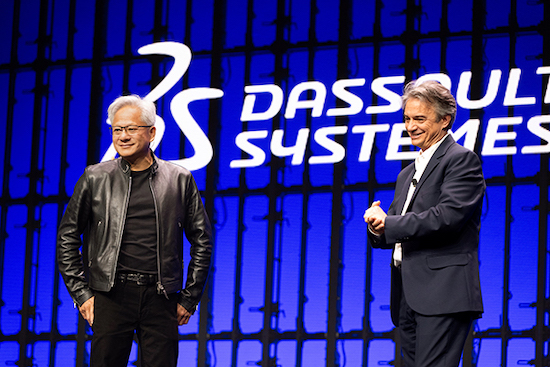
As part of the partnership, Dassault Systèmes’s OUTSCALE brand, which offers AI factories for digital twin deployment, will incorporate the latest NVIDIA AI infrastructure. NVIDIA is adopting Dassault Systèmes model-based systems engineering (MBSE) to design AI factories, starting with the integration of NVIDIA Rubin platform and the NVIDIA Omniverse DSX Blueprint, an open-reference design and software-driven framework for gigawatt-scaled AI factories.
Huang believes that everything, from a pair of tennis shoes to cars and the robots and the factories that build the cars, will be software-defined. That aligns with Dassault Systemes's vision. Daloz described the current era as "the generative economy, the world where the virtual is driving the physical, where intellectual property is the true currency."
Huang said, "The type of things you will be building in the future will be impossible without accelerated computing, real-time simulation, and AI ... AI has human in the loop, and that's important. But you will now have AI in the loop, in your [virtual] companions. That AI remembers your preferences, how you like to do things, and it codifies your skills, habits, and domain expertise."
“Virtual twins are not applications. They are knowledge factories,” Daloz said.
On the exhibit floor, Ken Flannigan, Director of Industry Alliances, Dell Technologies, showcased the Dell Pro Max 18 Plus, an 18-inch laptop. “This is our largest scalable mobile workstation for SOLIDWORKS users. It has 120GB RAM, with an NVIDIA RTX 4000 GPU in it,” he said. He also highlighted the Dell Pro Max T2 desktop tower, equipped with an NVIDIA RTX Pro 6000 GPU. “You can run SOLIDWORKS Visualize on it, and get very good response and performance,” he pointed out. “These are ideal for simulation, reality capture—applications that drive more value out of your 3D data.”
Dell also demonstrated its new Dell Pro Max with GB10, a desktop AI supercomputer. You can see it in action in the video below:
Darren Murphy, founder and CEO of Push Industries, is a cyclist and a mountain bike maker. He and his team use SOLIDWORKS for design and SOLIDWORKS Simulation for structural analysis. He said, “When we looked at larger assemblies, we needed the power to run SOLIDWORKS efficiently. Our rear shock absorber, for instance, has more than 150 individual components. The Dell workstations with NVIDIA GPUs gave us a lot of horsepower.”


DE's editors contribute news and new product announcements to Digital Engineering. Press releases may be sent to them via [email protected].
Follow DE






About Us · Contact Us · Editorial Team · Advertising · Privacy Policy · Subscriber Services · © 2026 Digital Engineering 24/7 · Peerless Media