Helping design and engineering professionals discover, evaluate and specify technologies and processes that shorten the design cycle and enable success.



May 2026 Special Focus: Artificial Intelligence in Design and Simulation
In this Special Focus Issue, learn about the latest developments in the integration of artificial intelligence into engineering workflows.

April 2026 Special Focus Issue: Generative Design
In this Special Focus Issue, Digital Engineering takes a look at how generative design solutions can be used across different types of design problems and with a variety of manufacturing approaches to accelerate design space exploration, and…
A white paper by Jim Comb, a systems engineer with Stratasys, Inc., titled "How to Design Your Part for Direct Digital Manufacturing," makes some good points about the AM mindset needed by design engineers. Below are my takes on it.
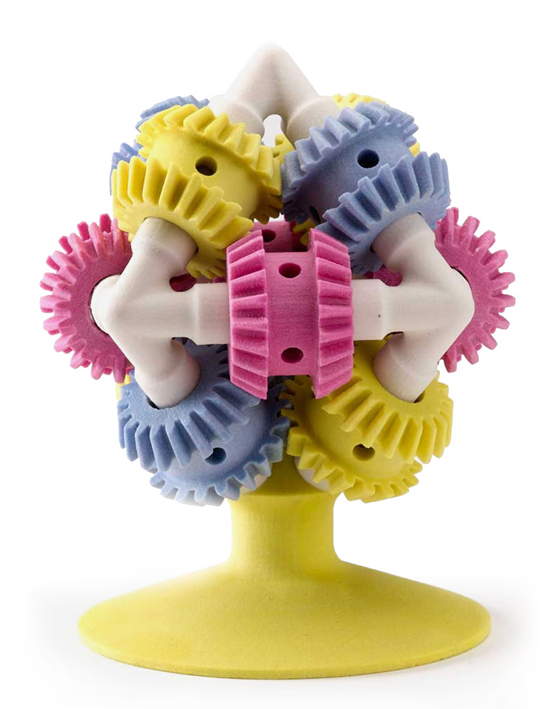
Most 3D printing processes allow for sturdy objects to be built with fewer concessions made to the actual method of manufacturing. Instead of worrying if a design will require new tools (that increase cost) to be created or taking into account things like proper draft angles to ensure a part will eject from a machine, 3D printing encourages innovation over methodology.
Even if an object doesn’t perform exactly as expected the first time, making changes and building a new part is much faster when you can print it out in hours, instead of wasting days reworking specialized parts or machining new tools for the job.
Designing for AM allows people to concentrate on functionality. 3D printing can create incredibly complex objects with internal geometries that would be time consuming to reproduce through traditional manufacturing. The first pass of a design can be drawn up without concern for how feasible it will be to build the object in question. Form follows functionality, instead of the reverse.
Thinking about how the materials used to create a part or object also changes when using AM. Using traditional methods, once a set of tools are created to manufacture something, the materials involved often can’t be changed without extensive refitting. 3D printing allows you to change the materials used after each print run. This can be useful for prototyping as well as end use products.
Wall thickness is another area that changes with AM. In place of the 0.04 to 0.08 in. minimum thickness required to avoid warping and sink marks that occur as part of the manufacturing process, the only concern need be if the wall is thick enough for the object to perform as intended. Variable-density printing can also create walls with a lattice structure that can reduce overall weight of a part.
Finally, 3D printing allows for a quick flow of design and redesign, all the way up to the launch of the product or part. Feedback can be quickly implemented and even a complete redesign is possible without a massive loss of time or money. If a breakthrough is made in the twilight hours of a deadline, AM allows for that breakthrough to go into immediate production.
Below you’ll find a short video that features complex designs created with 3D printing.
Source: Stratasys


John Newman is a Digital Engineering contributor who focuses on 3D printing. Contact him via [email protected] and read his posts on Rapid Ready Technology.
Follow DE
Join over 90,000 engineering professionals who get fresh engineering news as soon as it is published.






About Us · Contact Us · Editorial Team · Advertising · Privacy Policy · Subscriber Services · © 2026 Digital Engineering 24/7 · Peerless Media