Helping design and engineering professionals discover, evaluate and specify technologies and processes that shorten the design cycle and enable success.



Digital Engineering April 2026
In the latest issue of Digital Engineering, we take a look at the latest innovations in design for additive manufacturing, including the use of natural language inputs, social media cosplayers, and AI integration. The issue also includes a feature…

January Special Focus Issue: Design for Additive
In this Special Focus Issue of Digital Engineering, learn about the latest advancements in design for additive manufacturing, including new software tools, additive in automotive, custom medical devices, and more.
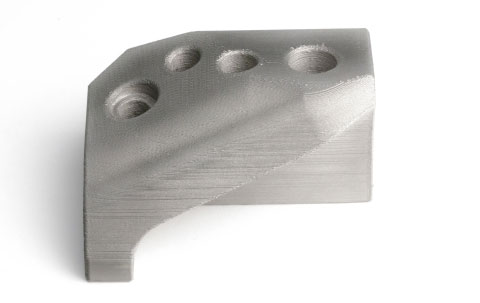
Desktop Metal has qualified D2 tool steel for the Studio System 2, an accessible metal 3D printing platform that offers a way to print high-performance metal parts in low volumes for pre-production and end-use applications. Desktop Metal offers the material in a two-step bound metal additive manufacturing process, allowing ability to leverage a simple, nearly hands-free process to produce parts for high-strength D2 applications such as cold work metal forming tools, dies, punches and injection molds with conformal cooling channels.
D2 is a high-carbon, high-chromium air-hardening tool steel characterized by its high hardness and compressive strength after heat treatment. This tool steel offers high wear resistance properties, dimensional stability and corrosion resistance in the hardened condition. D2 is used for various cold work tools that require a combination of wear resistance and moderate toughness, such as coining and sizing tool members, blanking and forming dies, shear cutting tools, gauges, burnishing tools, and other wear parts.
“D2 tool steel has traditionally been a challenging and expensive material to work with,” says Jonah Myerberg, co-founder and CTO of Desktop Metal. “With this material now available on the Studio System 2, we’ve streamlined production of D2 parts to just two simple steps for improved affordability and accessibility. We are excited to be able to offer our customers this new material with higher hardness after heat treatment than all of the other Studio System materials qualified to-date, unlocking new applications that require tooling material grade strength.”
With the Studio System 2, D2 tool steel parts demonstrate mechanical properties on a more accessible platform than legacy powder bed fusion 3D printing alternatives.
An example of a key use case includes:
Aerial cam cutting section tools are a component of stamping dies that make frame components on high-volume vehicle manufacturing lines. D2 tool steel is a key material for this application because of its high hardness and wear resistance. Stamping tools like these are produced in low volumes, traditionally using advanced machining techniques and slow feed rates because of the material’s high hardness. With the Studio System 2, businesses can now print these tools in D2 at low volumes cost-effectively while reducing complex machining operations, CNC fixturing setups, and CNC tool wear, according to the company.
The Studio System 2 is an office-friendly metal additive manufacturing system that leverages Desktop Metal’s proprietary Bound Metal Deposition (BMD) technology to produce parts. The easy, two-step process—allowing parts to be transferred directly from the printer into the furnace—provides a nearly hands-free experience, while eliminating loose powders and dangerous lasers commonly associated with metal 3D printing. Consisting of a printer and furnace, the Studio System 2 simplifies in-house low volume production of a wide range of complex geometries with surface finish and mechanical properties.
In addition to D2, the Studio System 2 is compatible with Ti64 and 316L stainless steel, as well as all materials previously supported by the Studio System, including 17-4PH stainless steel, 4140 low-alloy steel, H13 tool steel and copper. A portfolio of additional materials that take advantage of the Studio System 2’s streamlined, two-step process is in active R&D with new releases slated to roll out this year.
Sources: Press materials received from the company and additional information gleaned from the company’s website.


Desktop Metal was started to address a problem—how to make metal 3D printing accessible for engineering teams. In 2013, CEO Ric Fulop began collaborating with world-leading experts in materials science, engineering, and 3D printing. Their work…

DE's editors contribute news and new product announcements to Digital Engineering. Press releases may be sent to them via [email protected].
Follow DE
Join over 90,000 engineering professionals who get fresh engineering news as soon as it is published.






About Us · Contact Us · Editorial Team · Advertising · Privacy Policy · Subscriber Services · © 2026 Digital Engineering 24/7 · Peerless Media