Helping design and engineering professionals discover, evaluate and specify technologies and processes that shorten the design cycle and enable success.


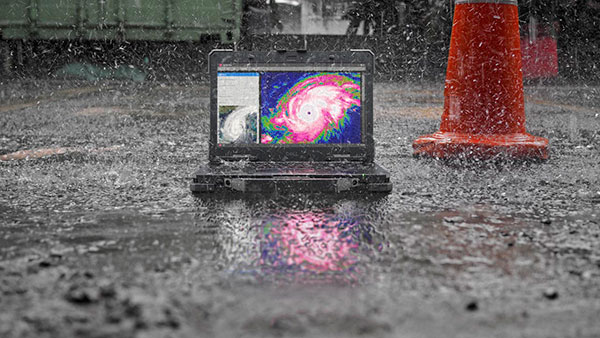
Not every engineer needs a computer to withstand temperatures that would fry an egg or freeze water in seconds. But those few who do really need such performance.
The computers capable of working in extreme environments are called rugged computers. It is a small market, a segment most major workstation and PC vendors avoid. The list of vendors offering workstation-class rugged computers is even smaller. Yet there are options.
“Rugged computers provide what we call ingress protection,” says David Plourde, a business development consultant at Dell. “If the computer has to sit out on a farm in the rain or be next to you when cutting concrete, you have protection” from the wind, rain or dust. Dell says it offers various levels of ingress protection.
Typical computer specs like screen brightness have new meaning in the world of rugged computers. Standard notebook computers generate about 200 nits of light, while rugged computers generate up to 1700 nits, similar in intensity to a 4K high-dynamic range smart TV. The higher brightness level is often required for outdoor use.
Rugged computers are tested using the U.S military standard, MIL-STD-810. The standards are written to define various environmental stress sequences and durations over specified lifecycles. Testing labs offer compliance certification to vendors.
Plourde says some customers are surprised to find Dell’s rugged computers have fan hardware. Before Dell decided to enter the market, Plourde says unfanned rugged computers were the norm. “But that means using underpowered CPUs” to rein in operating temperature.
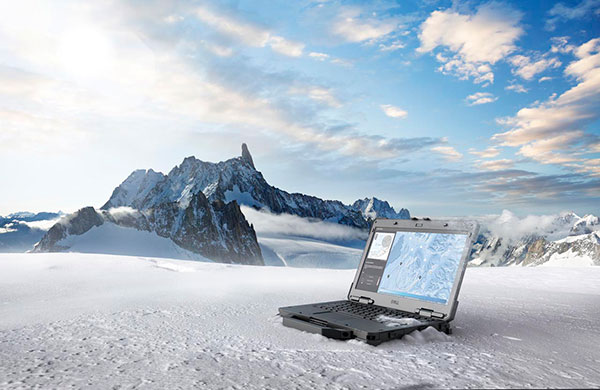
Plourde says Dell introduced its QuadCool thermal management systems as a new option. It uses a combination of forced convection and passive cooling. The fan resides in a sealed IP-65 chamber, enhanced by conductive cooling. Dell’s rugged computers resemble other notebook computers, only thicker.
ACME, another vendor of rugged portable computers, prefers a lunchbox-style design. The larger form factor allows for the use of internal expansion cards and a variety of ports for data gathering.
One important non-engineering market for ACME is live sports or news broadcasting. These customers need a computer robust enough to handle live streaming and editing in real time, says Myles Kelvin, VP of sales and marketing at Portexa, which partners with ACME and is responsible for aerospace and defense.
Data collection is a common requirement for ACME customers, Kelvin says. The U.S. Navy, for example, collects a wide variety of data in real time on its ships. Navy vessels are upgraded on a 10-year schedule, so they often have computers that are outdated well before other ship systems. By using rugged portables, the Navy can bring the latest technology onboard as needed.
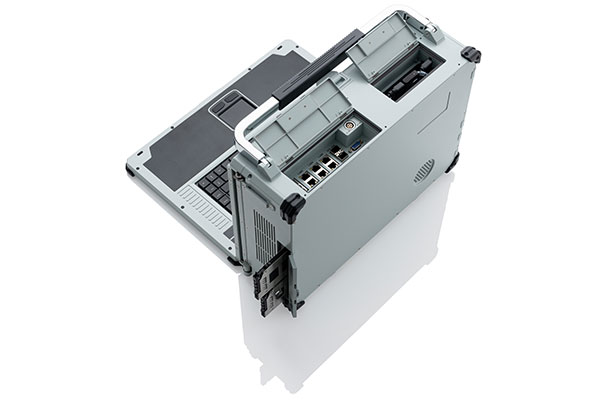
Another data collection pain point for the U.S. military is the F35 fighter jet. For security, it uses a custom data port. Support personnel need a rugged computer with an expansion slot for the special data connection since they may need to gather data on a jet in any environment.
One ACME model offers three fold-out displays, a high-end Intel Xeon processor and four drive bays each capable of supporting up to 30TB. All ACME models have handles, a feature not commonly found on standard notebook computers.
“We found that a significant number of product failures come from dropping,” Kelvin says.
A Google search for “rugged computers” or “rugged workstations” suitable for use by DE readers opens a rabbit hole to nowhere. Many vendors only do vehicle-mounted rugged tablets. Others do handheld terminals.
The following list of vendors offer rugged portable computers that would be powerful enough for field engineers and consulting engineers. Companies who specialize in rugged tablets are not included. Companies primarily operating outside North America are not included.


Dell sells personal computers (PCs), servers, data storage devices, network switches, software, computer peripherals, HDTVs, cameras, printers, MP3 players, and other electronics.

Artificial Intelligence for Design and Engineering Workflows
In this white paper, learn how artificial intelligence and machine learning can improve design and simulation.

Randall S. Newton is principal analyst at Consilia Vektor, covering engineering technology. He has been part of the computer graphics industry in a variety of roles since 1985.
Follow DE
Join over 90,000 engineering professionals who get fresh engineering news as soon as it is published.






About Us · Contact Us · Editorial Team · Advertising · Privacy Policy · Subscriber Services · © 2026 Digital Engineering 24/7 · Peerless Media