Helping design and engineering professionals discover, evaluate and specify technologies and processes that shorten the design cycle and enable success.



Digital Engineering April 2026
In the latest issue of Digital Engineering, we take a look at the latest innovations in design for additive manufacturing, including the use of natural language inputs, social media cosplayers, and AI integration. The issue also includes a feature…

January Special Focus Issue: Design for Additive
In this Special Focus Issue of Digital Engineering, learn about the latest advancements in design for additive manufacturing, including new software tools, additive in automotive, custom medical devices, and more.
3D scanning helps a kayak maker navigate between hand crafting and digital design.
Kayaking has two extremes—the slow, leisurely float and the adrenaline-pumping rush of whitewater paddling. For these extremes, and everything in between, Watermark Sports has just the right boat. Through its Dagger, Perception, and Mainstream product lines, it offers recreational, fishing, expedition, touring, whitewater, and freestyle kayaks.
Watermark introduces 12 to 18 new boats each year at the Outdoor Retailer Summer Market, and year–after–year, the industry honors Watermark’s kayaks. Most recently, its Dagger Crazy 88 freestyle boat won Outside magazine’s Gear of the Year award. The judging criteria included comfort, aerial capabilities, speed, predictability, control, and stability. Producing a boat that excels in all these categories requires a combination of skill, experience, and craftsmanship. It also demands the right tools.
 |
| Photo by Charlie Munsey |
Design of a new boat begins with CAD. In the digital world, Watermark applies its years of experience to develop a product that both looks great and performs well. But experience, knowledge, and computer programs cannot predict a boat’s handling and stability. So after a designer has done his job at the computer, the design must be refined for peak performance. To do this, Watermark must put a prototype boat in the water.
The prototype, which is called a plug, is milled from high-density foam by a CNC machine. Watermark’s design team puts the full-scale model in the water and takes it out for a paddle. The test run provides performance data and highlights needed modifications. The prototype is then pulled from the water and sent to the model shop, where it is reshaped by hand. At this point, experienced model-makers take over and adjust the hull’s contours with hand rasps, sandpaper, other shaping tools, and body filler.
After repeated testing and reshaping, the design team settles on the perfect boat. The boat, however, exists only as a physical model that is an alteration of its original CAD model. To bridge the gap and get a CAD model from which to manufacture a line of boats, Watermark digitally scans the plug to capture its design modifications.
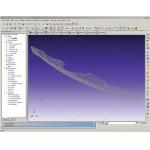 |
| The point cloud for half of the Carolina kayak’s hull contains 2.5 million points. |
Watermark begins by scanning one-half of the plug, the data from which is later mirrored to create perfect symmetry. Each plug will yield between 20 and 40 scans over the length of the kayak, which ranges from 7 to 19 feet. Although the Vivid 910 scanner can capture 307,000 points per scan, Maughan has found that the fast mode, which captures 77,000 points in 0.3 seconds, provides all the detail and speed that he needs. "I am amazed at how accurate it is even though we are only using a one-quarter scan," says Maughan. Scanning a seven-foot boat takes 45 minutes.
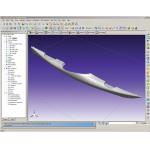 |
| In RapidForm, the point cloud is processed to yield a smooth polygonal data file that captures all of the hand-worked detail. |
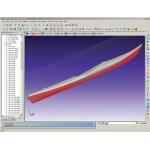 |
| Prior to export, the scanned data is converted into NURBS surfaces. Then desired data is selected and surfaced data is exported in IGES format. |
Another benefit of using the Vivid 910 and RapidForm to expedite the entire process has been improved quality and performance of Watermark boats. The company’s designers now make use of the time saved in reverse engineering to do more research and development.
"With our tight timeframes to get these boats to market," Maughan says, "we used to have to ask ourselves how much testing we could do before the release. Now, we have more time to get the work done earlier in the design cycle, and we have the time we need to fully test so that we can deliver the best product."
Reverse engineering also lets Watermark design and test more than just boat hulls. The company has expanded its use of 3D scanning to include seats, decks, internal components and mounting hardware. With this scanned data, the company mates digital components with the hull and reviews designs for tolerance and fit. Watermark now designs more boats and components, and completes more testing and analysis; all without adding staff.
Maughan notes that his small crew has many responsibilities. For example, there’s CAD programming, boat design, testing, and CNC machining. With so many jobs to do, the time saved by reverse engineering means each crew member can get back to vital tasks and take on more projects. Maughan says that the biggest personal benefit is that the reverse engineering tools let him do the best job possible without burning the midnight oil.
Originally, the company had planned on a two-year payback. However, with improved accuracy, enhanced control, and faster processing, the scanning system has paid for itself in just one year: an unexpected, but not unwelcome benefit from the move to digital scanning.
Todd Grimm is president of T. A. Grimm & Associates, a consulting firm that focuses on rapid prototyping and reverse engineering. He is also chairman of the Society of Manufacturing Engineers’ 3D Data Capture/Reverse Engineering technology group. Contact him through e-mail about this article c/o the DE Editors by clicking here.
INUS Technology develops advanced 3D scan data processing software. Its RapidForm products are comprehensive suites of tools for the conversion of 3D scanner data into accurate 3D models used for a wide range of applications.
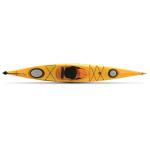 |
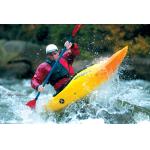
| With its reverse engineering tools, Watermark Sports blends hand crafting and digital design to manufacture performance kayaks like the Carolina. |
INUS Technology
Seoul. Korea
Konica Minolta
Tokyo, Japan


DE's editors contribute news and new product announcements to Digital Engineering. Press releases may be sent to them via [email protected].
Follow DE
Join over 90,000 engineering professionals who get fresh engineering news as soon as it is published.






About Us · Contact Us · Editorial Team · Advertising · Privacy Policy · Subscriber Services · © 2026 Digital Engineering 24/7 · Peerless Media
;)