Helping design and engineering professionals discover, evaluate and specify technologies and processes that shorten the design cycle and enable success.



Digital Engineering September 2025
In the September issue of Digital Engineering, we look at trends in engineering education, how engineering schools are handling DfAM, the limitations of ROMs, VR engineering workflows, reports from the Paris Air Show and Hexagon LIVE, and more.
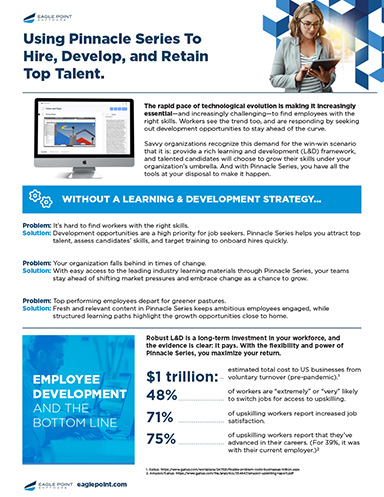
How Pinnacle Series Helps AEC Firms Attract, Train, and Retain Top Talent
Discover how AEC firms use Pinnacle Series to solve hiring challenges, upskill employees, and reduce turnover with personalized learning, skill assessments, and role-based training.
The AEC & Manufacturing industries are often among the first to feel disruptions in the market landscape. They regularly confront technological leaps, economic uncertainty, changing trends in labor and demand, supply chain interruptions, and any number of other shifts that can force a business to reevaluate and refocus. And as markets grow more global, the opportunities for disruption multiply.
Successful firms don’t just weather the uncertainty-they pivot, adapt, and capitalize. Agility is critical for navigating change in a way that can both limit your losses and open the door to new opportunities. But agility is a skill, and to make use of it, your organization first needs to build it.
A strong learning and development initiative shows your workforce that your organization is committed to flexibility and growth. A powerful Learning Management System (LMS) at its core gives your employees the tools to upskill, making every level of your organization ready to tackle change with confidence. Here’s how a well-crafted L&D strategy, supported by the right technology, can enhance your organization’s agility and keep you nimble for whatever challenges you face.
For your L&D initiatives to contribute to overall business agility, they need to be in alignment with your organization’s goals and priorities. This might sound counterintuitive-the idea of agility doesn’t seem consistent, at first glance, with the idea of fixed structure. But flexible knowledge frameworks and adaptable operations are the foundation that allow businesses to pivot quickly, and building those skills within your workforce will set your organization up for success.
Alignment between employee development and strategic priorities doesn’t happen on its own. A few needs have to be met first:
Progress begins with an accurate picture of where you are now, so that you can determine your best next step. To support business agility, you first need to understand the skills your employees have, and which ones you need to strengthen. A richly featured LMS helps you do this with skill assessments and reporting tools that surface details about the strengths and gaps within your workforce.
Once you know where you stand and can see where you need to go, the only piece left is determining the route. Designing a customized, targeted learning path for employees both respects their valuable (and limited) time and gets your workforce where it needs to go faster. With the right kind of LMS, you can leverage assessment and course results to automatically generate and assign personalized learning paths, saving time for your L&D managers and making sure no crucial skills are missed.
Agility at the organizational level comes from adaptability at the level of individuals. While unfamiliarity can make workers resistant to change, engagement with learning tools encourages exploration and new approaches. The more comfortable your employees get with finding and incorporating new information, the more easily your workforce as a whole can embrace disruption with confidence.
One of the best-known hurdles to L&D engagement, however, is time. Even in the most supportive workplaces, employees can struggle to find a window for a lengthy training session. When they do, retaining material is challenging when it comes in the form of a standalone block, unconnected to a worker’s day-to-day activities.
Microlearning offers a more natural integration of training content and reference materials into employees’ flow of work. Housed in a quality LMS, microlearning content is easy to find, relevant, and digestible, allowing workers to search for it when it’s needed and apply it right away—a process which also considerably boosts retention. Leveraging an LMS as your organization’s single source of truth also ensures that workers can find information applicable to your environment and your best practices, avoiding the need to search external platforms like Reddit or YouTube and then spend time validating the results.
A culture of learning can become its own virtuous cycle, with the benefits feeding back into the organization and strengthening the culture further. To achieve it, however, requires buy-in from organizational leadership. Employees need the confidence to invest time in learning and the freedom to test out new skills, as well as the assurance that seeking out knowledge—and the associated admission that you don’t know something—is both welcome and encouraged.
Investing in and using your LMS is an ideal first signal that your organization values learning and development. This kind of culture attracts top talent and is a crucial aspect of employee retention: employees who see development paths in their organization are more engaged, more invested in the health of the business, and likelier to stay on, helping to preserve valuable institutional knowledge.
Beyond simply providing a platform for consuming vendor content, an LMS can become a centralized knowledge base for your organization’s unique body of institutional and industry learnings-a brain for your business. As your L&D initiatives mature, an LMS helps you capture the knowledge you surface about your own workflows, your history, and your experiences, so that you can build on them. With its tools, you can consolidate and standardize reference materials, document and streamline your business processes, and solidify your tried-and-true successes so that you have a stable foundation for taking the next step.
Cultivating business agility puts you in a position to succeed when speed bumps come along, and a robust L&D initiative is central to your organization’s readiness and flexibility. We’ve talked about a lot of things that an LMS can do to get you there, but the reality is that not every LMS can support your agility-focused L&D strategy.
We designed our flagship Pinnacle Series LMS to provide AEC & Manufacturing businesses with that essential transparency, flexibility, and depth. Our content library features training materials from leading industry software titles, including Autodesk, AutoCAD, Procore, SolidWorks, and more. But beyond content, our platform empowers you to design your own knowledge ecosystem for your business.
With Pinnacle Series, you can incorporate your own materials into content libraries, leverage customizable skill assessments, and adapt courses and learning paths for your workforce—everything you need to build your framework for agility, and monitor your progress toward your goals.

Eagle Point Software is a company that specializes in providing e-learning solutions for the architecture, engineering, construction, and manufacturing (AEC&M) industries. They offer unparalleled learning solutions designed specifically for…
How Pinnacle Series Helps AEC Firms Attract, Train, and Retain Top Talent
Discover how AEC firms use Pinnacle Series to solve hiring challenges, upskill employees, and reduce turnover with personalized learning, skill assessments, and role-based training.

Join over 90,000 engineering professionals who get fresh engineering news as soon as it is published.






About Us · Contact Us · Editorial Team · Advertising · Privacy Policy · Subscriber Services · © 2026 Digital Engineering 24/7 · Peerless Media