Helping design and engineering professionals discover, evaluate and specify technologies and processes that shorten the design cycle and enable success.



Digital Engineering April 2026
In the latest issue of Digital Engineering, we take a look at the latest innovations in design for additive manufacturing, including the use of natural language inputs, social media cosplayers, and AI integration. The issue also includes a feature…

January Special Focus Issue: Design for Additive
In this Special Focus Issue of Digital Engineering, learn about the latest advancements in design for additive manufacturing, including new software tools, additive in automotive, custom medical devices, and more.
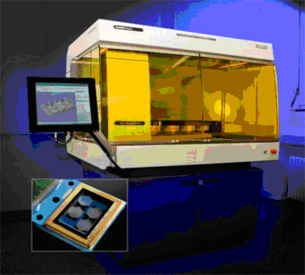 At the heart of Araldite Digitalis is the MLS MicroLightSwitch, a radical new exposure system operating via a computer-controlled micro-mechanical shutter system. |
Laser and radiation curing techniques have been around for some time in rapid manufacturing, and are sought after for providing an accurate and efficient way to cure resin for part manufacture.
A process based on micro-electro mechanical technology (MEMS) takes radiation curing one step further. Araldite Digitalis, a rapid manufacturing (RM) machine from Huntsman Advanced Materials (The Woodlands, TX), uses an MLS MicroLightSwitch, an exposure system that operates via a computer-controlled micro-mechanical shutter system that selectively exposes, in one step, a large area of radiation curable resin. The machine differs from traditional 3D printers in that it is not based on laser or light reflecting MEMS. Lasers expose one point at a time, whereas the MSL MicroLightSwitch exposure is said to be greater and more accurate.
According to Harald Wiedemann, global marketing director for Advanced Materials,MLS MicroLightSwitch is the heart of Araldite Digitalis. “The computer-controlled MLS micro light switches are moving across the bath and expose layer after layer similar to ]those] in a photocopier machine.”
Araldite Digitalis is presented as more of a “complete development philosophy,” rather than simply a machine or product. It consists of three components: operating console, vat enclosure with a recoater, and the exposure system.
How It Works
The UV light from UV lamps is dispersed through fiber optics onto the exposure bar where MLS MicroLightSwitch units apportion UV light pixels onto the resin surface. The exposure of the UV light is directed by the computer-controlled shutter mechanisms to prevent scattering of light. The constant exposure angle of exactly 90° over the full building platform ensures a homogeneous and reproducible accuracy for the entire build, according to Wiedemann.
Microlenses then refocus the UV light after it leaves the MLS. The Araldite Digitalis and building platform’s dimensions allow great flexibility in terms of size. Wiedemann said that the exposure head sweeps at constant speed over the full building platform, resulting in the same building time regardless of how densely the building platform is packed. Thus, the number or size of parts do not reduce build time.
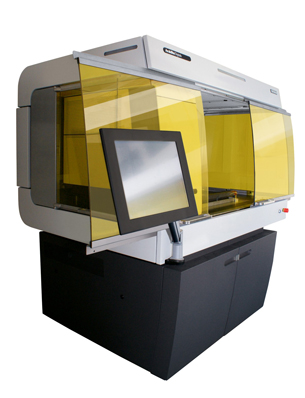 Araldite Digitalis is a new rapid manufacturing machine capable of producing large numbers of parts simultaneously at high speed and with high accuracy. |
The machine offers possibilities for huge numbers of smaller, complex parts as well as large parts.
Challenges
Araldite Digitalis has been well received by beta testers and also won the EuroMold AWARD 2008 Gold Prize in Frankfurt in December. This award honors the three best products and services out of those exhibiting at EuroMold for their internationally focused innovation.
Wiedemann pointed out that one of the challenges of developing the Araldite Digitalis was that the company needed to provide competitive UV-curable resin that simulated thermoplastic properties. Already available is a transparent product, with more products currently in development. Customers working with the Araldite Digitalis make sure the materials operate with the machine under market conditions.
Cost and Energy Savings
In the rapid manufacturing process, there are many variables that contribute to cost, such as part complexity, number of builds, and final properties. The use of standard UV light bulbs in Araldite Digitalis is an advantage to keeping maintenance costs of the equipment down. The size of the building platform limits the number of parts produced, and Huntsman plans to extend the size of the building platform by developing a larger Araldite Digitalis in the future.
Wiedemann said, “An extended length of the building platform, combined with the exposure method and process, will open a variety of opportunities in size – like a full dashboard – for a huge number of fast and accurate additive builds.”
In addition to cost savings, Araldite Digitalis consumes nearly half the energy of laser-based processes or even sintering processes, according to the technical specification.
Further Applications Possible
Huntsman has an extensive background in global chemical materials and marketing. The company reports that the “competitive benefits of the new technology increase exponentially” as the number, size, and complexity of parts produced simultaneously increase.
The company anticipates commercial use of Araldite Digitalis later in 2009. Riding the market trend of moving rapid prototyping towards rapid manufacturing, Huntsman is well positioned with Araldite Digitalis and their resins. The company is also looking beyond traditional applications for this machine, toward the areas of microelectronics, micro size laboratory equipment, and the medical industry.
Huntsman Advanced Materials
The Woodlands, TX
Susan Smith is a contributing editor for Desktop Engineering magazine. Send e-mail about this article to [email protected].


DE's editors contribute news and new product announcements to Digital Engineering. Press releases may be sent to them via [email protected].
Follow DE
Join over 90,000 engineering professionals who get fresh engineering news as soon as it is published.






About Us · Contact Us · Editorial Team · Advertising · Privacy Policy · Subscriber Services · © 2026 Digital Engineering 24/7 · Peerless Media